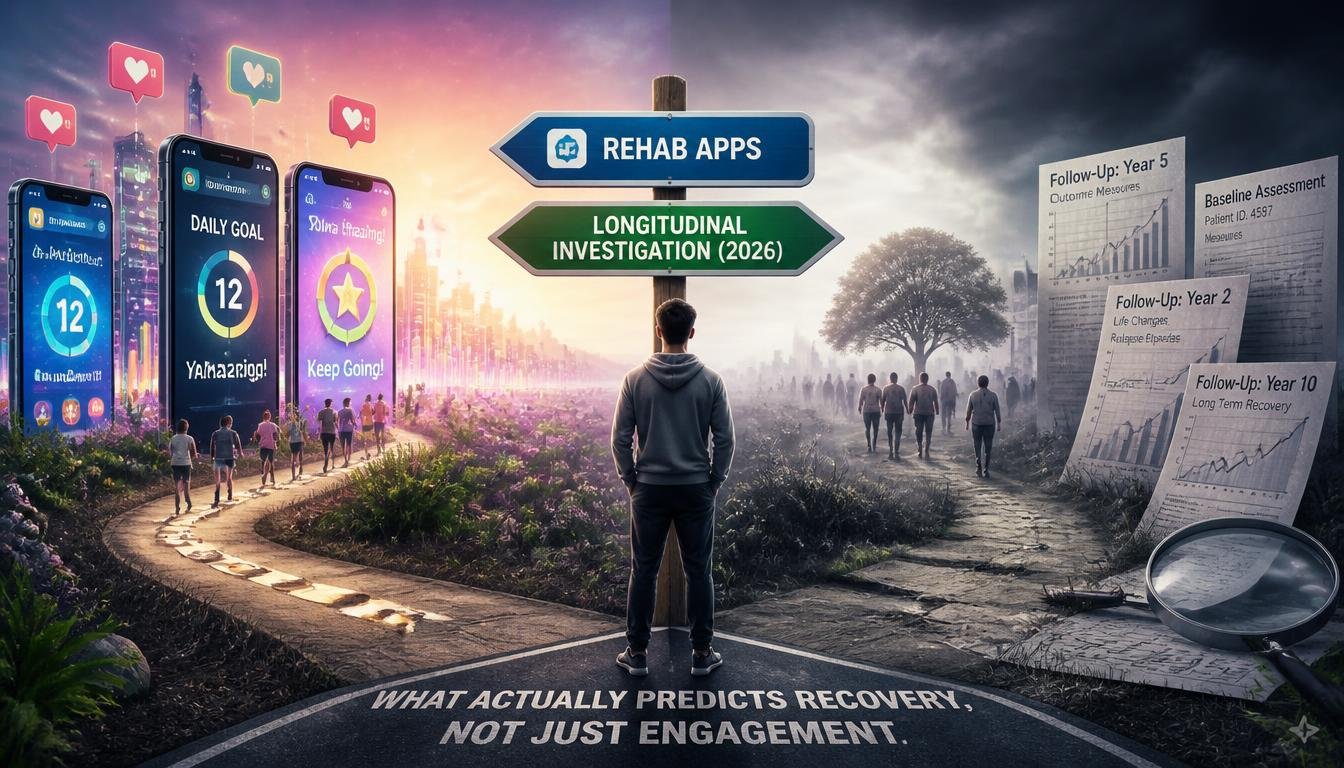
In 2026, you will still see rehab apps judged on “progress” after a short stint, even though a key longitudinal benchmark can stretch to three years in real-world health data. When you compare rehab apps vs longitudinal investigation, the gap is not philosophical, it is measurable, and it determines whether you get training that matches how the brain actually changes.
| Rehab apps vs longitudinal investigation | Apps often optimize engagement and short-term performance; longitudinal work tracks outcomes over time. |
| Dosing principles | Evidence-based brain training depends on intensity, frequency, and the “edge of current ability,” not passive repetition. |
| Clinical targets | We treat BDNF as a repair-protein target, supported by training, movement, and lifestyle. |
| Measurement matters | Longitudinal investigation uses standardized outcomes and follow-through, not “you practiced today” metrics. |
| What you should ask | What is the outcome, who measured it, how often, and for how long? |
| Where we focus | Research-to-practice, closing the “gap” between published evidence and the unregulated public market. See our 2026 neuro-rehabilitation guide. |
Let’s make the comparison concrete. Rehab apps often track what is easiest to measure quickly: minutes spent, levels completed, daily streaks maintained. Longitudinal investigation tracks what you actually care about: functional outcomes measured repeatedly over time.
Evidence over enthusiasm. Static difficulty, predictable puzzles, and passive scrolling through trivia don’t meet that threshold. Even when an app is well-designed, its success metrics can drift toward the user experience, not the biology of recovery.
In our work, we treat neuro-rehabilitation as a measurable process built on rigorous evidence, clear dosing principles, and real follow-through. That means the goal is not “use it,” it is “train the right system at the right intensity, and measure whether the system changes.”
When we say rehab apps vs longitudinal investigation, the key contrast is time-depth. A longitudinal approach can show delayed gains, plateau phases, and the difference between short-term learning and structural plasticity.
Apps can detect improvement within a session window. But recovery is rarely that tidy. You may need weeks to change strategy, months for transfer into real tasks, and a longer horizon to see whether gains are stable or just temporary.
That is why longitudinal investigation is not just “better data.” It is a different kind of truth. It tells you whether training produces durable improvements that matter in daily function, not just performance during practice.
Let’s focus on the cognition side first. A memory app can improve test-like performance while you practice it. That is not the same thing as improving memory in life, under stress, with distractions, while multitasking.
In 2026, we see a lot of “brain training” content that confuses familiarity with function. The rigour comes from whether the training changes measurable cognitive performance over time in ways that generalize beyond the app environment.
If you want a grounded breakdown of what separates generic memory apps from structured cognitive training, we lay it out in Cognitive Training vs Memory Apps: What Works for Seniors.

In motor rehabilitation, you cannot hide behind “feels better” data. You need measurable outcomes, because brain recovery has predictable bottlenecks.
Rehab apps often suggest isolated cognitive tasks, generic hand exercises, or adherence prompts. Post-stroke recovery needs targeted training that matches motor skill restoration principles, plus progression that adapts to ability at the edge of current performance.
This is exactly why we focus on evidence-supported exercise selection. Start with Best Neuroplasticity Exercises for Rapid Post-Stroke Motor Recovery: What the Evidence Actually Supports in 2026, where the discussion stays anchored to what research supports, not what an app leaderboard would like you to believe.
Here is the issue with many rehab apps, even in 2026. The interface is optimized for ease, not the nervous system. Often, difficulty is not dynamically calibrated. Progression becomes predictable, which makes practice less likely to drive change.
Modern neuro-rehabilitation is no longer guesswork. It is a measurable process built on dosing principles, including how often you train, how hard you train, and how you progress when you improve.
That is also where longitudinal investigation earns its place. If the method does not show durable improvements over time, it fails a key test, regardless of how engaging it looks on day one.
We are not anti-app. We are anti-mismatch. Rehab apps can support your plan if they behave like a delivery system for clinically grounded protocols, not like a self-contained “solution.”
When you evaluate an app in the rehab apps vs longitudinal investigation conversation, look for these features:
You need measurable progress, not vibes. If the app cannot tell you what improves, how much, how often, and for how long, it is not the same category as longitudinal investigation.
In neuro-rehabilitation, we keep returning to biological targets. We treat Brain-Derived Neurotrophic Factor (BDNF) as your brain’s “repair protein,” supported by training, movement, and lifestyle.
That is not marketing language, it is a clinical framing. The point is to align training with mechanisms that plausibly support recovery and measurable neuroplastic change. When you compare rehab apps vs longitudinal investigation, the longitudinal side is where you check whether the target strategy holds up across time.
For how we think about this in the real world, we also discuss the kind of recovery timelines and evidence we use in our 2026 neuro-rehabilitation guide.
If you want a clean conclusion to the rehab apps vs longitudinal investigation debate, here it is.
That is how we operate, evidence-based and protocol-driven. Every protocol we deliver is grounded in published research and adapted to the individual in front of us, not a generic profile, not a marketing persona, but a specific person with specific goals, a specific history, and a specific brain.
And you will never hear us promise to “reverse ageing” or “unlock 100% of your brain.” Those phrases belong in marketing copy, not in a clinical setting.
The 2026 reality is simple. Rehab apps vs longitudinal investigation is not an argument about technology, it is an argument about what counts as proof. Apps can capture engagement quickly, longitudinal investigation captures recovery patterns over time, which is where durable neuro-rehabilitation evidence lives.
If you want measurable progress, not vibes, you need dosing principles, real outcome measurement, and protocols aligned to biological targets like BDNF and structural plasticity. Use rehab apps if they support that plan, but let longitudinal investigation be the standard you judge results by.
Rehab apps can be worth it in 2026 as delivery support, but they do not replace the logic of rehab apps vs longitudinal investigation. If you cannot see standardized functional outcomes over time, you are mostly measuring engagement, not recovery.
In the rehab apps vs longitudinal investigation comparison, longitudinal investigation follows measurable outcomes across a longer timeframe, so it can detect whether gains persist or fade. App trials often emphasize short windows and practice performance, which can miss delayed transfer and durability.
Cognitive training apps can improve task performance, but the key question is whether improvement transfers to daily function and stays stable. That is exactly what longitudinal investigation checks in the rehab apps vs longitudinal investigation framing, beyond “you did the exercises” metrics.
Look for dosing principles, adaptive progression, and outcome measures that match your real goals, not just time spent. If the app does not support measurable reassessment over time, it is not meeting the standard implied by rehab apps vs longitudinal investigation.
BDNF is treated clinically as a repair-protein target in evidence-based neuro-rehabilitation frameworks, supported by training, movement, and lifestyle. In rehab apps vs longitudinal investigation terms, the proof comes when protocols tied to targets show durable measurable outcomes across time.
You do not have to avoid them, but you should not treat them as proof. The rehab apps vs longitudinal investigation difference means apps can support work, while longitudinal investigation is what validates durability and functional transfer.