If you think The Real Difference Between Cognitive Training and Simple Memory Apps is mostly about “practice more,” you are already setting yourself up for disappointment. In 2026, it is estimated that 4822 potential apps were identified, of which 24 met eligibility criteria for meaningful cognitive-training evaluation.
| Question people ask | Evidence-first answer |
|---|---|
| Are memory apps basically the same as cognitive training? | No. Real training uses dosing, progression, and targeted brain-system demands, not passive recall or static drills. |
| What is usually missing from simple memory apps? | Personalization and clinical structure, plus clear intensity and measurable outcomes. |
| How do we measure whether training works? | We look for measurable progress over time, not “engagement” metrics or feel-good streaks. |
| Do lifestyle factors matter alongside training in 2026? | Yes. Memory retention hinges on sleep, movement, and encoding support, not training alone. |
| Where do we start for seniors, executives, or recovery? | Start with the brain networks involved, then match protocols and dosing principles to the person in front of you, not a generic profile. See cognitive training vs memory apps for seniors. |
| What about BDNF? | We treat Brain-Derived Neurotrophic Factor (BDNF) as a repair signal that training can support, alongside neuro-rehabilitation lifestyle targets. See memory decline mechanisms you can influence. |
Most marketing around memory apps is built for one goal, to keep you engaged. It is rarely built for one job that matters clinically, to drive neuroplasticity in the specific networks that support encoding, retrieval, attention, and executive function.
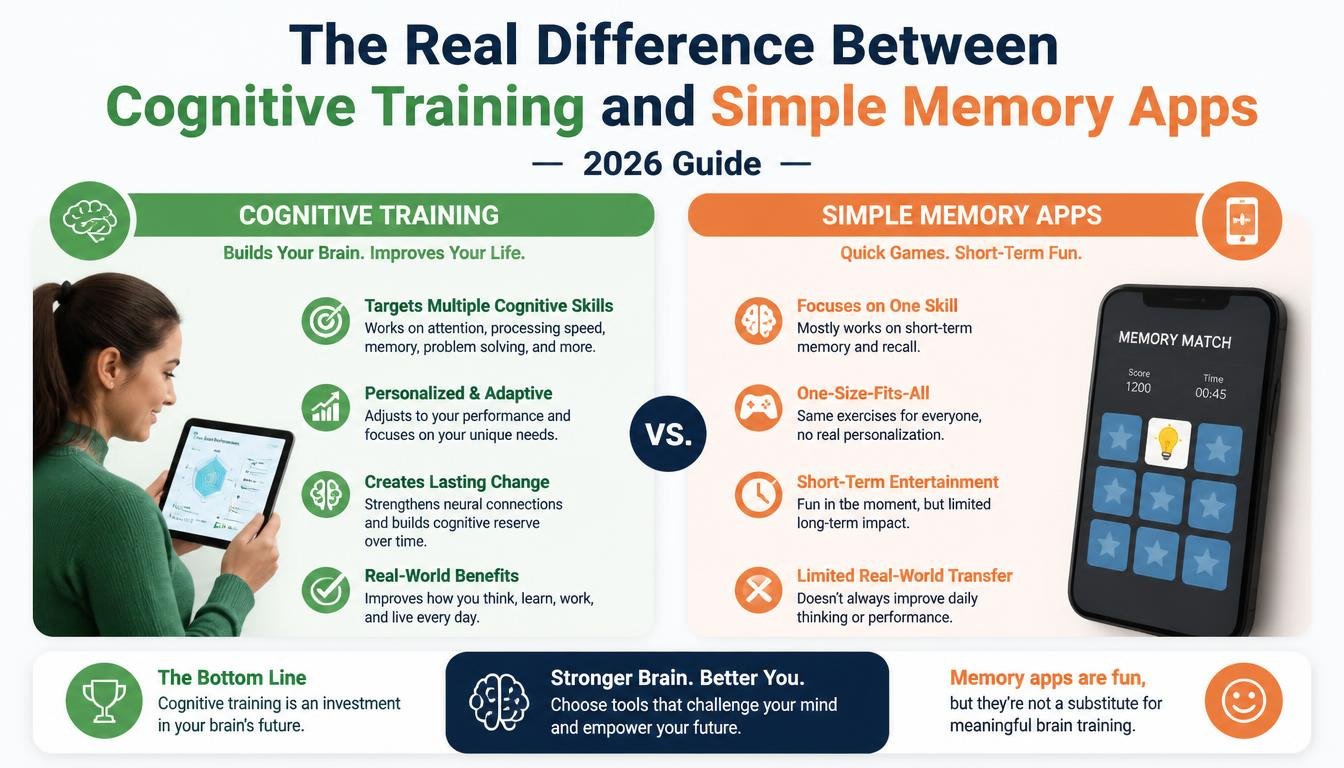
The Real Difference Between Cognitive Training and Simple Memory Apps shows up in the design philosophy. Consumer apps often optimize for repetition and convenience. Cognitive training, when it is evidence-based and clinically grounded, optimizes for neuro-rehabilitation dosing principles, progression, and task demands that genuinely challenge the right circuitry.
If you want a fast reality check, ask this. Does the program adjust difficulty based on performance, and does it deliberately load the processes behind memory, like working memory and attention control? If it does not, you may be buying practice, not training.
We are not interested in “brain games” or passive scrolling through trivia. Those formats rarely meet the threshold for neuroplasticity, because they do not reliably land on the edge of current ability with enough intensity and the right feedback loops.
In our work, cognitive training is structured to engage systems linked to memory and executive function, especially in people who need greater continuity of performance. That means the tasks are not random. They are mapped to cognitive functions like encoding efficiency, working memory capacity, and prefrontal control.
Here is the biological logic in plain English: if the brain has to do the same easy thing repeatedly, it adapts less. If the brain is required to solve a problem that is hard enough, with progression and feedback, it has a reason to change.
That same logic is why our protocols and program design frameworks exist. We treat Brain-Derived Neurotrophic Factor (BDNF) as your brain’s “repair protein”, supported by training, movement, and lifestyle. You will never hear us promise to “unlock 100% of your brain.” Those phrases belong in marketing copy, not in a clinical setting.
That is why we keep coming back to dosing principles and task specificity. Structured speed training and cognitive control demands are not interchangeable with “memory practice” alone.
Let’s be fair. Many simple memory apps help you build a habit of recall. They can also make it easier to practice daily, especially if you are starting from a low routine.
But The Real Difference Between Cognitive Training and Simple Memory Apps is what happens after the novelty wears off. Static difficulty, predictable puzzles, and passive scrolling through trivia do not meet the same neuro-rehabilitation threshold.
Across app evaluations, the weak point is often not functionality, it is engagement design and how well the app actually maintains productive challenge. In 2026 terms, “engaging” is not the same as “effective.”
If you are using a memory app, use it as a warm-up for routine. Do not assume it substitutes for structured cognitive training that targets the underlying brain processes.
Evidence-based cognitive training is built around one core idea, measurable change requires a program that controls key variables. That includes difficulty scaling, progression, and the number of sessions, not just “daily practice.”
In our corporate framework, we treat professionals like cognitive athletes. We build tracks based on cognitive load, goals, modalities, and dosing schedules. The outcome focus is consistent across contexts, from executive function support to preventative cognitive longevity.
If you are comparing programs, look for these signals:
If that sounds strict, it should be. Modern neuro-rehabilitation is no longer guesswork; it is a measurable process built on rigorous evidence, clear dosing principles, and real follow-through.
To understand how we frame the difference across ages and settings, you can read how we build corporate cognitive training programs, including our blueprint generator approach.
Some people approach cognitive training like it is only mental effort. That is incomplete. In 2026, the most clinically grounded approaches treat neuroplasticity as a state you can support, not just a skill you can grind.
We treat BDNF as your brain’s “repair protein,” and we support it with training, movement, and lifestyle targets. When you pair training with BDNF activation, you are changing the conditions under which learning happens, not just adding another app screen.
This is also where “manifestation manifestation techniques BDNF BrainWave boost brain power naturally” shows up as a misunderstanding you should avoid. Any phrase that reads like it is trying to “manifest” outcomes without measurable training design is not a biological plan. Real BDNF support is tied to protocols and measurable training follow-through, not vague intent.
If you want an example of how we structure a priming step, our evidence-based memory preservation ranking for 2026 positions the Genius Switch as a BDNF activation foundation before structured cognitive work.
And yes, you can still keep it practical. The Genius Switch 40Hz Gamma Audio is listed at $39 in our program materials, and it is used as a primer to support subsequent training effects.

The needs change, but the difference between cognitive training and simple memory apps does not. Seniors often need memory encoding support and retrieval strategy under everyday stress. Executives need sustained attention, working memory under load, and impulse control.
In high-stakes roles, the executive brain depends on prefrontal circuits and BDNF pathways. When training is structured, it can provide measurable gains over consumer brain games, because the tasks are built to demand the right cognitive control, not just to be “fun.”
If you want a focused view of how we connect leadership demands to cognitive continuity, read the executive brain and cognitive continuity for leaders.
And for the senior-side of things, structured programs are built to support hippocampal engagement and prefrontal attention control. The approach matters, because you are not trying to win at a puzzle game. You are trying to protect cognitive longevity.
Here is the part many consumers miss. Even when apps claim “cognitive training,” the evaluation outcomes can be inconsistent, and the features that drive real change may be absent.
In an app screening process relevant to cognitive training evaluation, researchers identified thousands of candidate apps but found only a small subset met eligibility criteria. That matters because it tells you how hard it is to build something that truly matches clinical evaluation standards.
This is why The Real Difference Between Cognitive Training and Simple Memory Apps is not simply “pick a popular one.” App quality can vary significantly, even within sets that pass basic screening.
In 2026, we treat this as a dosing and design problem, not a motivation problem. If your program does not include adaptive challenge, clinical involvement, or tailored modules, you may experience less measurable progress, even if you enjoy using it.
For a structured comparison that we tailor to seniors and real-world use, revisit cognitive training vs memory apps, specifically for seniors.
If you want the most useful way to decide, stop thinking in terms of app vs non-app. Think in terms of what the program is designed to change, and how it controls challenge.
Best for simple memory apps: You have a low starting routine and need a low-friction way to practice recall while you build a bigger plan.
Best for cognitive training: You want measurable progress, you are willing to follow a dosing schedule, and you want training that targets cognitive control and the memory networks behind real learning.
Best for combined protocols: You want cognitive training plus BDNF support, sleep and movement targets, and a structured track that accounts for cognitive load.
Here is a practical checklist you can apply to any option you are considering:

Finally, remember that memory is not only a “memory” problem. It is also a sleep, vascular, inflammation, and hippocampal encoding problem. That is why our approach connects cognitive training with the mechanisms you can actually influence, not just app drills. If you want the deeper background, see memory decline mechanisms and what to do about them.
The Real Difference Between Cognitive Training and Simple Memory Apps is not whether the app is “about memory.” It is whether the program is built to drive neuroplasticity with structured dosing, progression, and targeted cognitive demands, supported by measurable outcomes.
In 2026, you can no longer rely on “engagement” as a proxy for effectiveness. You need cognitive training that challenges the right networks, maintains intensity at the edge of your ability, and supports BDNF-related repair conditions through evidence-based protocols, not vibes. Evidence over enthusiasm.
Not necessarily. The Real Difference Between Cognitive Training and Simple Memory Apps comes down to dosing, adaptation, and whether the tasks target cognitive control and memory networks. In 2026, app quality can vary widely, so you should look for progression logic and measurable outcomes, not just entertaining drills.
The evidence that shows dementia-risk impact is tied to structured cognitive speed training with specific session dosing, not memory-only practice. When participants only had memory or reasoning training, there was no statistical difference in that outcome. This is a major reason we separate The Real Difference Between Cognitive Training and Simple Memory Apps in how we recommend next steps.
Look for adaptive difficulty, planned progression, session structure, and outcome measurement. If the program lacks those elements, it is usually closer to simple memory apps, which can be fine for routine but may not drive measurable neuroplasticity.
In our evidence-based approach, BDNF support is designed to prime the brain for subsequent structured training. The key point is that priming is not a replacement for cognitive training, it is a support step paired with dosing and progression for measurable change.
We recommend treating that framing skeptically. Manifestation manifestation techniques BDNF BrainWave boost brain power naturally is not a substitute for measurable training design, lifestyle supports, and targeted cognitive dosing principles. If you want brain change, focus on protocols that can be tracked.
Choose a corporate cognitive program when you need personalization, structured dosing, and clear targets for executive function and cognitive longevity. For simple routine practice, a consumer memory app may help, but it usually does not replicate the measurable, adaptive structure behind true cognitive training.