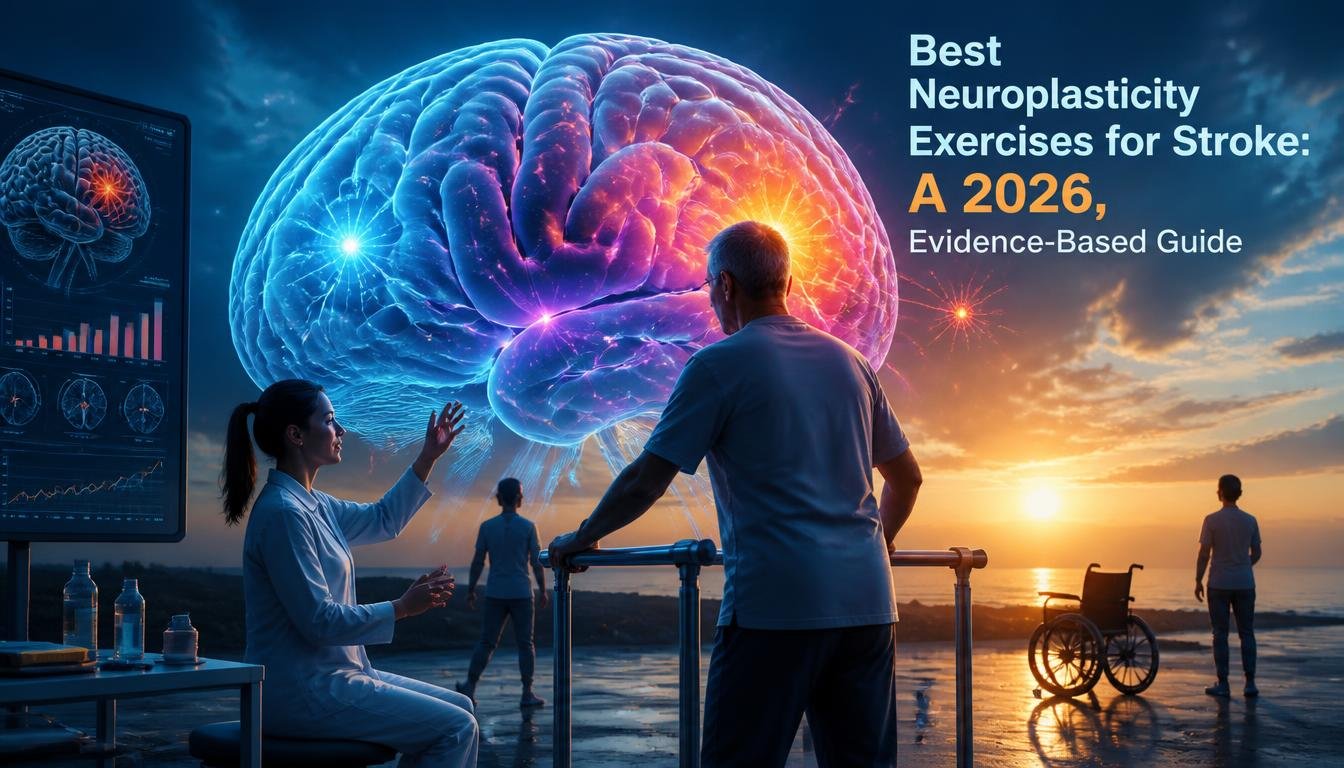
In 2026, one of the most frustrating realities for neuro-rehabilitation is that only about 31% of adult stroke survivors report using outpatient rehabilitation after hospitalization, which means the majority never get consistent, structured neuroplasticity exercises for stroke.
|
1) Evidence-first dosing You need the “edge of current ability” and measurable reps, not vague mental effort. |
2) Task-specific training wins Neuroplasticity exercises for stroke should match the real movement or language goal. |
|
3) Repetition is necessary High-repetition practice drives structural plasticity and functional gains over time. |
4) Intensity must be measurable Use clear metrics so progress is visible (speed, range, accuracy, transfers). |
|
5) Combine motor and cognition Reaching, grasping, speech, and attention all contribute to recovery and neurogenesis pathways. |
6) Use a clinical roadmap Our approach follows research-to-practice and the 2026 guide logic, not generic profiles. Read our Neurological Recovery 2026 Guide. |
Neuroplasticity exercises for stroke are not about “hoping your brain adapts.” They are about deliberately creating the conditions that support learning-related change, through repeated practice of meaningful tasks.
In 2026 neuro-rehabilitation standards, the bar is simple: you need measurable progress, not vibes. That means you design exercises around the same biological principles clinicians try to translate into real-world dosing principles, including task specificity, intensity, and consistency.
Every protocol we deliver is grounded in published research and adapted to the individual in front of us, not a generic profile, not a marketing persona, but a specific person with specific goals, a specific history, and a specific brain.
Evidence over enthusiasm. Static difficulty, predictable puzzles, and passive scrolling through trivia don’t meet that threshold.
When people ask for the best neuroplasticity exercises for stroke, they usually want a list. But the real question is what the list should contain. The best exercise set is organized around recovery targets: motor control, sensory-motor integration, and communication or cognition.
Below are the categories we prioritize, and the practical “what to do” each category supports.
This is where neuroplasticity exercises for stroke earn their keep. You train the movement you care about, repeatedly, with constraints and feedback that keep effort high.
Your brain adapts at the edge of current ability. That means the task should be challenging enough to drive learning-related change, but not so chaotic that you stop producing consistent outputs.
Feedback is not “correction for correction’s sake.” It shapes what the nervous system pays attention to during practice.
Language recovery uses many of the same learning systems as motor recovery. If your goal is speech intelligibility or swallowing safety, you train that specific output.
Not every exercise is right for every stroke survivor. A “best” list only becomes useful when it matches your current impairments, your tolerance, and your timeline.
In our neuro-rehabilitation model, we treat recovery like a measurable process. That means we start with functional goals and build protocols around real outputs, then adjust difficulty so you stay near the edge of current ability.
If you want a starting point for stroke rehab protocols, our stroke rehab motor skill restoration page lays out how we think about motor skill rebuilding, step by step.
For the larger framework, browse our Neurological Recovery category and pick the protocol ideas that align with your current needs.
Modern neuro-rehabilitation is no longer guesswork. It is a measurable process built on rigorous evidence, clear dosing principles, and real follow-through.
But follow-through depends on access, and in 2026 the gap remains visible in the data. This matters for neuroplasticity exercises for stroke because consistent practice is one of the strongest practical predictors of change you can control.
You still need structured neuroplasticity exercises for stroke. If clinic time is constrained, we recommend you protect the parts that drive learning: task specificity, repetition, and measurable progression.
Also, be skeptical of “one size fits all.” Those tools often ignore the gap between published research and the unregulated public market.
We treat Brain-Derived Neurotrophic Factor (BDNF) as your brain’s “repair protein,” supported by training, movement, and lifestyle. That is not a slogan. It is a clinically grounded target we build around.
Neuroplasticity, structural plasticity, and neurogenesis are not promises. They are the biological pathways you try to support with the right kind of practice, the right intensity, and the right consistency.
If you want to explore neuro-rehabilitation as a whole, start with our Neuro Rehabilitation category hub, then filter for stroke-relevant content.
Below are example exercise “blocks” you can adapt. We are not prescribing for you directly, we are showing protocol logic you can bring to your clinician or therapist. In 2026, the goal is dosing principles, measurable outcomes, and task-specific repetition.
Metric idea: success rate per set, or reach distance within a defined boundary.
Metric idea: time to complete transfer, number of successful stands, or reduction in required assistance.
Metric idea: number of accurate target hits per minute, or variability reduction.
Metric idea: intelligibility rating, or percent of phrases meeting the target pacing standard.
We do not lump serious recovery work in with passive scrolling. Static difficulty, predictable puzzles, and entertainment-style tasks do not meet the measurable dosing threshold for neuroplasticity exercises for stroke.
If you are comparing formats, our resource on cognitive training vs memory apps helps you separate practice built for learning from practice built for distraction.
Exercises are the core. Add-ons help you stay in the training window. In 2026, the best recovery programs connect movement and lifestyle to your ability to practice consistently, because the protocol only works if you can keep doing it.
Supervision matters for safety, for feedback quality, and for preventing practice from turning into random effort. If you want a 2026 look at supervised neuro training environments, this overview is relevant: Blue Zone-Inspired Retreats: The Best Locations for Supervised Neuro Training in 2026.
We keep the lifestyle layer practical. The point is reducing friction so you can practice. If you want longevity-focused training logic alongside neuro-rehabilitation, explore Best Preventative Longevity Strategies and keep it tied to real dosing principles.
When progress slows, it usually is not because neuroplasticity stopped. It is because the protocol stopped matching the learning conditions.
If you are trying to build a more complete neuro-rehabilitation plan, use the broader hub at Neurological Recovery and then select the exercise categories that match your current deficits.
Modern protocols are not just “what exercises.” They are how you dose, how you progress, and how you keep feedback meaningful. That is the “gap” we focus on between published research and the unregulated public market.

Only about a third of adult stroke survivors reported using outpatient rehabilitation services.
Neuroplasticity exercises for stroke can be powerful when they are built around evidence-based dosing principles, task-specific repetition, measurable progression, and real feedback that drives learning. If you want change in 2026, you cannot rely on passive “brain games” or vague effort, you need protocols that make progress visible.
You will never hear us promise to “reverse ageing” or “unlock 100% of your brain.” Those phrases belong in marketing copy, not in a clinical setting. Our focus is measurable neuro-rehabilitation, centered on BDNF as a repair protein target, so the work you do has a biologically plausible pathway forward.
The best neuroplasticity exercises for stroke in 2026 are task-specific and dose-controlled, meaning you practice the actual movements or language outputs you want to improve with measurable repetition. The goal is progressive difficulty at the edge of current ability, supported by feedback so practice becomes learning, not just activity.
There is no universal number, but the pattern that works is consistent practice that supports dosing principles, typically multiple sessions per week with clearly defined sets and reps. The key is that your neuroplasticity exercises for stroke should include measurable metrics and progression so you can adjust intensity based on performance.
Home can be enough when the exercises are structured, task-specific, and measurable, and when safety guidance is clear. If you cannot access outpatient rehab reliably, we still recommend neuroplasticity exercises for stroke that follow the same principles clinicians use, including feedback cues and progression.
Most generic brain apps do not meet neuroplasticity exercises for stroke standards because they often rely on passive engagement, static difficulty, or trivia-like engagement instead of meaningful output training. If you use an app, it must map to your real functional goals and include measurable progression and active practice.
BDNF is treated as a central repair protein target, and structural plasticity reflects the kind of brain change you support through repeated, learning-driven practice. Neuroplasticity exercises for stroke aim to create the training conditions that support these mechanisms, using dosing principles, intensity, and task-specific repetition.
Track one or two metrics tied to your goals, such as reach success rate, transfer time, gait target accuracy, or intelligibility ratings. When neuroplasticity exercises for stroke are working, you see consistent improvements in those measures and your ability to increase reps, accuracy, or speed safely over time.