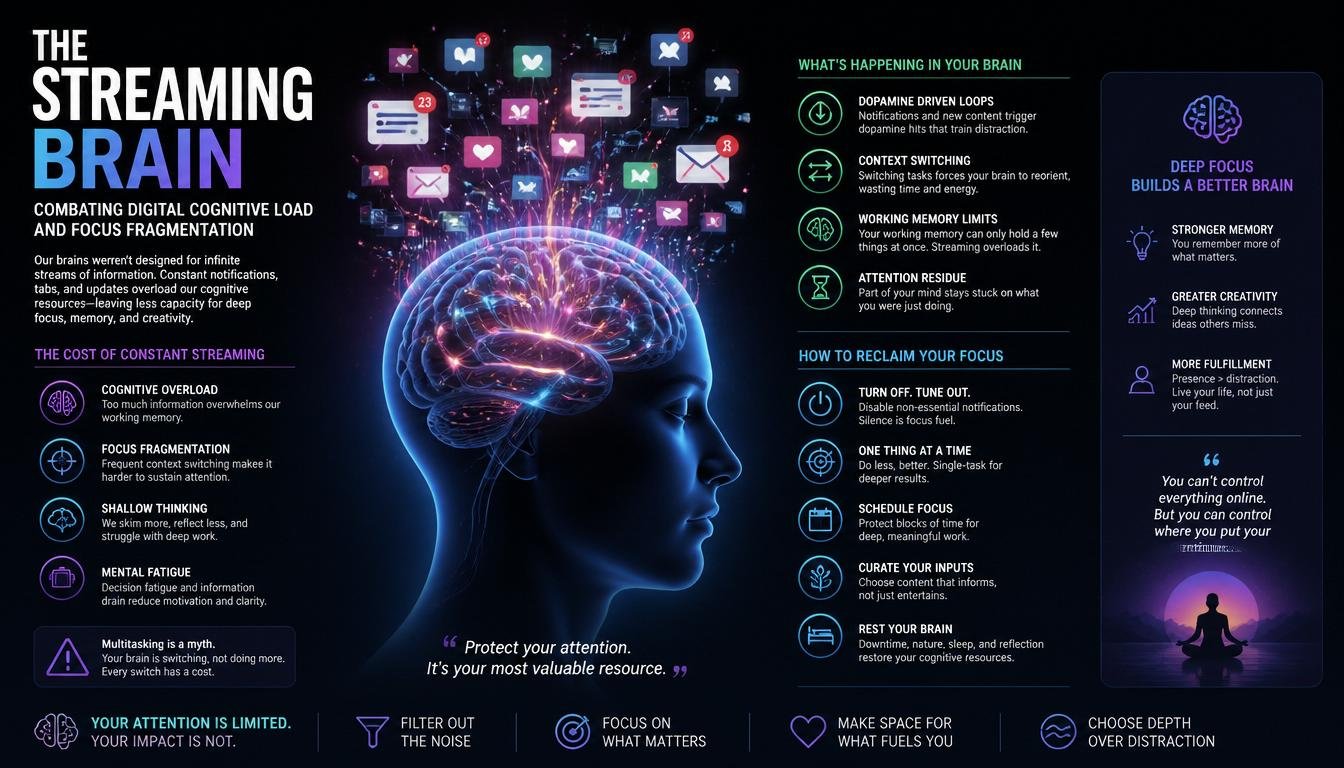
The average human attention span on a screen has collapsed to roughly 47 seconds, down from two and a half minutes back in 2004. That number is the whole problem in miniature, and it’s why we treat the streaming brain, the state of constant digital cognitive load and focus fragmentation, as a clinical issue rather than a lifestyle quirk.
This isn’t about willpower. It’s about biology under siege, and in 2026 the evidence for that is no longer theoretical.
| Question | Short Answer |
|---|---|
| What causes focus fragmentation? | Repeated task-switching and notification interruptions overload the prefrontal cortex, forcing constant, energy-expensive reorientation. |
| How long does it take to refocus after an interruption? | Around 23 minutes and 15 seconds on average, according to Speakwise research. |
| Is digital cognitive load a real medical concept? | Yes. It’s measurable through attention testing, cognitive assessment tools, and BDNF-linked recovery markers, not just a feeling of being “busy.” |
| Do brain training apps fix focus fragmentation? | Static apps rarely do. See our breakdown of cognitive training vs memory apps. |
| What’s the clinical target for reversing digital burnout? | BDNF, the brain’s repair protein, supported by structured training and lifestyle protocols. |
| Who needs this most? | Knowledge workers, streamers, content creators, and anyone whose job requires sustained executive function under constant digital noise. |
| Can this be reversed? | Evidence points to yes, but only with measurable, dosed intervention, not passive scrolling breaks. |
We use the phrase “streaming brain” to describe a specific neurological state, not a metaphor. It’s what happens when a brain spends most of its waking hours processing an uninterrupted feed of notifications, tabs, messages, and short-form content.
Digital cognitive load is the mental effort required to process all of that incoming information. Focus fragmentation is what happens when the load exceeds what the prefrontal cortex can manage without breaking down into scattered, shallow attention.
Knowledge workers now face around 275 interruptions during a single workday, roughly one every two minutes during core hours. Add 153 average daily messages from workplace chat tools, and the picture is clear: this isn’t distraction, it’s structural overload.
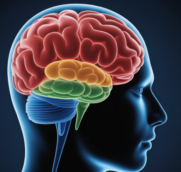
Every time you glance at a notification, your prefrontal cortex, the region responsible for planning, working memory, and impulse control, has to drop what it was doing and reorient.
That reorientation isn’t instant. It’s a full cognitive process with a measurable price tag.
Task-switching alone can drain nearly 40% of a person’s productive time through constant mental reorientation. That’s not a productivity tip we’re sharing to make you feel bad. It’s a biological tax, and it’s the reason “just focus harder” has never worked as advice.

Glancing at a notification doesn’t just pause your work. It forces your brain into a lengthy recovery period.
Search around for “manifestation manifestation techniques BDNF BrainWave boost brain power naturally” and you’ll find a lot of noise: affirmation apps, vague energy talk, and supplement pages promising to “unlock” cognitive potential overnight.
We’re going to be blunt: manifestation techniques don’t change your neurochemistry. What does change it is Brain-Derived Neurotrophic Factor, BDNF, the protein your brain uses to repair, grow, and reinforce neural connections after real cognitive effort.
If you’re genuinely trying to boost brain power naturally, the mechanism is training intensity plus recovery, not intention-setting. We treat BDNF as your brain’s repair protein, and you can read the underlying science on our page about how to activate your brain’s BDNF.
For readers curious about legitimate, technology-based support alongside training, our overview of botanical nootropic technology covers what’s actually been studied, not what’s trending on social feeds. Evidence over enthusiasm, always.
Digital burnout recovery has become a buzzword, and most of the advice attached to it is thin. Turning your phone to grayscale for a weekend isn’t a clinical intervention.
A proper reset requires structured withdrawal from high-stimulation input paired with deliberate reintroduction of sustained-attention tasks. We laid out the full protocol in our Digital Neuro-Detox 2026 guide, built specifically for people whose “brain rot” symptoms, that scattered, can’t-finish-a-paragraph feeling, have become a daily baseline rather than an occasional bad day.
Roughly 70% of people report feeling tired, drained, or outright exhausted after long stretches of digital activity, and 51% hit mental fatigue after just four hours of screen time. That’s not laziness. That’s a nervous system running past its dosing threshold.
We get a lot of questions from full-time streamers, YouTubers, and content creators, a group we sometimes half-jokingly call “streamer university” graduates because their entire professional education happened live, on camera, under constant multitasking demand.
Their job is a perfect case study in focus fragmentation: monitoring chat, tracking donations, managing overlays, reading the room, and performing, all at once, for hours.
Executive function for creators isn’t a nice-to-have. It’s the entire job.
These are trainable, measurable functions, not personality traits. Streamers who invest in structured cognitive training tend to report longer sustainable careers and less end-of-stream mental collapse, which lines up with what we see across other high-stimulation professions in our cognitive performance work.
Static difficulty, predictable puzzles, and passive scrolling through trivia don’t meet the threshold your brain needs to change. That’s the core problem with most consumer memory apps marketed as “brain training.”
They feel productive. They aren’t dosed correctly.
We break down exactly why in our comparison of cognitive training vs memory apps. The short version: change happens at the edge of current ability, adjusted continuously, not in a fixed puzzle loop designed to keep you subscribed.
The specialized web-based cognitive systems that show strong clinical results are built around a fundamentally different design philosophy: make it scientifically rigorous first, then make it accessible.
Employers are starting to notice what digital cognitive load is doing to their teams. Around 77% of people now spend more than five hours online daily, and much of that is unavoidable, job-required screen time.
Our corporate cognitive training programs exist because leadership teams asked for something more rigorous than a mindfulness app subscription. We use standardized tools, including a MoCA to MMSE score conversion chart, to establish a real baseline before we ever start training an employee’s focus.

Generation Z employees are entering the workforce with a particularly fragile baseline, losing focus on social media content after just 1.3 seconds. That’s the population corporate training programs are increasingly built around, and it’s why static onboarding decks and generic “focus tips” webinars aren’t cutting it anymore.
You need measurable progress, not vibes. That applies just as much to combating digital cognitive load as it does to neuro-rehabilitation after injury.
A real protocol looks like this:
Modern neuro-rehabilitation is no longer guesswork; it is a measurable process built on rigorous evidence, clear dosing principles, and real follow-through. The same standard applies whether we’re helping someone recover from a neurological event through our broader neuro-rehabilitation services, or helping a chronically online professional rebuild sustained attention from a fragmented baseline.
People searching for manifestation techniques, BDNF hacks, or ways to boost brain power naturally are usually asking the right question with the wrong toolkit. The instinct to want a natural, sustainable fix is correct.
The execution matters more than the intention. Structural plasticity and neurogenesis, the actual mechanisms behind a sharper, less fragmented brain, respond to consistent, correctly dosed challenge, not affirmations repeated in a mirror.
Our page on natural brain boosting solutions covers the legitimate side of that search: sleep, movement, targeted nutrients, and structured cognitive load management, the actual levers that move BDNF and support long-term Cognitive Longevity.
The streaming brain is a real, measurable state, and combating digital cognitive load and focus fragmentation takes more than a weekend detox or a positivity mantra. It takes an evidence-based protocol built around how your prefrontal cortex, your BDNF levels, and your attention system actually function.
Whether you’re a streamer running on constant multitasking, a corporate team drowning in notifications, or someone simply tired of losing focus every 47 seconds, the fix is the same: rigorous, dosed, measurable training. Not vibes.
The streaming brain refers to a neurological state caused by nonstop digital input, notifications, tabs, and short-form content, that fragments attention and overloads the prefrontal cortex. In 2026, with average attention spans down to about 47 seconds, it’s become a clinical concern for workers, students, and creators alike.
Chronic overload doesn’t cause structural damage the way an injury would, but sustained focus fragmentation can suppress BDNF activity and impair the neural pathways involved in sustained attention. Left unaddressed, this shows up as digital burnout, mental fatigue, and reduced executive function over time.
Research from Speakwise puts the average full refocus time at 23 minutes and 15 seconds after a single interruption. Multiply that by 205 daily phone checks and it’s easy to see why focus fragmentation compounds throughout a normal day.
Most consumer memory apps use static, predictable puzzles that don’t push training intensity high enough to trigger real change. Combating digital cognitive load requires dosed, adaptive cognitive training, not passive app-based repetition.
BDNF response to exercise, structured cognitive challenge, and sleep quality is well documented in published research, so yes, it’s genuinely possible to support it naturally. What’s marketing fluff is the idea that manifestation techniques or affirmations alone can move BDNF levels; that requires actual physiological effort.
Yes. The multitasking demands of live streaming, tracking chat, managing overlays, and performing simultaneously, place unusually high load on working memory and cognitive flexibility, making executive function training especially relevant for creators.
Start with a real baseline cognitive assessment rather than guessing at the problem, then move into structured detox windows and dosed training. A generic screen-time limit alone rarely resolves established focus fragmentation.