Stopping a moving car generates enough heat at each wheel to boil a liter of water in roughly 7 seconds. That is the kind of raw energy a mechanical brake system has to absorb and dissipate on command, and it is also the closest physical analogy we have for what transcranial direct current stimulation is trying to do inside a hyperactive nervous system. The ‘Brake Pedal’ Effect: tDCS for Emotional Reactivity is the working name we use for a specific neuromodulation target, the prefrontal-limbic circuit that either lets an emotional reaction run away with you or catches it before it does.
This is not a metaphor we invented for marketing. It is a functional description of what the dorsolateral prefrontal cortex is supposed to do when the amygdala fires. When that braking circuit is weak, slow, or under-resourced, reactivity wins. When it is properly supported, you get a pause, a beat, a moment where the reaction can be steered instead of just endured.
| Question | Short Answer |
|---|---|
| What is the “brake pedal” in tDCS for emotional reactivity? | The prefrontal-amygdala inhibitory circuit, targeted by anodal stimulation over the dorsolateral prefrontal cortex. |
| Does tDCS actually reduce emotional reactivity? | Published research shows measurable changes in reaction time and self-reported affect regulation, though effect sizes vary by protocol and dosing. |
| Is this the same as a “brain game” or wellness app? | No. Cognitive training vs. memory apps covers why passive puzzle-solving does not meet a clinical threshold. |
| What is BDNF’s role here? | BDNF acts as the “repair protein” supporting the structural plasticity that makes any brake-strengthening protocol stick. |
| Can I boost brain power naturally without a clinic visit? | Partially. Non-invasive tools like 40Hz gamma audio and structured lifestyle habits support the same BDNF pathway, though they are not a substitute for supervised stimulation. |
| Who is a good candidate? | Leaders under chronic stress, people recovering from a neurological event, and anyone whose reactivity is measurably out of proportion to the trigger. |
| Where can I get an evidence-based baseline first? | See our Cognitive Reserve Scorecard for a structured starting point. |
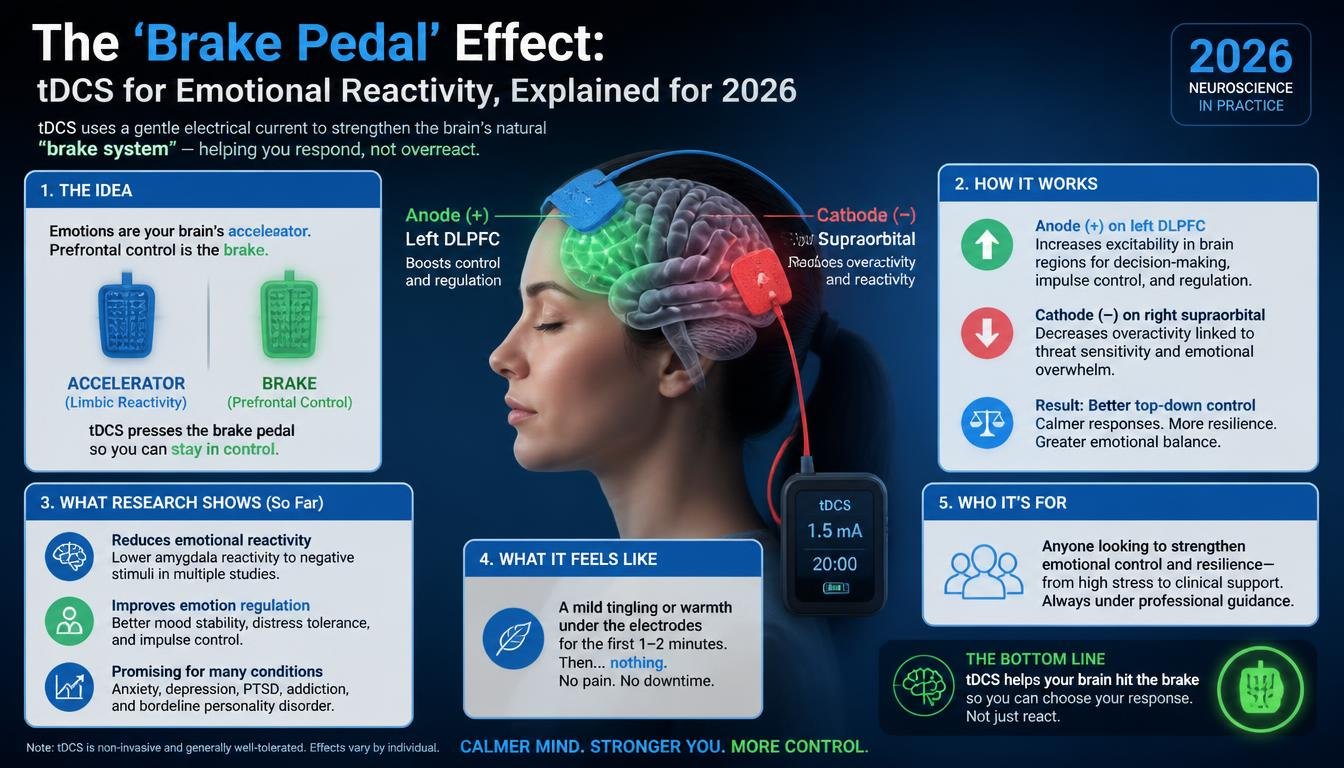
The ‘Brake Pedal’ Effect: tDCS for Emotional Reactivity describes a specific pattern researchers see when anodal current is applied over the left dorsolateral prefrontal cortex during emotionally provoking tasks.
Reaction to a negative stimulus is delayed. Self-reported intensity of the reaction drops. The brain, in effect, gets a slightly firmer pedal.
This is not sedation. Nobody goes numb. What changes is the gap between stimulus and response, the same gap a mechanical brake needs to convert forward motion into controlled heat instead of a collision.
We treat this gap as a measurable target, not a vibe. Evidence over enthusiasm.
The circuit in question runs between the dorsolateral prefrontal cortex and the amygdala. Under chronic stress, that connection weakens, and the amygdala starts firing faster than the prefrontal cortex can regulate it.
tDCS applies a weak, constant electrical current through electrodes placed on the scalp, typically 1 to 2 milliamps, over a session lasting 20 to 30 minutes. The current does not force neurons to fire. It shifts their resting membrane potential, making the target region more or less excitable depending on polarity.
Anodal stimulation over the prefrontal cortex increases excitability in the region responsible for top-down control. That is the brake pedal getting more responsive.
Cathodal stimulation, applied elsewhere, can reduce excitability in overactive regions. Together, the combination is closer to adjusting both the brake and the throttle rather than just slamming one down.

Comparing standard versus extreme operating temperatures for brake components.
None of this works on a single session. The circuit strengthens the same way any other neural pathway strengthens, through repeated, dosed activation paired with the right biochemistry.
We treat Brain-Derived Neurotrophic Factor as your brain’s “repair protein,” supported by training, movement, and lifestyle. BDNF plays a critical role in neurogenesis, synaptic plasticity, and neuroprotection, and it is the molecule that turns a single stimulation session into a durable change in the prefrontal-amygdala pathway.
Landmark research has shown that 40Hz sensory stimulation, delivered through light or audio, can meaningfully influence amyloid-beta clearance and support BDNF production in animal models. That research is part of why gamma-frequency audio has become a serious non-invasive adjunct alongside tDCS protocols, not a replacement for them.

Search around this topic long enough and you will run into manifestation techniques promising to rewire your brain through intention alone. We do not use that language, and here is why.
Manifestation techniques are not a clinical intervention. There is no published, peer-reviewed protocol that shows visualization alone changes prefrontal-amygdala connectivity in a measurable way.
What does help, and what is genuinely part of any legitimate plan to boost brain power naturally, is far less glamorous: consistent sleep, aerobic movement that elevates BDNF, structured cognitive load at the edge of current ability, and non-invasive tools like gamma audio that have actual dosing data behind them.
If someone frames manifestation techniques as a substitute for tDCS, neuro-coaching, or a supervised recovery plan, that is marketing, not medicine. We close the gap between the published literature and the unregulated public market. We do not add to the noise.
Static difficulty, predictable puzzles, and passive scrolling through trivia don’t meet that threshold. Neither does a consumer memory app that never adapts to your actual performance.
Emotional reactivity training, like cognitive training generally, only produces change when the task sits at the edge of current ability. That is where structural plasticity happens.
Our comparison of cognitive training versus memory apps goes deeper into why most consumer brain-training products stall out well before they reach a clinical threshold. The short version: intensity and adaptivity are not optional.
The same logic applies to emotional reactivity. A mild trigger is manageable at low speed. A high-stress trigger arrives with disproportionately more force, and a weak braking circuit simply cannot absorb it in time.
We don’t position 40Hz gamma audio as a replacement for supervised tDCS. We position it as an accessible, evidence-informed way to support the same BDNF pathway between clinical sessions.
Genius Switch uses precision 40Hz gamma audio stimulation to trigger the brain’s natural BDNF production, the molecule researchers have called the “Miracle-Gro” for neurons, without pills or prescriptions. No apps, no subscriptions, no complicated setups. Press play, put headphones on, and let the auditory frequencies do the work.
At $39, it is priced as a supportive tool, not a clinical replacement. We are direct about that distinction because we would rather you know exactly what you are buying than assume it does more than it does.
Not everyone needs this protocol. Reactivity that matches the size of the trigger is normal. Reactivity that consistently overshoots it is a different problem, and it is the one we target.
Modern neuro-rehabilitation is no longer guesswork; it is a measurable process built on rigorous evidence, clear dosing principles, and real follow-through.
A serious tDCS protocol for emotional reactivity starts with a baseline. We measure current reactivity, not assume it, using validated cognitive and emotional metrics before a single electrode goes on the scalp.
Evidence over enthusiasm. You need measurable progress, not vibes.
From there, session frequency and current intensity are dosed against the individual, not a generic template pulled from a study population that may not resemble the person in front of us.
Follow-up assessment matters just as much as the initial baseline. Our 2026 cognitive assessment comparison chart shows how we track progress across standardized screening tools rather than relying on how someone feels on a given day.
Emotional reactivity does not appear overnight, and it rarely resolves overnight either. It builds up over years of chronic stress, poor sleep, and unaddressed cognitive load.
The best time to strengthen the prefrontal-amygdala brake is before it starts failing under normal pressure, not after a crisis forces the issue. Our preventative longevity strategies combine BDNF stimulation, digital detox, and structured cognitive training into a single, evidence-based plan.
Whether you are a high-performing professional looking to sharpen your edge, a senior aiming to preserve memory, or someone recovering from a neurological event, our local expertise provides a proactive roadmap to cognitive longevity.
The ‘Brake Pedal’ Effect: tDCS for Emotional Reactivity is not a shortcut, and it is not a wellness trend dressed up in neuroscience language. It is a clinically grounded target, the prefrontal-amygdala circuit, approached with real dosing principles, baseline measurement, and BDNF-supported follow-through.
You will never hear us promise instant emotional control or a “rewired brain” overnight. Those phrases belong in marketing copy, not in a clinical setting.
What we can promise is a research-to-practice approach: a measurable starting point, a protocol dosed to the individual, and honest tracking of whether the brake pedal is actually getting stronger.
It refers to the strengthening of the prefrontal-amygdala circuit through anodal tDCS, which creates a measurable pause between an emotional trigger and the reaction that follows. This is the neurological equivalent of a more responsive brake pedal, not a numbing of emotion.
Yes, though the field continues to refine dosing standards. Current evidence shows measurable changes in reaction time and self-reported emotional intensity following supervised protocols, which is why we treat baseline assessment as non-negotiable.
Partially. Sleep, aerobic exercise, and 40Hz gamma audio tools like Genius Switch support the same BDNF pathway that underlies emotional regulation, but they are supportive measures, not a full substitute for supervised neuromodulation.
No published clinical evidence supports manifestation techniques as a mechanism for changing prefrontal-amygdala connectivity. We recommend evidence-based tools with actual dosing data instead.
Consumer memory apps and passive brain games rely on static difficulty and repetition, which does not meet the threshold for structural plasticity. The Brake Pedal Effect approach uses adaptive, dosed stimulation paired with baseline and follow-up measurement.
Leaders under chronic stress, people recovering from a neurological event, and anyone whose emotional reactions are measurably disproportionate to their triggers are the clearest candidates for this protocol.
If your reactions consistently match the size of the trigger, a full protocol may not be necessary, though preventative BDNF support is still worthwhile. The Brake Pedal Effect: tDCS for Emotional Reactivity is most valuable when reactions are measurably out of proportion to what caused them.