Researchers have now found what Britannica describes as a spoon’s worth of microplastics lodged directly in human brain tissue, a finding that turned a slow-moving environmental story into an urgent neurological one. Microplastic Neuro-Detox Awareness didn’t start as a wellness trend. It started as a data problem, and we’ve watched it evolve into one of the more serious conversations in preventative brain health.
Before anyone said the phrase “Microplastic Neuro-Detox Awareness” out loud, oceanographers and materials scientists were counting plastic fragments in seawater. The numbers were already staggering.
Stanford Medicine estimates that somewhere between 10 and 40 million metric tons of plastic enters the environment every year, a volume large enough to guarantee it ends up in soil, water, air, and eventually us. That’s the backstory nobody was connecting to brain health yet.

Estimated range of plastic entering marine environments each year
Microplastic research spent roughly two decades focused almost entirely on marine ecosystems. Fish, plankton, and seabirds got the headlines.
The human body was a footnote until the ingestion data became impossible to ignore.
The turning point came when researchers stopped asking “how much plastic is in the ocean” and started asking “how much plastic is in us.” Stanford Medicine’s analysis puts the average adult’s microplastic ingestion at roughly one credit card’s worth per week, absorbed through food, water, and simple daily living.
That single comparison did more for public understanding than a decade of parts-per-million data ever managed.
Once ingestion was established, detection technology caught up with the question everyone actually wanted answered: does it stay in the body, and where does it go? Microplastics have since been identified in over 1,300 species according to Stanford Medicine’s reporting, which tells you the food chain has been carrying this problem for longer than the public conversation has existed.
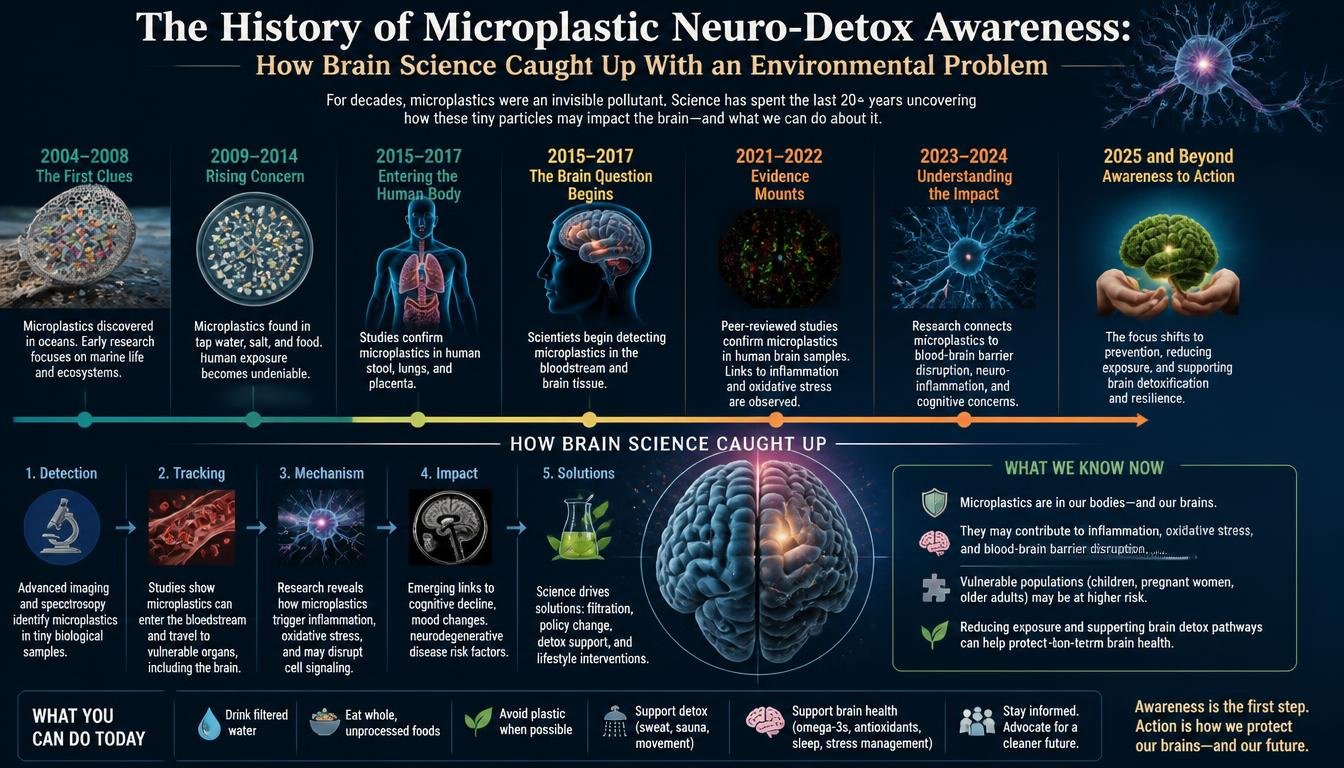
Neurological researchers weren’t looking for plastic when they found it. Autopsy and biopsy studies designed to map other biomarkers turned up polymer particles in brain tissue, at concentrations serious enough to prompt Britannica’s now widely cited comparison to a full spoonful of material.
That finding is the actual origin point of Microplastic Neuro-Detox Awareness as a distinct field of concern. It’s not a supplement trend. It’s a tissue-level observation that raised immediate questions about the blood-brain barrier.
The EPA notes that a human hair is roughly 80,000 nanometers wide, which puts nanoplastics (technically anything under 1,000 nanometers) into perspective. These particles are small enough to slip past biological defenses that were never built to filter them out.
We treat Brain-Derived Neurotrophic Factor as your brain’s repair protein, supported by training, movement, and lifestyle. Any conversation about environmental neurotoxic load has to run through that lens.
If particulate matter is accumulating in neural tissue, the relevant clinical question isn’t cosmetic. It’s whether that accumulation interferes with the biological processes that drive neurogenesis and structural plasticity, the actual mechanisms behind memory formation and cognitive recovery.
We don’t have a definitive answer yet. What we have is a reasonable, evidence-grounded hypothesis: chronic low-level inflammatory load from foreign particulate matter is not a neutral background condition, and supporting BDNF pathways through structured lifestyle habits is a rational, measurable countermeasure.
That’s a very different statement than promising to “flush plastic out of your brain.” We don’t make that claim, and nobody credible does.


Most Microplastic Neuro-Detox Awareness content focuses on what people eat and drink. That’s incomplete.
MDPI’s published research measured airborne microplastic concentrations between 0.49 and 0.82 items per cubic meter in campus micro-environments, everyday indoor spaces most of us spend hours in daily. Fibers, largely from synthetic textiles, made up 63% of what was detected.
Polypropylene, polystyrene, and polymethyl methacrylate accounted for roughly 70% of identified airborne particles. That means the air in an ordinary room, not just seafood or bottled water, is a legitimate exposure pathway that awareness campaigns are only now starting to address seriously.
This is where the science stopped being an ocean story and became an indoor air quality story with direct relevance to preventative longevity for brain health.
NOAA points out that plastic microbeads have been used in personal care products for roughly 50 years. That’s half a century of accumulation before the public conversation caught up with the chemistry.
The shift happened fast once it happened. Peer-reviewed findings on brain tissue accumulation moved from specialist journals like Nature Medicine into mainstream health reporting within a matter of months, not years.
That speed created a problem we see constantly in our own field: public awareness outrunning clinical consensus. People started searching for “neuro-detox” solutions before the research community had established what, if anything, actually works.
Here’s where we get direct. There is no clinically validated protocol that removes microplastic particles from existing brain tissue. None.
Anyone marketing a “brain detox” supplement, cleanse, or device with that specific claim is selling a story, not a rigorous, evidence-based intervention. That phrase belongs in marketing copy, not in a clinical setting.
What does exist, and what we can stand behind, is a two-part strategy: reduce ongoing exposure where practical, and support the biological systems responsible for resilience and repair. That second part is where our actual expertise lives.
Evidence over enthusiasm. You need measurable progress, not vibes, and that applies just as much to environmental neurotoxin exposure as it does to stroke rehab or cognitive training.
Modern neuro-rehabilitation is no longer guesswork; it is a measurable process built on rigorous evidence, clear dosing principles, and real follow-through. The same standard applies to how we think about environmental toxin load.
A measurable approach looks like this in practice:
None of this is static difficulty or passive scrolling through wellness trivia. It’s a protocol, and protocols get measured.
Neuroplasticity Solutions was founded on the premise that the brain today is not fixed, and that premise extends directly to how we handle emerging environmental threats. We translate published research, not internet consensus, into structured guidance.
That’s the gap we exist to close: the space between peer-reviewed literature on microplastic accumulation and the unregulated market of “detox” products racing to capitalize on public anxiety. We won’t tell you a supplement pulls plastic out of your neurons, because no rigorous study supports that claim.
What we will tell you is that supporting cognitive performance and resilience through evidence-based protocols is the only defensible response available right now, and it happens to be the same framework we already use for stroke recovery, TBI rehabilitation, and age-related cognitive preservation.


We expect the next few years to bring longitudinal studies tracking cognitive outcomes against measured plastic accumulation, not just presence-or-absence detection. That’s the research that will actually move this field from awareness into treatment.
Until that data exists, we treat Microplastic Neuro-Detox Awareness the same way we treat every other emerging threat to cognitive longevity: seriously, cautiously, and without hyperbole. Whether you are a high-performing professional protecting your mental edge, a senior focused on memory preservation, or someone managing recovery from a neurological event, the honest answer is the same. Reduce exposure where you reasonably can, and support your brain’s repair systems with rigorous, measurable practice.
Microplastic Neuro-Detox Awareness didn’t emerge from a single study or a single headline. It built up over decades of environmental research, accelerated sharply once particles were found in human brain tissue, and is now colliding with a marketplace eager to sell solutions the science hasn’t validated yet.
We’re not going to hand you a miracle cleanse. We’re going to keep doing what we’ve always done: translating rigorous, published research into protocols you can actually measure, so that Microplastic Neuro-Detox Awareness stays grounded in evidence rather than enthusiasm.
Microplastic Neuro-Detox Awareness refers to the growing public and clinical recognition that microplastic and nanoplastic particles accumulate in human tissue, including the brain, and the resulting interest in exposure reduction and cognitive resilience strategies. It is grounded in environmental and neurological research, not a formal medical treatment category.
No clinically validated protocol currently removes existing microplastic particles from brain tissue. The evidence-based approach focuses on reducing ongoing exposure and supporting BDNF-driven repair processes rather than claiming to “flush” plastic out of neural tissue.
Ingestion through food and water, combined with inhalation of airborne fibers and particles, are the two main documented routes. Nanoplastics are small enough, often far smaller than a human hair, to cross the blood-brain barrier, which is how they end up in neurological tissue.
Yes, the underlying accumulation data comes from rigorous sources including Stanford Medicine, the EPA, and peer-reviewed journals like Nature Medicine. What lacks strong 2026 evidence is the “detox” side of the phrase, since no supplement or cleanse has been clinically proven to remove plastic from brain tissue.
Practical steps include reducing heated plastic contact with food, improving indoor air filtration since airborne fibers make up a majority of detected particles, and maintaining consistent aerobic exercise and sleep to support BDNF and structural plasticity. None of this reverses existing accumulation, but it addresses ongoing exposure and resilience.
If particulate accumulation contributes to low-level neuroinflammation, it becomes a relevant variable in long-term cognitive longevity planning alongside sleep, nutrition, and cognitive training. We treat it as one more environmental factor worth tracking, not a standalone crisis requiring separate “detox” products.
Airborne exposure is often underestimated because it’s constant and passive, with research showing measurable concentrations of inhalable fiber particles in ordinary indoor spaces. Dietary ingestion, estimated at roughly a credit card’s weight per week by Stanford Medicine, remains significant, so the two routes should be addressed together rather than ranked against each other.