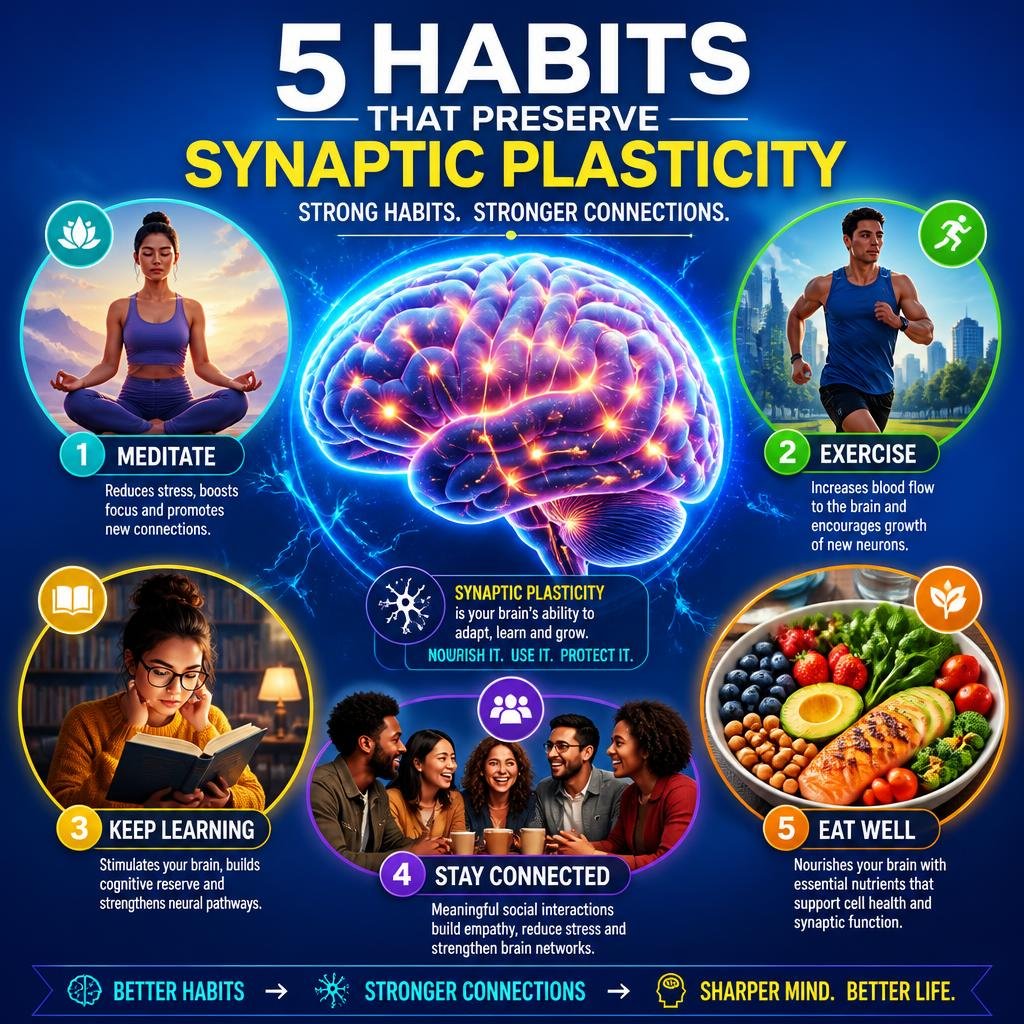
Research published through the National Institutes of Health found that a structured routine of exercise restored the activity of more than half of the genes disrupted in oligodendrocyte progenitor cells in Alzheimer’s models, a finding that reframes daily habits as a biological intervention rather than a wellness suggestion. The 5 lifestyle habits that actually preserve synaptic plasticity are not mysterious, and they are not trendy.
They are measurable, repeatable, and backed by evidence that has nothing to do with brain games, supplements, or marketing copy promising to “unlock” your brain.
| Question | Direct Answer |
|---|---|
| What are the 5 lifestyle habits that actually preserve synaptic plasticity? | Dosed aerobic exercise, protected sleep, structured cognitive challenge, metabolic and nutritional control, and consistent social engagement. |
| Is one habit more important than the others? | No single habit compensates for the absence of the other four; plasticity is a systemic outcome, not a single-lever switch. |
| Do brain games count as one of these habits? | No. Passive apps and static puzzles don’t meet the intensity threshold required to drive measurable cognitive performance gains. |
| Can these habits help after a stroke or brain injury, not just prevent decline? | Yes. The same principles anchor structured brain exercises for stroke recovery we use in clinical settings. |
| Is 2026 too late to start building these habits? | No. Structural plasticity responds to input at any age, though earlier and more consistent dosing produces stronger, faster gains. |
| Do supplements replace these lifestyle habits? | No published evidence supports that substitution; preventative longevity strategies are built on behavior, not pills. |
Most brain-health content stops at “stay active” and “eat well.” That advice is not wrong, but it is not dosed, and dosing is the entire point.
Synaptic plasticity, the brain’s capacity to form, strengthen, or prune connections between neurons, doesn’t respond to vague good intentions. It responds to specific, repeated, sufficiently intense inputs delivered at the edge of your current ability.
That is the gap we exist to close. Published research on Brain-Derived Neurotrophic Factor, the protein we treat as your brain’s repair protein, is extensive and rigorous. What’s missing is the translation of that research into daily, dosed, trackable habits that an actual person can follow.
Evidence over enthusiasm. You need measurable progress, not vibes.
Below are the five habits with the clearest, most consistently replicated evidence behind them. Each one has a mechanism, a dosing principle, and a threshold below which it stops working.
Aerobic exercise is the single most reliable trigger for BDNF release currently documented in the literature. It is not optional cardio for weight management; it is a neurological input with a dose-response curve.
In mouse models of Alzheimer’s disease, 60 days of free-wheel running significantly improved cognitive function and restored gene activity in cells responsible for supporting neural signaling. That is not a marginal effect. That is a structural change driven entirely by movement.
We activate BDNF through structured aerobic protocols, not open-ended “get moving” suggestions, because intensity and consistency are what separate a real intervention from a lifestyle footnote.

Sleep is when synaptic pruning and consolidation actually happen. Skip it, and the day’s cognitive gains don’t get filed anywhere useful.
This is not a “wellness” recommendation. It is a biological maintenance window with measurable consequences for memory retention and structural plasticity.
If half of adults are running a sleep deficit, half of adults are also running a plasticity deficit. That is not a coincidence, and it is not a small gap to close.
Static difficulty, predictable puzzles, and passive scrolling through trivia don’t meet the threshold required to drive change. The brain adapts to novelty and effortful difficulty, not repetition of tasks it has already mastered.
This is the core distinction we draw in our comparison of cognitive training versus memory apps: one is built to hold your attention, the other is built to move your ability. Seniors placed in structured lifestyle interventions performed at a level comparable to adults one to two years younger than those using self-guided memory apps alone.
That gap between “engaging” and “clinically effective” is exactly where consumer brain-training products tend to fall short.
Fewer than four in ten adults report eating a balanced diet daily or most days, according to current Alzheimer’s Association data. Nutrition affects synaptic plasticity indirectly, through inflammation, insulin sensitivity, and vascular health, all of which determine how well BDNF and its downstream signaling actually reach neural tissue.
This is not about a specific diet trend. It is about metabolic stability as a precondition for the other four habits to work at all.
Isolation is a measurable risk factor for cognitive decline, and it is often the most overlooked of the five habits because it doesn’t feel “clinical.” It is, however, deeply structural.
Purposeful routines, community contact, and environmental variety show up consistently in longevity research, which is part of why we built our Blue Zone-inspired supervised neuro-training retreats around social connectivity rather than isolated screen-based drills.

Share of Americans who say they’d want to know early — and who worry it’ll happen to them
You will never hear us promise to “reverse ageing” or “unlock 100% of your brain.” Those phrases belong in marketing copy, not in a clinical setting.
Supplements marketed for “brain health” almost never publish dose-response data comparable to what exists for exercise, sleep, and structured cognitive load. Brain games are worse: they’re optimized for engagement metrics, not neurological outcomes.
The specialized, evidence-based approach documented in our overview of cognitive training programs built for real clinical results exists precisely because the unregulated public market rarely asks the harder question: does this actually change the brain, or does it just feel productive?
That 9% figure is the gap. It’s the reason a research-to-practice bridge matters more than another app promising daily “brain boosts.”
Knowing the five habits is not the same as executing them with enough intensity to matter. Modern neuro-rehabilitation is no longer guesswork; it is a measurable process built on rigorous evidence, clear dosing principles, and real follow-through.
Whether someone is recovering from a neurological event or simply working to preserve function proactively, the same clinical logic applies. Our neuro-rehabilitation protocols are built around individual assessment, not a generic checklist, because a 45-year-old executive and a 70-year-old stroke survivor are not working from the same starting point or the same threshold for productive difficulty.
Every protocol we deliver is grounded in published research and adapted to the individual in front of us, not a generic profile, not a marketing persona, but a specific person with a specific brain.
| Life Stage | Primary Focus | Habit With Highest Leverage |
|---|---|---|
| Midlife professionals (35-64) | Sustained cognitive performance under load | Dosed aerobic exercise and protected sleep |
| Seniors | Preserving memory and independence | Structured cognitive challenge and social engagement |
| Stroke or TBI recovery | Rebuilding neural networks after injury | Task-specific, high-repetition motor and cognitive drills |
Alzheimer’s Association data shows 38% of adults believe midlife is the most critical window to start building these habits. We agree with the urgency, but the underlying biology doesn’t put a hard expiration date on it.
The 5 lifestyle habits that actually preserve synaptic plasticity, dosed aerobic exercise, protected sleep, structured cognitive challenge, metabolic control, and social engagement, are not a wellness checklist. They are a clinical framework with published evidence behind every component.
Neuroplasticity Solutions was founded on a simple but radical premise: the brain you have today is not the brain you are stuck with. Building the habits that preserve synaptic plasticity starts with treating your brain as a specific, measurable, changeable system, not a generic profile waiting on a supplement or an app to do the work for you.
They are dosed aerobic exercise, protected sleep, structured cognitive challenge, metabolic and nutritional control, and consistent social engagement. Each has published, mechanism-level evidence, and none of them works well in isolation from the other four.
Animal research shows measurable gene activity changes after roughly 60 days of consistent aerobic exercise, and human studies on sleep and cognitive training show benefits accumulating over weeks to months. There is no single-day fix; dosing has to be sustained to be measurable.
No. Passive apps and static puzzles are designed for engagement, not for pushing the brain to the edge of its current ability, which is the threshold required for real structural plasticity. Structured, individualized cognitive training programs consistently outperform self-guided apps in published comparisons.
Exercise has the strongest, most directly measured effect on BDNF and gene activity currently documented, but diet sets the metabolic conditions that determine how well that effect actually reaches neural tissue. Treating them as competing habits misses the point; they work together.
They apply in both contexts. The same principles anchor structured neuroplasticity exercises used in stroke recovery, just with more intensive dosing and closer supervision during the active rehabilitation phase.
You can start building awareness on your own, but dosing intensity correctly, tracking measurable progress, and adjusting protocols as your brain adapts is where most self-guided efforts stall. That is the specific gap a research-to-practice, evidence-based program is built to close.
Treating one habit as sufficient, usually exercise or diet, while ignoring sleep and cognitive challenge entirely. Synaptic plasticity is a systemic outcome, not a single-lever switch, and skipping any one of the five habits caps how much progress the others can produce.