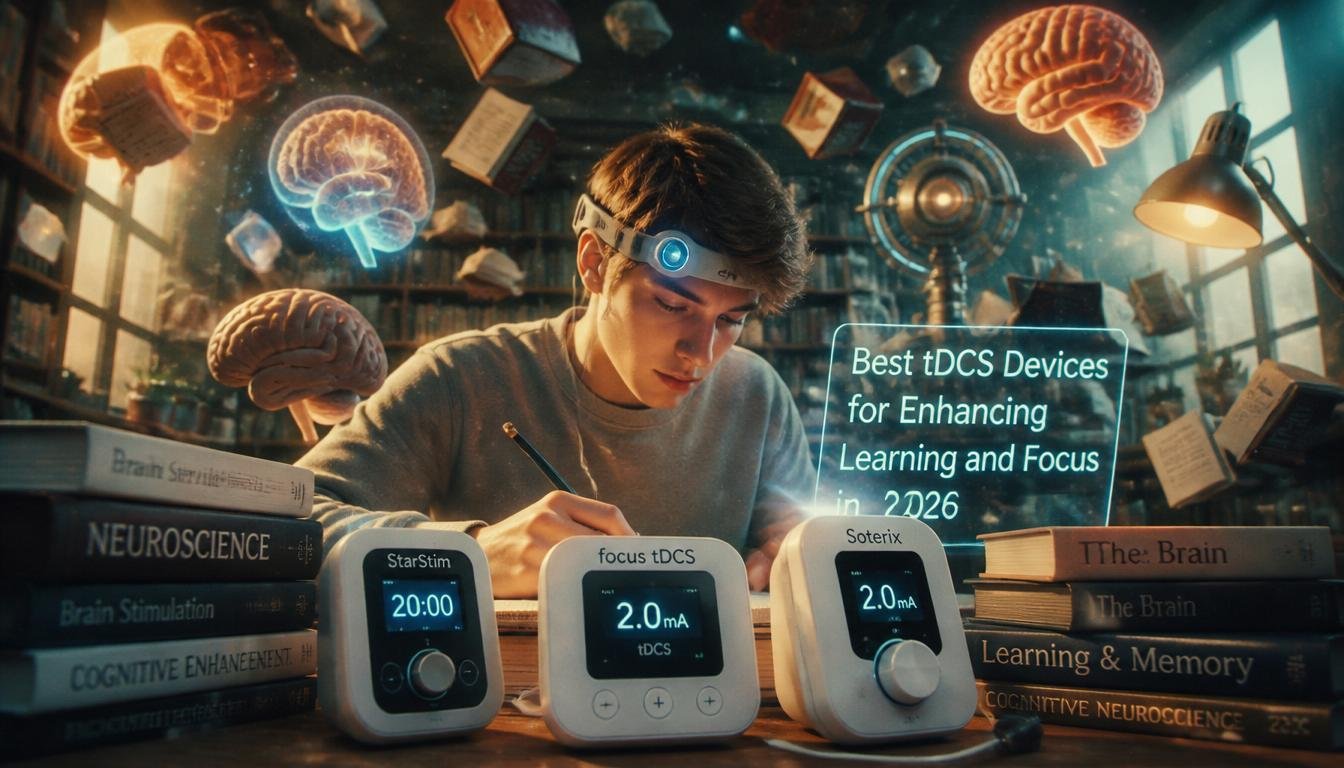
Choosing the Best tDCS Devices for Enhancing Learning and Focus matters more than most people realize, especially when you learn that certain commercial headsets have actually been shown to decrease accuracy on working memory tasks, the opposite of what their marketing promised.
That single fact reframes the entire conversation. tDCS is not a wellness gadget. It is a tool for neuroplastic rewiring, and it only works when you respect dosing principles, electrode placement, and the science behind brainwave entrainment.
We approach these devices the way we approach everything: evidence over enthusiasm. If you want to boost brain power naturally and pair stimulation with deliberate training, this guide is for you.

| Question | Quick Answer |
|---|---|
| Do tDCS devices actually improve focus? | Yes, when used correctly. HD-tDCS paired with feedback shows a 24% boost in working memory, but only as an adjunct to structured training. |
| How long should a session last? | 20 to 30 minutes is the proven sweet spot. Sessions under 20 minutes rarely deliver lasting cognitive gains. |
| What does a good device cost? | Reliable hardware ranges from $99 for basic stimulators to over $800 for clinically regulated headsets. |
| Is tDCS a standalone fix? | No. We treat it as non-invasive stimulation that primes learning, not a replacement for it. |
| What separates the best from the rest? | High-Definition targeting, built-in timers, and validated electrode placement. Marketing claims are not evidence. |
tDCS stands for transcranial direct current stimulation. It sends a low, constant electrical current through electrodes placed on your scalp to nudge neurons closer to firing.
That is the whole mechanism. It does not “unlock 100% of your brain,” and any device promising that belongs in marketing copy, not on your head.
What it does do is prime cortical tissue during a window when you are actively learning. Think of it as fertiliser for the soil right before you plant. The current makes neurons more responsive, but you still have to do the work.
This is why we always pair stimulation with deliberate motor or cognitive practice. The current opens the door. Your training walks through it.
Not every best-selling unit deserves a place on your desk. We judge devices against the same rigorous criteria we apply to any clinical modality.
Here is what actually matters when you compare hardware:
One-size-fits-all design with no attention to placement is a red flag. Your brain is specific. Your device should respect that.
The single biggest divide in this market is High-Definition versus conventional sponge-based stimulation. The gap is wider than most buyers realize.
Standard sponge units place two large pads on the scalp and push current between them. It works, loosely, but the current spreads across regions you never intended to stimulate.
HD-tDCS uses smaller ring electrodes to concentrate current on a target. That precision is the difference between flooding a whole street and watering one specific plant.
That 24% figure is not a small edge. It is the reason we steer serious learners toward HD systems whenever the budget allows.

This infographic highlights the four key principles for using tDCS to enhance learning and focus. It guides readers on choosing effective devices and safe usage.
Price tells a story, but not the story most people assume. Higher cost usually buys ease of use and app-based tracking, not magic.
Here is how the current market breaks down:
| Tier | Price Range | What You Get |
|---|---|---|
| Entry-level stimulators | $99 – $200 | Basic current control, manual placement. Good for disciplined users who already understand dosing. |
| Mid-range headsets | $200 – $500 | Built-in timers, app guidance, wearable integration. The practical sweet spot for most learners. |
| Clinical-grade systems | $500 – $800+ | HD targeting, regulated current, session tracking. Closest to what a professional setting uses. |
You can find effective entry-level units under $200. You can also waste $800 on a device you never use correctly. The hardware is only as good as the protocol behind it.
This is the part most buyers skip, and it is the part that matters most. tDCS follows dosing principles, exactly like medication or athletic training.
Too little current does nothing. Too much offers no extra benefit and raises the chance of irritation. The window is narrow and specific.
A 0.89 effect size on global cognition is substantial. It is also conditional on hitting that 20-minute floor consistently.
This is why we favor devices with a built-in timer that defaults to the proven window. Guesswork is the enemy of measurable progress.
Here is the reality check the industry rarely admits. The device does not teach you anything.
In our framework, active training is only about 30% of the outcome. The other 70% comes from neurological priming and integration around it.
tDCS sits firmly in the priming category. It softens the ground so synaptic reinforcement can take hold during the work that follows.
Use the stimulation window for the exact skill you want to improve. If you are learning a language, study during the session. If you are building executive function, run your attentional control drills while the current is active.
The brain you have today is not the brain you are stuck with. A device can prime it, but only deliberate practice rewires it.
You will see a lot of language out there about manifestation manifestation techniques BDNF BrainWave boost brain power naturally, and most of it is noise. But there is a genuine cluster of mechanisms underneath the buzzwords.
Manifestation is not a marketing slogan here. It sits at the intersection of neurochemistry, brainwave entrainment, and deliberate practice.
BDNF (Brain-Derived Neurotrophic Factor) acts as a fertiliser for neurons, promoting new synaptic connections and protecting existing tissue. We treat it as your brain’s repair protein.
The smart move is to support that biology before you stimulate. Aerobic priming, even a brisk walk, raises BDNF and primes the system. Pair that with tDCS and focused work, and the manifestation manifestation techniques BDNF BrainWave boost brain power naturally angle starts to mean something concrete instead of vague.
So when you read about manifestation manifestation techniques BDNF BrainWave boost brain power naturally, translate it into action: move your body, raise your BDNF, prime with stimulation, then train hard. That is the real version.
If a modality lacks rigorous evidence, we say so. Some popular consumer headsets fail this test outright.
Independent research has shown certain units actually reduced accuracy on N-back working memory tasks. The marketing said focus. The data said interference.
This happens when electrode placement is wrong for the cognitive target, or when the current is poorly regulated. A confident product page is not a clinical trial.
Before you buy, look for published validation, sane placement guidance, and a regulated current. If a brand cannot show you the evidence, treat the silence as your answer.
The best protocol fails if the device sits in a drawer. Practicality is part of the evidence.
Modern consumer units like the Mave Headset deliver roughly 7 to 10 sessions per charge, which suits a 20-minute daily habit cleanly. That cadence matters because consistency is what builds structural plasticity over weeks.
Wearable integration is now the 2026 standard. Syncing sessions with an Oura ring or Apple Watch lets you track focus against real physiological data, not just how you think you felt.
We like devices that make the right behavior the easy behavior. A short charge cycle and a daily reminder beat a powerful unit you forget to use.
Owning the hardware is step one. Building a repeatable loop is what produces functional gains.
Here is a simple structure we recommend to anyone starting out:
This is the same logic behind our broader work in neuro-rehabilitation and recovery, just applied to performance instead of repair. The principles do not change. The brain rewards specificity and consistency.
The Best tDCS Devices for Enhancing Learning and Focus are the ones that respect the science: HD targeting, a 20-to-30-minute timer, a stable current, and real data to track your progress.
But the device is the smaller half of the equation. Stimulation primes, training rewires, and BDNF does the structural work beneath it all.
Buy for precision and consistency, not for the loudest marketing claim. Neurological progress in 2026 is no longer guesswork. It is a measurable process built on rigorous evidence, clear dosing principles, and real follow-through.
Choose your device the way you would choose any tool for the only organ you cannot replace. It deserves a plan built around real data, not good intentions.
The best tDCS devices for enhancing learning and focus combine High-Definition targeting, a built-in 20-to-30-minute timer, and wearable integration. HD systems outperform basic sponge units because they concentrate current on specific neural networks, delivering measurably better working memory gains.
It can be, but only as an adjunct to real training, never a replacement for it. The current primes your neurons so learning sticks better, yet roughly 70% of your results still come from the deliberate practice and integration you do during and after each session.
Reliable hardware ranges from about $99 for basic stimulators to over $800 for clinically regulated headsets. Effective entry-level units exist under $200, while higher prices mostly buy ease of use, app guidance, and session tracking rather than stronger effects.
Yes, some have. Independent research found certain commercial headsets reduced accuracy on working memory tasks, the opposite of their marketing claims, usually due to poor electrode placement or unregulated current. Always choose a device backed by published validation.
tDCS primes cortical tissue, but BDNF does the structural rewiring by promoting new synaptic connections. To boost brain power naturally, raise BDNF with aerobic movement before your session, then stimulate and train, which turns the manifestation manifestation techniques BDNF BrainWave boost concept into a concrete routine.
The proven window is 20 to 30 minutes, with sessions over 20 minutes showing a 0.89 effect size on global cognition. Shorter sessions tend to under-dose, which is why a device with a built-in timer defaulting to this range is strongly preferable.
It is not mandatory, but it has become the industry standard. Syncing sessions with an Oura ring or Apple Watch lets you track focus against real physiology, so you can map your own plasticity threshold and confirm measurable progress instead of guessing.