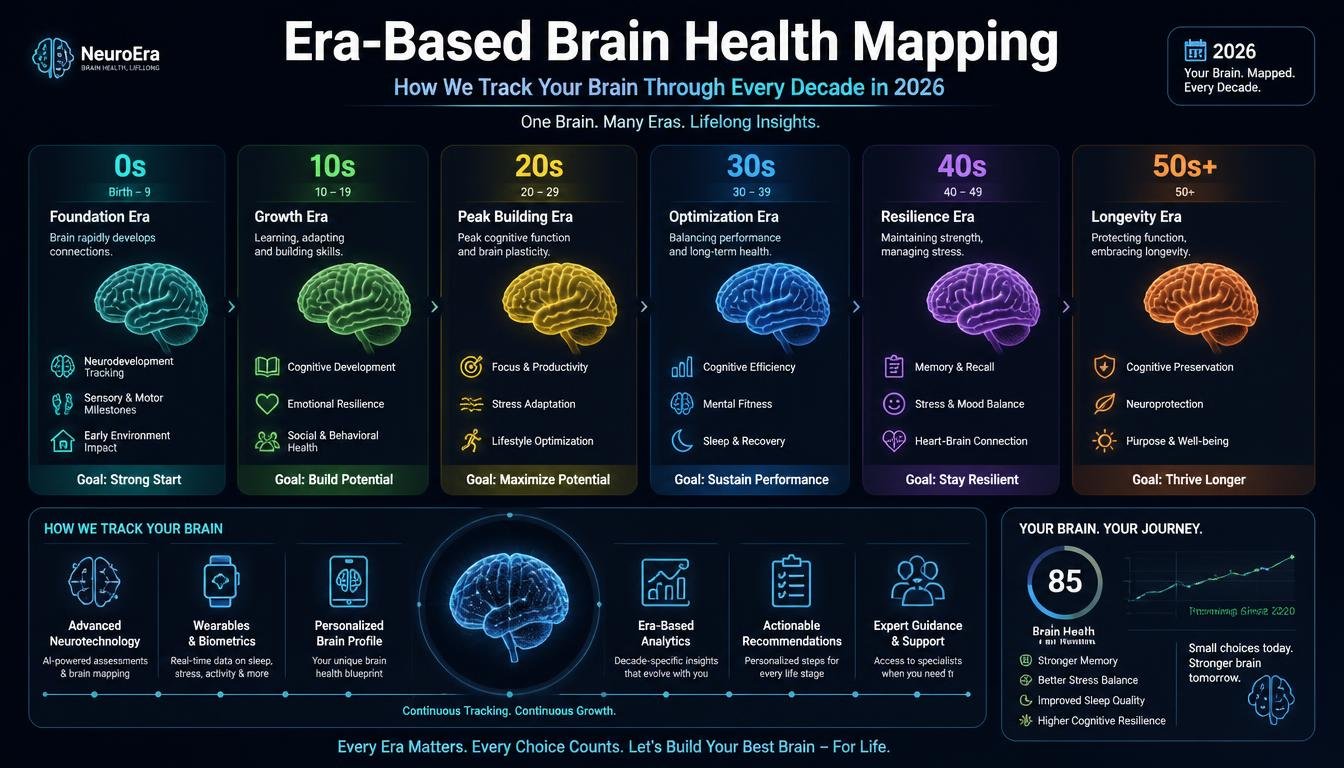
Era-Based Brain Health Mapping is our term for tracking BDNF production, cognitive performance, and recovery capacity according to the specific decade of life you are actually living in, not some generic 25-to-65 average. In 2026, we treat your 30s, your 50s, and your post-injury recovery window as three separate neurological environments, each one requiring its own protocol, its own dosing, and its own evidence base.
Most “brain health” content still talks about the brain as one static object that either declines or doesn’t. That’s not how neuroplasticity works, and it’s not how we build programs at Neuroplasticity Solutions.
| Life Era | What We’re Actually Mapping | Primary Clinical Target |
|---|---|---|
| Foundation Years (20s-30s) | Baseline attention span, digital overstimulation, early BDNF reserves | Functional plasticity |
| Performance Years (30s-50s) | Executive function under chronic occupational stress | Sustained attention, impulse control |
| Preventative Longevity Era (50s+) | Cognitive reserve, early thinning, memory preservation | BDNF activation, structural plasticity |
| Recovery Era (any age) | Post-stroke, post-TBI, or post-concussion neural rebuilding | Neurogenesis, targeted rehabilitation |
Era-Based Brain Health Mapping means we don’t hand you a single, one-size-fits-all cognitive plan. We assess where you are in your neurological life cycle first, then build the protocol around that reality.
A 28-year-old drowning in short-form content has a different problem than a 58-year-old noticing early word-finding slips. A stroke survivor at 45 has a different problem than either of them.
Functional changes in the brain can occur within weeks. Structural changes, the kind that actually protect you long-term, take months of consistent, correctly-dosed practice. Era-based mapping is how we decide which one we’re targeting, and for whom.
Evidence over enthusiasm. You need measurable progress, not vibes, and that means knowing exactly which era of brain health you’re mapping before you pick a protocol.
In your 20s and 30s, the biggest threat to cognitive longevity usually isn’t decline. It’s attentional erosion from chronic digital stimulation, what’s now commonly called “brain rot.”
This is where a structured reset matters. Chronic short-form content consumption reshapes attention networks and dampens the reward circuitry your brain needs for sustained focus.
Mapping this era correctly means restoring baseline attention before it calcifies into a lifelong pattern.

Our Digital Neuro-Detox protocol is built specifically for this stage of the map. It uses BDNF and neural priming principles to re-tune executive networks, not just a “put your phone down for a week” suggestion.
By the time most people hit their 30s through 50s, the challenge shifts. It’s no longer about attentional erosion alone. It’s about sustaining executive function under real occupational pressure, deadlines, decision fatigue, leadership responsibility.
This is where neurofeedback earns its place in an era-based map. It’s not a novelty tool. It’s a measured, EEG-driven retraining process.
Clients who use neurofeedback for executive function maintain their gains at a striking rate: 80% to 90% keep their brain function improvements for six to twelve months after completing treatment. That kind of retention is exactly what we’re looking for when we map a working professional’s era.
For organizations, this era-based logic scales into full workplace design. We treat leaders as cognitive athletes, not just employees who need a wellness perk.
Somewhere in the 50s, the map shifts again, this time toward protection rather than optimization. This is the era where BDNF production naturally starts to decline, and where early cognitive thinning can quietly begin before anyone notices memory loss.
Preventative longevity at this stage blends lifestyle design with targeted BDNF activation. Sleep, movement, and nutritional strategy still matter, but they’re no longer sufficient on their own.
Our preventative longevity strategies guide walks through the specific protocols we use to extend healthspan starting from the brain outward, not the other way around.
Here’s where era-based mapping breaks from strict age brackets entirely. A stroke, a concussion, or a traumatic brain injury can reset someone’s neurological era regardless of how old they are.
Modern neuro-rehabilitation is no longer guesswork. It is a measurable process built on rigorous evidence, clear dosing principles, and real follow-through.
Mapping a recovery era means identifying exactly which motor and cognitive functions are impaired, then applying targeted neuroplasticity exercises at the edge of current ability, not below it and not far beyond it. That edge is where structural change actually happens.

Era-based neurorehabilitation focuses on tracking cognitive milestones at every stage of life.
If there’s a single thread connecting every era we map, it’s BDNF. We treat Brain-Derived Neurotrophic Factor as your brain’s “repair protein,” supported by training, movement, and lifestyle, and it behaves as the common denominator across a 25-year-old’s foundation era and a 65-year-old’s preventative longevity era alike.

The Genius Switch Audio Series uses 40Hz gamma audio stimulation, delivered through headphones, to encourage brainwave entrainment without pills or supplements passing through the digestive system. At $39, it’s a passive, non-invasive way to support the BDNF side of an era-based brain health map, whether you’re in your foundation years or actively working through preventative longevity protocols.
We’ll never tell you it “reverses aging” or “unlocks 100% of your brain.” Those phrases belong in marketing copy, not in a clinical setting, and Genius Switch is positioned as exactly what it is: a gamma-frequency tool with a specific mechanism, not a miracle.
Three things converged this year to make era-based thinking non-negotiable. First, digital overstimulation is hitting younger brains earlier and harder than it did even a few years ago.
Second, corporate demands on executive function keep climbing, which is why we now build dedicated corporate cognitive training programs instead of generic workplace wellness add-ons. Third, the population entering the preventative longevity era is larger than ever, and they’re asking for evidence, not supplements with vague claims.
Static difficulty, predictable puzzles, and passive scrolling through trivia don’t meet that threshold for any of these groups. Era-based mapping does, because it forces the question: what specific brain, at what specific stage, needs what specific protocol?
Neuroplasticity Solutions was founded on a simple but radical premise: the brain you have today is not the brain you are stuck with. That premise only works if we know which brain, at which era, we’re actually working with.
Every protocol we deliver is grounded in published research and adapted to the individual in front of us, not a generic profile, not a marketing persona, but a specific person with a specific goal, a specific history, and a specific brain at a specific stage of life. You can read more about how that philosophy took shape on our about page.
For cognitive performance strategies specific to your current era, our full cognitive performance library, listed earlier in this piece, is the right place to keep exploring.
Era-Based Brain Health Mapping isn’t a rebrand of generic brain training. It’s a recognition that the brain of a 28-year-old scrolling through short-form content, the brain of a 45-year-old executive under deadline pressure, and the brain of a stroke survivor rebuilding motor function all need different dosing, different tools, and different timelines.
Whether you are a high-performing professional looking to sharpen your edge, a senior aiming to preserve memory, or someone recovering from a neurological event, era-based brain health mapping gives us a proactive roadmap to cognitive longevity instead of a guess.
Era-Based Brain Health Mapping is a clinical approach that matches brain health protocols to the specific decade or life stage a person is in, rather than applying one generic cognitive plan to everyone. It accounts for differences in BDNF production, executive demands, and recovery needs across foundation years, performance years, preventative longevity years, and recovery periods.
Yes, especially given how differently digital overstimulation, workplace cognitive load, and age-related BDNF decline each affect the brain. Era-based mapping in 2026 lets us apply the right dosing and protocol intensity instead of a one-size-fits-all cognitive plan.
BDNF, the “repair protein” behind neurogenesis and synaptic plasticity, behaves differently depending on age, stress load, and neurological history, which is exactly why era-based mapping tracks it as a central biomarker. Activation strategies like gamma audio stimulation or structured exercise are dosed differently depending on which era someone is in.
Yes. Recovery is treated as its own distinct era in this framework, regardless of the person’s chronological age, because post-injury neuroplasticity requires targeted rehabilitation exercises dosed at the edge of current ability. This differs significantly from preventative or performance-focused protocols used in other eras.
Regular brain training apps typically offer static difficulty and generic puzzles regardless of who’s using them. Era-based mapping starts with an assessment of the person’s actual life stage and neurological needs, then builds a measurable, evidence-based protocol around that specific reality.
Because eras shift with both age and life events (a new job, a health scare, a neurological incident), we recommend reassessment whenever a major life transition occurs, not just on a fixed annual schedule. Preventative longevity protocols in particular benefit from periodic reassessment starting in the 50s.
Yes. Executive teams fall into what we call the Performance Years era, where sustained attention and decision-making under pressure are the primary targets rather than general wellness. Corporate cognitive training programs are built specifically around this era’s demands, using neurofeedback and structured dosing rather than generic workplace perks.