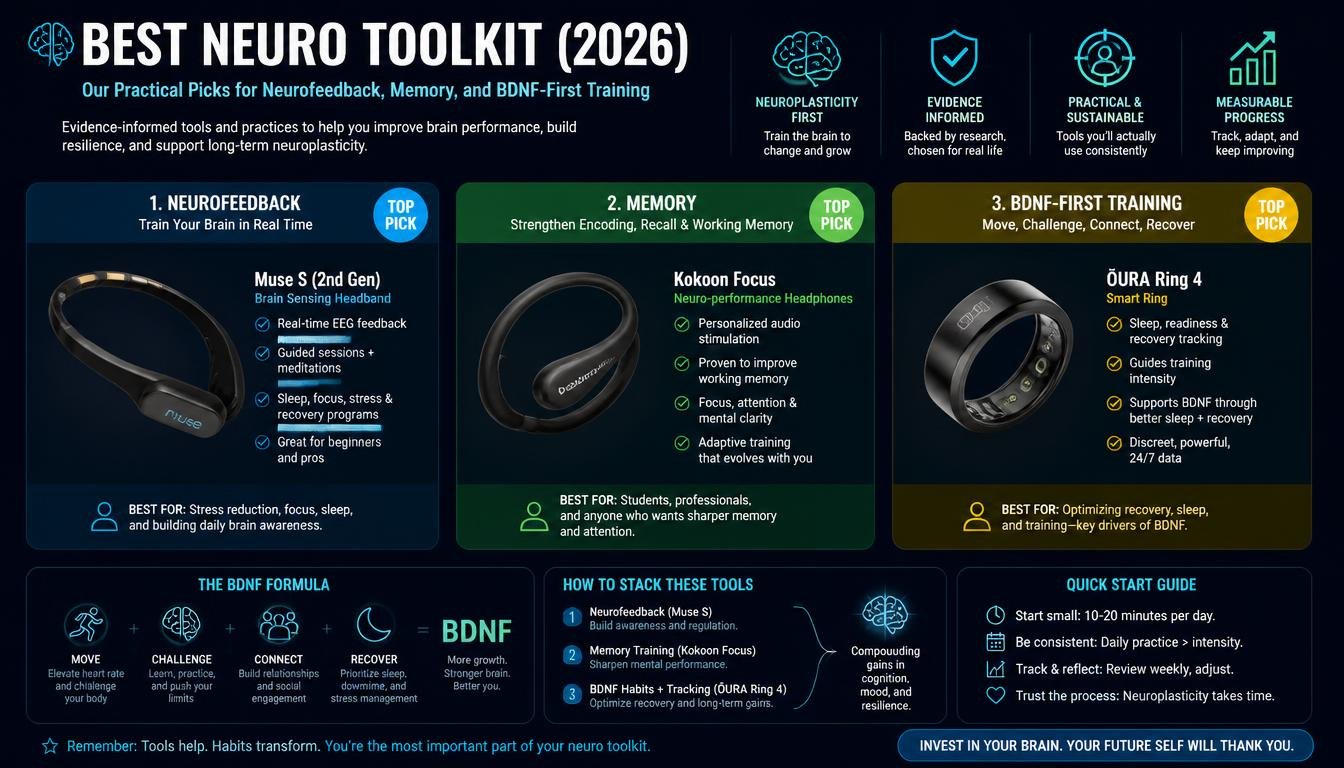
In 2026, 212 West Nile virus neuroinvasive disease cases are being reported, which is a real reminder that brain health tools are not just “wellness ideas,” they are practical systems for tracking, recovery, and measurable change. That’s why we built this best-for guide to help you assemble a neuro toolkit that actually works with dosing, repetition, and BDNF-centric protocols.
| What you’re trying to do | Best neuro toolkit approach | What to track in 2026 |
|---|---|---|
| Improve focus and executive function | EEG-guided neurofeedback protocols (at-home or practitioner-guided) | Session consistency and structured program progression |
| Support memory recovery | BDNF priming plus adaptive cognitive training (not generic brain games) | Baseline-to-follow-up performance on specific tasks |
| Stroke rehab momentum | Repetition at home paired with BDNF-targeted 40Hz gamma audio | Daily practice volume and multimodal adherence |
| Build long-haul brain habits | Sleep, movement, nutrition, plus targeted cognitive routines | Routine consistency, sleep quality, and cognitive challenge level |
| Start comparing tools for home training |
Professional-grade EEG headset criteria for home-based training | Prioritize signal fidelity, electrode consistency, and protocol pairing |
Quick “what people ask” answers (2026-style):
If you want a neuro toolkit that feels grounded, start with the “data side” of the plan. In 2026, people keep buying home setups, but the difference between “fun gadget” and “professional-grade training” is mostly about signal fidelity and how consistently you run the protocol.
Our favorite framework is the one we use to evaluate EEG for home-based work, which is covered in detail in our guide to professional-grade EEG headsets for home-based training. We look for consistent electrode placement, software that ties brainwave patterns to a real training session, and a program that supports measurable progress.
What counts as “professional-grade” in 2026?
We also like to separate the “hardware” from the “stack.” A neuro toolkit is the full setup: EEG neurofeedback (if you’re using it), plus targeted training tasks, plus recovery habits like sleep and load management.


If your goal is planning, attention, and cognitive control, we recommend building your neuro toolkit around neurofeedback for executive function. In 2026, the most useful programs use real-time EEG feedback to help the brain self-regulate patterns tied to focus.
We explain the “why it matters” and the practical setup options in neurofeedback for executive function: best protocols, tools, and training approaches in 2026. The key idea is that neurofeedback targets prefrontal cortex processes, and you get better results with structured programs that run for weeks to months.
Does it work without ADHD? We approach it as executive function training, not a label-based fix. If you can follow a routine and track outcomes, your neuro toolkit can be used as executive performance support.
Can you do it at home in 2026? Yes, but we still recommend a program with a defined structure because “doing sessions” is not the same thing as doing a protocol.
If your toolkit includes BDNF priming, you can also pair neurofeedback sessions with BDNF-first preparation, like gamma-entrainment support, so your training does not fight your recovery.
For stroke recovery, a neuro toolkit has to do one thing really well, high-volume repetition. Clinics are valuable, but at home you can often run more reps per day, and in 2026 that leverage matters.
Our best picks for stroke survivors focus on BDNF priming plus repetition dosing. In Top home-based neuroplasticity tools for stroke survivors (best picks for 2026), we highlight how BDNF-focused 40Hz gamma audio is most useful when paired with structured motor and cognitive practice.
Here’s what we prioritize in your stroke neuro toolkit:
We also keep it simple on cost so the toolkit stays realistic. The BDNF-targeted tool we repeatedly recommend here is Genius Switch – Activate Your Brain’s BDNF, priced at $39.


If memory is your target, we recommend a neuro toolkit that blends routines with BDNF activation concepts. In 2026, memory work tends to fail when it relies on passive exposure or generic “brain games,” instead of structured practice.
We start with habits. In Memory retention habits that actually work in 2026, we lay out the kind of daily system that helps your brain hold information. The basics matter because they create the repetition and recovery your brain needs.
Memory retention habits we recommend in 2026:
For memory recovery after injury, we go a step further. In Effective ways to restore memory after a brain injury: the 2026 evidence-first guide, we emphasize that BDNF is central to memory restoration and that structured training paired with BDNF activation tends to outperform generic approaches.
Where the BDNF idea fits your neuro toolkit: you use BDNF activation (like BDNF priming with gamma audio) as a “readiness layer,” then you run the actual cognitive training and memory tasks that force your brain to learn.
In 2026, lots of people ask us the same question, “Should we just use memory apps?” Our answer is usually no, because the most meaningful change comes from structured cognitive training with measurable progress.
In Cognitive training vs memory apps: what works for seniors, we lay out the difference between self-guided app use and real cognitive training. The big gap is adaptive difficulty and the focus on targeted brain regions like the hippocampus and prefrontal cortex.
What separates a real toolkit from a casual app:
If you also care about BDNF and “brain power naturally” support, the same logic applies. Pair your cognitive training with BDNF-centric priming ideas and protective recovery habits so your training is easier to sustain and easier to track.

If you want your neuro toolkit to last, we focus on longevity. That means you plan for consistency and recovery, not just one training burst.
In our A practical 2026 guide to protecting your brain for the long haul, we combine multi-modal exercise, dietary strategies, cognitive training, and BDNF stimulation to protect brain health long-term. We also emphasize structured dosing and adherence, which is what turns “good intentions” into real outcomes.
Movement, memory, and BDNF, in the same toolkit:
And if you’re into the “manifestation manifestation techniques BDNF BrainWave boost brain power naturally” angle, we get it. But we treat that kind of phrasing like a mindset layer, not the training itself. Your real toolkit still needs measurable sessions, sleep-support, and practice that drives neuroplastic change.
If you’re assembling your own neuro toolkit right now, use this checklist. It keeps the plan practical, repeatable, and aligned with how neuroplastic change tends to show up in structured training.
Neuro toolkit builder checklist (2026):
Real example: executive decision-making under pressure
When we talk about high-performance executive decision making, we recommend structured interventions that include BDNF activation with 40Hz gamma and recovery. In Top neuroplasticity strategies for high-performance executive decision making, we describe Genius Switch Gamma Audio as a 60 to 90 day approach with daily 5 to 15 minute gamma-entrainment sessions to prime BDNF and support decision-making under pressure.
And yes, this is where “manifestation manifestation techniques BDNF BrainWave boost brain power naturally” sometimes shows up in conversations. We still treat it like a mindset support, but we make sure the toolkit also includes the measurable components that actually drive improvement.
Practical cost sanity check: Genius Switch – Activate Your Brain’s BDNF is $39 on our toolkit pages, which makes it easier to run a consistent program without blowing the budget.
A neuro toolkit is a structured set of tools and protocols you use together with dosing and tracking. Unlike many memory apps, a proper toolkit usually includes targeted practice plus measurable progress, and in 2026 we often pair it with BDNF-centric approaches for consistency (for example, gamma-entrainment support).
Yes, many people do build a neuro toolkit at home in 2026, especially when it includes structured cognitive training and optional home neurofeedback. For executive function, follow a defined EEG-guided protocol instead of doing random sessions, and make sure your plan includes recovery habits.
For many people, neurofeedback for executive function can be worth it in 2026 because it uses real-time EEG feedback to support attention, planning, and cognitive control. We typically see better results when the toolkit includes a structured program and you run sessions over weeks, not just a few days.
In a neuro toolkit, BDNF-first strategies like 40Hz gamma audio are usually used as a priming layer. You pair BDNF activation support with active training tasks, and you track progress so the toolkit shows measurable change over time.
Our neuro toolkit memory approach in 2026 centers on active recall and spaced repetition, supported by sleep and movement. If you want “brain power naturally” support, you still need structured cognitive practice, plus routines that make it easy to keep going consistently.
They can help as a motivation and consistency layer, especially when you’re trying to stick to daily dosing. But for a true neuro toolkit in 2026, you still need the measurable parts, like BDNF-centric support, structured sessions, and tracking outcomes.
Our take is simple: the best neuro toolkit in 2026 is not the fanciest gadget, it’s the stack that follows dosing, repetition, and measurable progress. Whether you’re aiming for executive function neurofeedback, memory recovery habits, or stroke rehab momentum, we recommend pairing BDNF-first ideas (including gamma-entrainment support) with real training protocols and recovery so your brain has the right conditions to change.