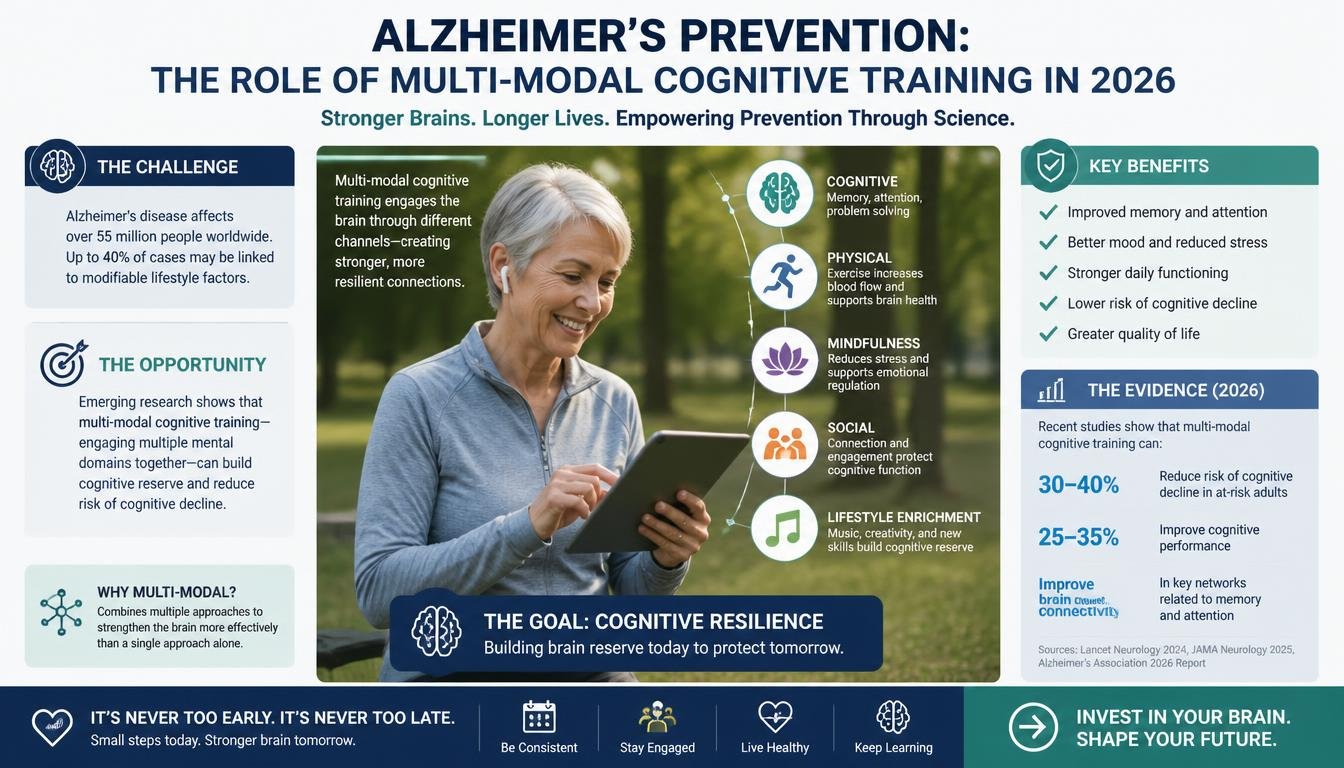
In 2026, the conversation around Alzheimer’s prevention is getting a lot more practical, because at least 40% of dementia cases are linked to modifiable vascular and lifestyle-related risk factors. That’s where multi-modal cognitive training fits in, combining targeted brain exercises with real-world habits that support brain resilience.
| What we focus on | Why it matters for Alzheimer’s prevention |
|---|---|
| Structured, adaptive training | Instead of guessing, you train at the right intensity for memory, attention, and processing speed. (See cognitive training vs memory apps.) |
| Multi-modal “dose” | We build programs that mix tasks, pacing, and reinforcement so the brain gets enough meaningful reps. |
| BDNF support | Protocols aim to support neuroplasticity pathways, including BDNF. (For example: Genius Switch.) |
| Habits that make memory stick | We anchor training with strategies for encoding, sleep, movement, and nutrition. (See memory retention habits.) |
| Prevention is bigger than apps | In 2026, we see the best results when cognitive training is paired with neuroprotective lifestyle design. (Explore preventative longevity.) |
| Measurable planning | We use structured blueprints and ongoing adjustments rather than “try a few games and hope.” |
When people ask about Alzheimer’s prevention: the role of multi-modal cognitive training, they usually want one clear answer. The reality in 2026 is that prevention works best when multiple systems are supported together, because cognitive decline is rarely caused by just one factor.
Multi-modal cognitive training usually blends things like memory tasks, attention drills, processing speed work, and real-world reinforcement. We also pair training with the biological foundation that helps those exercises “land”, especially sleep, movement, and nutrition.
That matters because memory is not a simple “file storage” process. On our memory retention habits guidance, we emphasize that most new information fades within hours unless you reinforce it. So if your Alzheimer’s prevention plan only includes occasional brain games, you can miss the reinforcement loop that helps memory stick.
Also, multitasking can reduce proper encoding, which means the brain is not storing what you think it is. Multi-modal training helps here by structuring sessions so the brain can focus, switch tasks intentionally, and consolidate what it learned.
Bottom line: Alzheimer’s prevention: the role of multi-modal cognitive training is about building consistent, targeted practice, then supporting it with habits that make the training effects last.
Most people start with an app because it’s easy, and in 2026 there are a lot of them. But our take on Alzheimer’s prevention: the role of multi-modal cognitive training is that structured training beats casual memory apps when you want real brain change.
On cognitive training vs memory apps, we break down what makes a program work for seniors. Cognitive training is designed as a structured, evidence-based approach with adaptive protocols, while casual apps often fail to maintain the intensity needed for structural change.
Here’s the key idea: effective programs keep you near your cognitive edge. That means the brain is consistently challenged in the specific networks you’re targeting, including hippocampal and prefrontal networks associated with memory and executive function.
We also like that structured programs make time-to-results less mysterious. If your sessions are adaptive and consistent, you can better estimate when improvements should show up, instead of wondering why you feel “no different” after weeks of random app play.

Let’s address the phrase we keep seeing in wellness circles, manifestation manifestation techniques BDNF BrainWave boost brain power naturally. Whether you view it as mindset or bio-support, the useful part for Alzheimer’s prevention is the mechanism behind why certain protocols aim to support neuroplasticity and BDNF.
BDNF is often described as a growth-support signal for the brain, connected to neurogenesis, synaptic plasticity, and neuroprotection. In our framework, we use BDNF-centric approaches as one component of a broader plan, alongside training, reinforcement habits, and lifestyle design.
If you want an example of a BDNF-adjacent protocol, Genius Switch is built around precision 40Hz gamma audio stimulation designed to trigger natural BDNF production, delivered as an audio file with a PDF guide. It’s not a replacement for cognitive training, but it is positioned as a support layer that aligns with the idea of dosing discipline.
That statistic supports a simple conclusion: if more than just one pathway is involved, then prevention plans should address more than one pathway. That is exactly why we like multi-modal cognitive training, not “one magic intervention.”

Most people don’t need a complicated plan, they need a consistent one. For Alzheimer’s prevention: the role of multi-modal cognitive training, our approach in 2026 starts with structure, then builds dosing discipline around it.
From our corporate cognitive training programs perspective, the “program blueprint” mindset matters. We look at cognitive load, goals, modality, and dosing, then tailor tracks instead of asking people to guess what to do next.
Here’s what that translates to for individuals too:
We also treat “dosing” seriously. If you do too little, you won’t get enough meaningful reps. If you do too much without recovery, you can worsen fatigue and reduce performance quality.
And if you’re curious about neuroplastic change concepts, it helps to understand why we emphasize consistency across the week, not just a big weekend effort.
If you train your brain but can’t retain what you learned, your plan feels like effort with no payoff. That’s why Alzheimer’s prevention: the role of multi-modal cognitive training should include memory retention habits, not just “brain workouts.”
On our memory retention habits collection, we lay out why memory fades quickly and why multitasking can interfere with encoding. We then connect that to practical behavior, like reinforcing new information instead of treating it as a one-time event.
In 2026, we see a common pattern. People start cognitive training, but their day-to-day routine still undermines consolidation (poor sleep, irregular routines, constant task switching). So the cognitive exercises never get the supporting conditions they need.
Here are habit moves we recommend alongside multi-modal training:
When we combine these habit layers with structured training, multi-modal cognitive training becomes more than a schedule. It becomes a loop that supports retention.

In 2026, people want to know what’s “worth adding” to multi-modal cognitive training. The answer depends on your goal, your baseline, and your consistency level. We avoid gimmicks, and we look for add-ons that can fit a disciplined routine.
One option is audio-based BDNF support using Genius Switch Audio Series. The page lists a price of $39 for the Genius Switch Audio Series, described as a non-invasive audio protocol delivered as an audio file with a PDF guide.
It can be a fit when you want a low-friction practice layer that aligns with neuroplasticity goals. We still treat it as supportive, not as a standalone replacement for structured cognitive work.
Another category of “best-fit thinking” is how neuro rehabilitation concepts translate into prevention. Our neuro rehabilitation collection frames neuro rehab as a structured, multi-modal process that depends on timing, intensity, and quality. Even when you’re not recovering from a specific injury, the prevention logic holds: structured practice with the right dosing is what drives neuroplastic change.
Finally, we connect cognitive training to longer-term neuroprotective planning through preventative longevity. This is where lifestyle design, diet adherence ideas (like a neuroprotective score), and cognitive training are discussed as an integrated system.

Not everyone needs the same version of Alzheimer’s prevention: the role of multi-modal cognitive training. Some people want at-home guidance, and others want a coached program they can follow consistently.
In 2026, our corporate track model is a good example of how we think about adaptation. The cognitive program blueprint generator approach aims to tailor training tracks based on cognitive load, goals, modality, and dosing. That’s important because the brain changes fastest when training is targeted and appropriately challenging.
If we zoom out, the common problem we see is mismatched intensity. People do either too-easy tasks that don’t stimulate change or too-hard tasks that create fatigue and inconsistency. Adaptive cognitive training is meant to keep you near your cognitive edge, which supports focused practice without burning you out.
So whether you’re choosing individual training or a structured corporate-style program, the most important question is not “Do we have content?” It’s “Is it adaptive, structured, and consistent enough to support neuroplastic change?”
And yes, mindset matters too, including the way people talk about manifestation manifestation techniques BDNF BrainWave boost brain power naturally. But in our view, mindset works best when it is paired with measurable behaviors, structured training, and habit support that make the brain practice actually happen.
Alzheimer’s prevention: the role of multi-modal cognitive training is not one single intervention. In 2026, we treat it like a system: structured, adaptive cognitive practice plus memory retention habits plus neuroplasticity support layers that can include BDNF-adjacent protocols.
When we combine training design with habit foundations like sleep, movement, and reinforcement, the plan becomes more than “trying.” It becomes a repeatable routine that aims to support resilience and cognitive longevity over time.
In 2026, Alzheimer’s prevention: the role of multi-modal cognitive training means doing structured, adaptive brain exercises that target more than one cognitive function, then supporting that training with habits that improve retention. It also often includes dosing discipline, so the brain gets consistent meaningful practice instead of random effort.
Memory apps can be useful for engagement, but Alzheimer’s prevention: the role of multi-modal cognitive training typically performs better when tasks are structured and adaptive. Casual apps often lack the intensity control needed for structural brain change, while multi-modal training keeps you challenged at your cognitive edge.
BDNF protocols like Genius Switch are positioned as a supportive layer for neuroplasticity goals, using 40Hz gamma audio stimulation to support natural BDNF production. In the bigger picture of Alzheimer’s prevention: the role of multi-modal cognitive training, audio support works best when paired with structured cognitive training and habit reinforcement.
The useful part is the intent to support brain health, but for Alzheimer’s prevention: the role of multi-modal cognitive training, outcomes depend on consistent, targeted practice. In 2026, we recommend pairing any mindset approach with measurable behaviors, structured training, and memory retention habits that make learning stick.
Alongside Alzheimer’s prevention: the role of multi-modal cognitive training, we focus on memory retention habits like reinforcing information soon after learning and reducing multitasking during encoding. We also prioritize sleep, movement, and nutrition as the biological foundation that makes training effects more likely to last.
Yes. The prevention logic overlaps with neuro rehabilitation because both emphasize timing, intensity, and quality of programming to drive neuroplastic change. In Alzheimer’s prevention: the role of multi-modal cognitive training, the rehabilitation mindset helps you choose structured protocols rather than one-off activities.