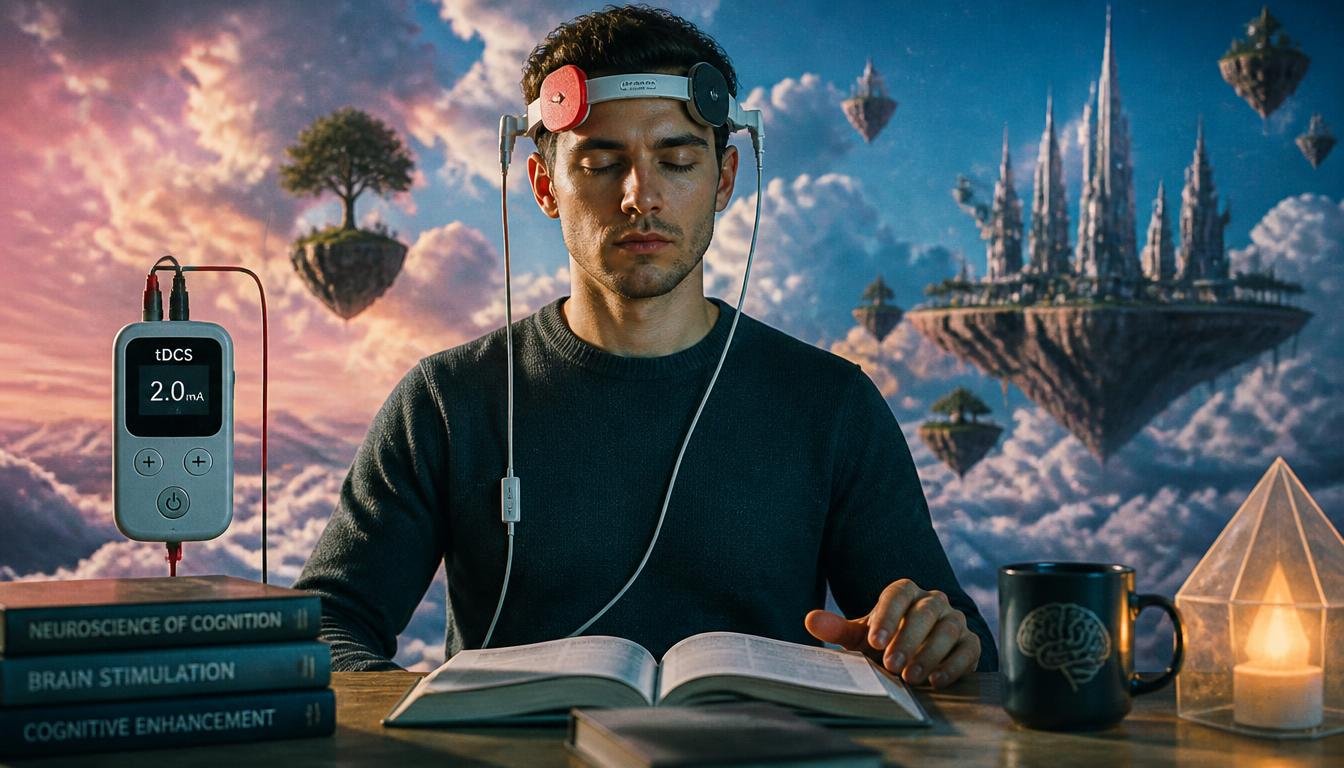
Nearly three quarters of people who buy a home tDCS device do it for one reason: they want sharper focus, faster recall, or an edge at work, not a medical treatment. That statistic alone tells you something important about tDCS for cognitive performance heading into 2026 – the demand is real, but the guidance around it is often not. This guide exists to close that gap.
| Question | Short Answer |
|---|---|
| Does tDCS actually improve cognition? | Modest, measurable gains when paired with structured cognitive training. Not a standalone miracle device. |
| Who is tDCS best for? | People already engaged in structured cognitive training programs, not casual users hoping for a shortcut. |
| Is it safe to self-administer at home? | Only with dosing discipline. Unsupervised overuse is where the real risk starts. |
| What’s the non-electrode alternative? | 40Hz gamma audio entrainment, like the Genius Switch audio series, targets BDNF without current at all. |
| How big is the tDCS market in 2026? | Valued at $2.8 billion as of 2025, growing fast, and largely unregulated for consumer use. |
| Can you boost brain power naturally instead? | Yes. Natural brain boosting solutions and BDNF-targeted lifestyle habits often outperform gadgets alone. |
| Where should recovery patients start? | With a baseline assessment through a neurological recovery plan, not a device purchased off a marketplace. |
Transcranial Direct Current Stimulation runs a weak electrical current through the scalp to nudge cortical excitability up or down. That’s the whole mechanism. It is not a memory download, and it is not a substitute for sleep, nutrition, or actual cognitive practice.
We say this a lot: evidence over enthusiasm. The device itself does nothing without a task layered on top of it, which is why the research consistently pairs tDCS with structured cognitive training rather than testing it alone.

A systematic review pooling 1,012 participants across 27 studies found a standardized mean difference of 0.36 for tDCS combined with cognitive training. That’s a small but real short-term benefit, not a transformation.
Small effect sizes matter clinically, but they are not marketing copy. If you’re evaluating tDCS for cognitive performance, that 0.36 number is the honest ceiling of what current peer-reviewed evidence supports, and any claim beyond it should raise your skepticism, not your excitement.
Roughly 8.4% of home tDCS users self-administer more than 100 sessions, far outside any protocol tested in a lab. That’s not dosing. That’s guessing.
Skin burns have been reported in home settings, and dropout is common too, with approximately 40% of buyers stopping or never starting because nobody gave them a real dosing framework. Modern neuro-rehabilitation is no longer guesswork; it is a measurable process built on rigorous evidence, clear dosing principles, and real follow-through, and that standard doesn’t disappear just because the device is now available for home delivery.
People search for a strange mix of things when they’re trying to sharpen their thinking: manifestation manifestation techniques, BDNF, BrainWave, boost brain power naturally, tDCS. Most of that search behavior comes from the same underlying frustration, wanting a faster path to focus without a clear map of what actually works.
Here’s the clinically grounded version. We treat Brain-Derived Neurotrophic Factor as your brain’s “repair protein,” supported by training, movement, and lifestyle, not by wishful thinking or vague mindset language.
Manifestation techniques on their own don’t move BDNF. Structured practice, aerobic exercise, and targeted stimulation (electrical or auditory) do, and that’s the distinction we build every protocol around.
If your goal is to boost brain power naturally before you ever touch an electrode, start with the fundamentals covered in our mindset and longevity science framework and our memory retention habits guide.
Not everyone wants electrodes on their scalp, and honestly, not everyone needs them. Genius Switch uses precision 40Hz gamma audio to trigger BDNF production through auditory neural entrainment instead of current.
The program is an 8-minute daily audio series paired with a PDF implementation guide, priced as a one-time purchase at $39. No pills, no prescriptions, no current running through your skull.

There’s also a Genius Switch + Botanical Nootropics bundle at the same $39 price point, pairing the gamma audio protocol with plant-based cognitive support for people who want to boost brain power naturally without adding a device to their morning routine.
The corporate athlete concept treats the brain as a trainable organ, the same way athletic training treats muscle. Our corporate cognitive training programs run Executive Performance, Stress Resilience, and Preventative Longevity tracks with actual assessment and dosing guidance behind them.
tDCS shows up in these tracks selectively, layered on top of structured training, never as a standalone fix. If a vendor is pitching you a device with no baseline testing and no follow-up assessment, that’s a red flag, not a shortcut.
For teams that want a clinical benchmark before starting any program, our MoCA to MMSE score conversion chart is a free reference point clinicians already use.
People recovering from a neurological event have different needs than a busy professional chasing an edge. Our neurological recovery pathway starts with baseline assessment, sets measurable goals, and only then decides whether tDCS or another modality belongs in the plan.

Structural plasticity doesn’t happen by accident, and it doesn’t happen at low effort either. Brain change occurs at the edge of current ability, which is why our rehabilitation protocols use precise dosing rather than generic “brain training” sessions.
Some people need more than a home protocol. Our Blue Zone-inspired retreats run 5 to 10 day programs with clinician supervision, priced at $3,579, combining longevity principles with actual neuro-training oversight.

These retreats matter for a specific group: stroke survivors and traumatic brain injury patients who need dosed, supervised sessions rather than an unregulated device shipped to their door. Full clinician oversight changes the risk profile entirely compared to solo home use.
The global tDCS device market was valued at $2.8 billion as of 2025, with depression treatment applications holding the largest single share at 32.5%. Cognitive enhancement is a growing slice of that market, but market size and clinical proof are two very different things.

Global demand for non-invasive brain stimulation is surging toward a massive valuation.
We stay skeptical of the hype curve on purpose. Static difficulty, predictable puzzles, and passive scrolling through trivia don’t meet the threshold for real cognitive change, and neither does buying into a growth chart without asking what the evidence actually supports.
Not everyone belongs on this device. Here’s our honest breakdown of who benefits most.
Neuroplasticity Solutions grew out of a frustration shared by clinicians, researchers, and clients alike: the peer-reviewed literature on tDCS for cognitive performance is real, but the unregulated consumer market rarely reflects it accurately. That’s the gap we’re built to close.
Whether you are a high-performing professional looking to sharpen your edge, a senior aiming to preserve memory, or someone recovering from a neurological event, our approach provides a proactive roadmap grounded in cognitive longevity research rather than device marketing. You can read more about how we built this philosophy on our about page.
tDCS for cognitive performance works, in a limited, measurable, evidence-supported way, when it’s dosed correctly and paired with real cognitive training. It is not a shortcut, it is not a replacement for sleep and nutrition, and it is definitely not a substitute for structured practice.
You need measurable progress, not vibes, and that’s true whether you’re eyeing a home tDCS kit, exploring the Genius Switch’s 40Hz gamma audio route, or trying to boost brain power naturally through daily habits first. Start with an honest baseline, respect the dosing principles the research actually supports, and treat every claim beyond that with the skepticism it deserves.
Yes, modestly. Pooled research across 1,012 participants shows a small but statistically significant benefit (SMD = 0.36) when tDCS is combined with structured cognitive training, not used alone.
It can be, but home use carries real risks when dosing protocols aren’t followed. Reported skin burns and a roughly 40% dropout rate among home buyers point to a gap between device availability and proper guidance.
Yes. Lifestyle habits that support BDNF, aerobic movement, quality sleep, and structured cognitive training, can meaningfully boost brain power naturally without any electrical or auditory device involved.
tDCS applies a weak electrical current to the scalp, while Genius Switch uses 40Hz gamma audio entrainment to trigger BDNF activation without any electrodes. Both target similar biological pathways through very different, non-invasive mechanisms.
It’s worth considering only if you’re already engaged in structured cognitive training, since the evidence shows tDCS amplifies training gains rather than creating gains on its own. Without that training component, the clinical benefit largely disappears.
Home tDCS devices are typically a one-time hardware cost, while structured programs like our corporate cognitive training tracks or Blue Zone-inspired retreats (from $3,579) include clinician oversight and dosing guidance built into the price. The Genius Switch audio protocol sits in between at $39, offering a supervised-style framework without hardware.
Nearly three quarters of home tDCS purchases are made specifically for cognitive enhancement rather than clinical treatment of conditions like depression. That demand is exactly why evidence-based guidance around tDCS for cognitive performance matters more in 2026 than ever.