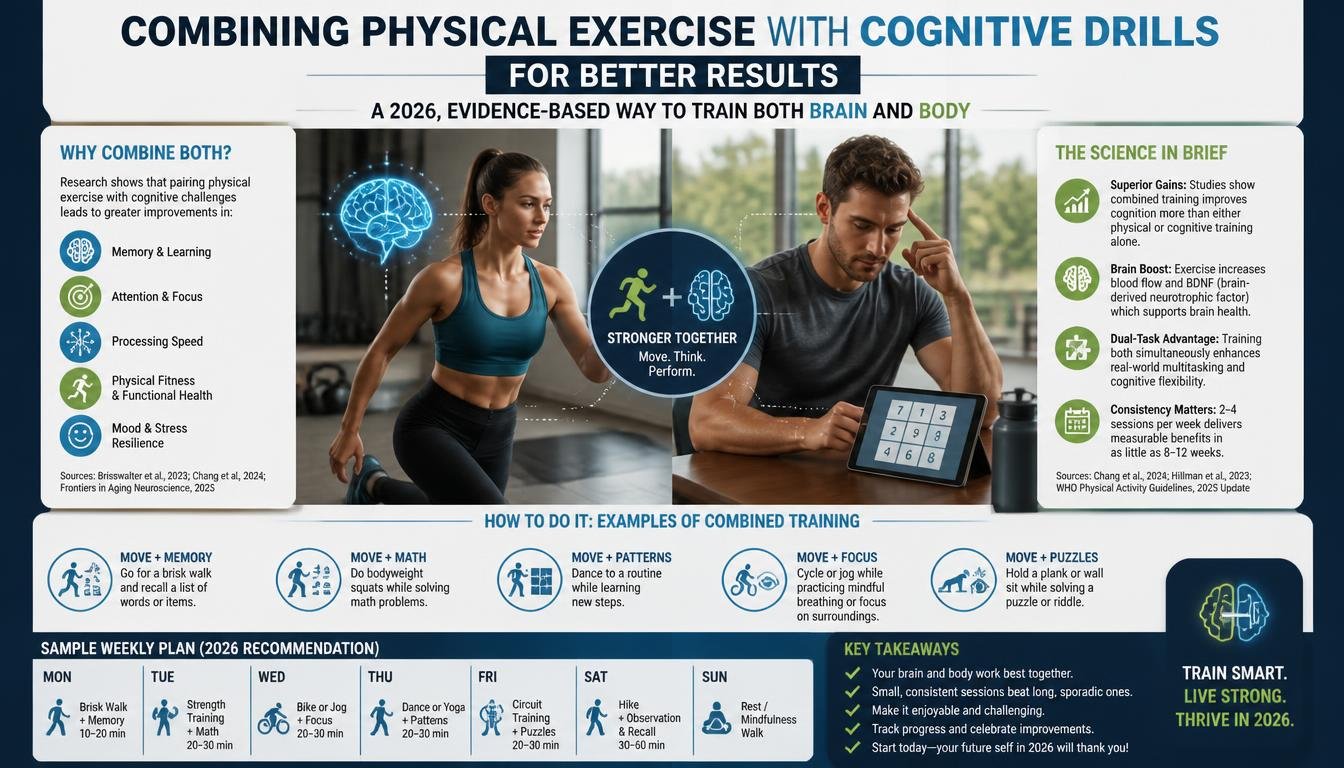
In 2026, evidence on combined cognitive and physical training is no longer vague enthusiasm, a total of 8180 articles were screened, and 16 randomized controlled trials were included. That matters, because when you combine Combining Physical Exercise with Cognitive Drills for Better Results, you are betting on biology plus training dosing, not on “brain games” or wishful thinking.
|
1) Train the edge of ability Cognitive drills should get harder over time, not stay static. |
2) Use real dual-tasking Pair movement demands with attention, rule switching, or decision-making. |
|
3) Dose it Programs that run 2 to 3 times per week for at least 30 minutes and 12+ weeks show the most consistent improvements. |
4) Priming can matter We treat BDNF as your brain’s “repair protein,” supported by training, movement, and lifestyle. |
|
5) Track progress If you cannot measure it, you cannot dose it. |
6) Avoid passive “engagement” Static difficulty, predictable puzzles, and passive scrolling do not meet a clinical threshold. |
Evidence over enthusiasm. You need measurable progress, not vibes.
Combining Physical Exercise with Cognitive Drills for Better Results works because your brain responds to training pressure, not just mental effort. In rigorous protocols, cognitive demands and motor demands create repeated, measurable states of attention, error detection, and adaptation.
When it fails, it is usually one of three issues. First, people do exercise and then do drills later, with no shared cognitive-motor context. Second, they use static difficulty so the brain stops getting pushed near the edge of current ability. Third, they skip progression and progress tracking, so they never find the dose that produces change.
To keep it clinical, our approach is “research-to-practice,” grounded in dosing principles, neuroplasticity mechanics, and clear follow-through. Every protocol we deliver is adapted to the individual in front of us, not a generic profile.
Modern neuro-rehabilitation is no longer guesswork, it is a measurable process built on rigorous evidence, clear dosing principles, and real follow-through.
If you want better results from Combining Physical Exercise with Cognitive Drills for Better Results, your drills cannot be random trivia or passive “practice.” Real cognitive training involves dosing, progression, and targeted engagement of brain systems responsible for encoding, retrieval, attention, and executive function.
We treat structured cognitive work as a training stimulus, so the drills should fit the same logic as resistance training. You should be able to answer, “What does this drill stress, and how does it get harder?”
And no, static difficulty, predictable puzzles, and passive scrolling do not meet that threshold. If the task feels too comfortable by session three, it is not “hardening your brain,” it is letting it coast.
Here is where Combined training becomes more than two activities stacked together. Dual-task cognitive training pairs a movement or motor control demand with a cognitive demand, so you train the brain’s ability to handle cognitive load while coordinating action.
In 2026, this concept shows up repeatedly in clinical thinking about realistic performance, because daily life is not “sit quietly and remember words.” It is walking and deciding, carrying and evaluating, moving and responding.
Dual-task drills are also practical for progression. You can increase complexity by adding speed, adding interference, or narrowing decision time. That gives you measurable training intensity on both tracks, body and brain.
Most people do not need more information. They need a repeatable plan that respects dosing principles. So when we talk about Combining Physical Exercise with Cognitive Drills for Better Results, we mean a schedule you can run long enough to measure change.
Try this structure. Keep it simple, then progress it.
Progression should be predictable. Increase time under cognitive load first, then increase complexity, then tighten response windows. If you jump all at once, performance drops, and you lose the chance to train at the edge of current ability.
We treat BDNF as your brain’s “repair protein,” supported by training, movement, and lifestyle. In 2026 protocols, priming is used to create a more favorable biological training state before structured work.
This is also where “brain games” fall apart. Games are usually engaging, but they are not designed around biological targets. Our stance is straightforward, we focus on evidence-based, clinical mechanisms that connect to outcomes you can measure.
If you are following a memory repair protocol in 2026, one relevant component is audio priming designed to prime BDNF before training. For example, Genius Switch audio priming is listed at $39 as a 40Hz gamma audio priming step before cognitive work.
We do not sell hope. We sell protocols, dosing principles, and follow-through that aim for cognitive longevity.

Edge-of-ability training is not a feeling. It is a rule: you push the system just beyond what you can do automatically, then you progress. If you are always perfect, the drill is too easy. If you are always failing catastrophically, it is too hard.
That is why we care about measurement and dual-task cognitive training performance, not just completion. In 2026, clinicians lean on measurable outputs because the brain adapts to training pressure, and training pressure depends on correct dosing.
If you need a direction for cognitive flexibility drills that actually sharpen performance under cognitive load, we outline edge-of-ability and dual-task progressions in our work on cognitive flexibility drills.
Learn more here: cognitive flexibility drills for professional decision-making.
This is where people overcomplicate things. They assume “more is always better,” then they add random add-ons, then wonder why nothing changes.
But evidence suggests there is a meaningful pattern when you combine components properly. In memory outcomes, cognitive-physical interventions with 2 components show measurable effects, and 3 or more components improve memory further.
So in practice, you want components that fit together and can be progressed. For many people, that means a base of movement training plus cognitive drills, then a third component that supports conversion into durable gains. That third component can be priming (for some protocols), adherence tracking, or a recovery and lifestyle alignment step.
We also recommend avoiding passive “neuro-adjacent” tasks that feel productive but do not drive measurable adaptation. If you are comparing consumer tools to real training, we cover the real difference between cognitive training and simple memory apps here: the 2026 guide to cognitive training vs memory apps.
Whether you are training for executive function, recall, or resilience after neurological events, you need a plan built for cognitive longevity. You will never hear us promise to “reverse ageing” or “unlock 100% of your brain.” Those phrases belong in marketing copy, not in a clinical setting.
Instead, we treat cognitive longevity as an evidence-based, measurable process. In 2026, that means baseline assessment, structured training, adaptive progression, and progress tracking. It also means integrating movement and cognition, because those systems influence each other.
If you want a complete evidence-based plan structure for recall, focus, and cognitive longevity in 2026, start here: our 2026 plan to improve recall, focus, and cognitive longevity.
And if your goal is preventive planning, we also publish a broader environment and lifestyle design guide that supports BDNF activation and consistent training conditions in 2026. Read: Environmental Longevity and Preventive Lifestyle Design.

You need practical constraints. Not more opinions. Here is the checklist we use to keep Combined training evidence-based and safe, especially when people are older, injured, or returning after time off.
That is the difference between training and “staying busy.” If you want better results from Combining Physical Exercise with Cognitive Drills for Better Results, you must design the program, then run it long enough to measure it.
Combining Physical Exercise with Cognitive Drills for Better Results is not magic, it is biology plus dosing. In 2026, the most consistent outcomes come from structured training that pushes the edge of ability, uses dual-task cognitive training that reflects real cognitive load, and includes progression plus progress tracking.
If you want a clinically grounded starting point, begin with a measurable memory or cognitive longevity plan, then fold in movement training and dual-task drills. Evidence over enthusiasm, and you will never be stuck chasing vibes again.
In 2026, the best way is to pair movement with cognitive load in a repeatable structure, usually through dual-task cognitive training (walking, balance, or strength work while you make decisions or switch rules). You also need dosing principles, 2 to 3 sessions per week, and progression based on measured performance, not how it feels.
Programs combining physical exercise with cognitive work improve cognition more consistently than simpler comparators, and memory benefits are seen when you combine multiple exercise components properly. For executive function, multi-component interventions can outperform control conditions even when the program includes only two combined components.
Evidence summarized in 2026 indicates that cognitive-physical interventions with 2 components improve memory versus controls, and 3 or more components produce larger effects. The key is not adding random extras, it is combining components that support the same training pathway with progression and tracking.
For some protocols in 2026, priming is used to create a more favorable training condition by supporting BDNF activation before structured cognitive work. If you are considering Genius Switch audio priming, it is listed at $39, and it is best treated as one component inside a full, measurable memory repair protocol.
You should see performance that is difficult but trainable, accuracy that is not collapsing, and measurable changes over weeks. If the drill is static and easy to master quickly, you are not training at the edge of current ability, so your progress stalls.
In 2026, consumer apps are often engaging but may lack dosing, progression, and targeted system engagement. For Combining Physical Exercise with Cognitive Drills for Better Results, we recommend structured cognitive training that mirrors real decision demands and includes progress tracking, not passive practice.