
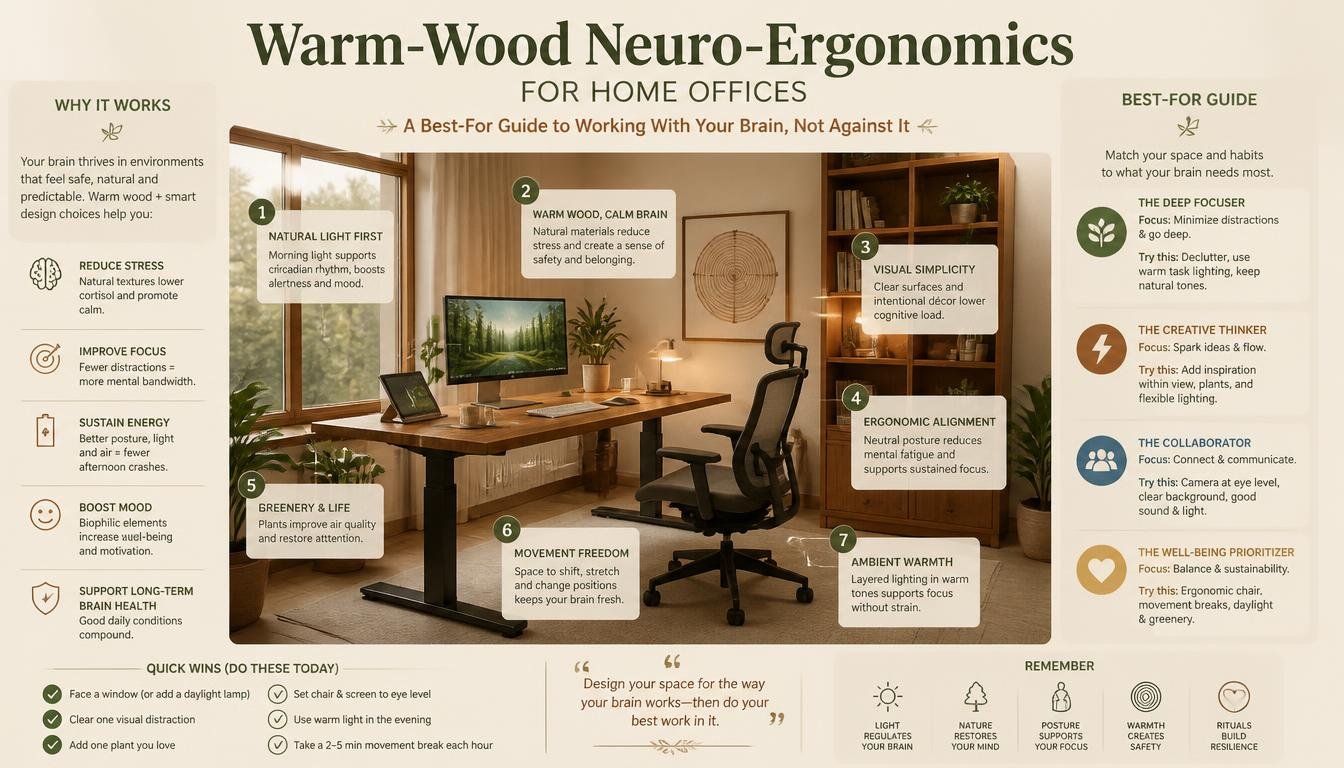
Did you know that content simply tagged “warm” has pulled over 57.8 million subscribers on YouTube alone? That scale of appetite for warmth as a feeling is exactly why Warm-Wood Neuro-Ergonomics for Home Offices has stopped being a niche design idea and started being a serious conversation among people who care about how their workspace shapes their cognitive state.
We are not a furniture company. We are a clinical brain-health practice, and we look at home office design the same way we look at every other lifestyle input: through the lens of measurable neurological effect, not aesthetic preference.
| Question | Evidence-Based Answer |
|---|---|
| What does “neuro-ergonomic” actually mean? | It means the workspace is designed around measurable cognitive load, not just posture or aesthetics. |
| Does warm wood really change brain state? | Natural materials reduce visual processing demand, which frees up attention for the actual work. |
| Is this the same as biophilic design? | Overlapping, but biophilic brain health is broader; warm-wood neuro-ergonomics is the specific application to a desk setup. |
| Can office design boost BDNF? | Indirectly, by lowering chronic stress load; direct BDNF drivers are still exercise, sleep, and targeted stimulation. |
| Do I need expensive furniture? | No. A sensory-aware workspace can start with two or three material swaps. |
| Is a neuro-ergonomic office 2026 trend or is it grounded in science? | The underlying cognitive load research is decades old; 2026 is simply when home offices caught up to the office design literature. |
| Where do BDNF-boosting tools fit in? | They complement, not replace, environmental design. See our cognitive performance coverage for the full protocol picture. |
Let’s define the term before we sell you on it. Warm-Wood Neuro-Ergonomics for Home Offices is the practice of pairing natural wood tones and grain patterns with ergonomic layout principles to lower the cognitive load your brain spends just processing the room.
Not a design trend. Not a Pinterest aesthetic.
It is an applied version of cognitive load design, the same discipline that shapes clinical environments, classrooms, and, increasingly, corporate offices. Steelcase’s own research team has published on how office design can boost brain health, and the findings line up with what we already know about sensory overload and attention: harsh materials and high-glare surfaces force the visual cortex to work overtime, and that work competes with the mental bandwidth you need for actual output.
Your visual system does not distinguish between “important” stimuli and “background” stimuli automatically. It processes everything in the field of view, and high-contrast, high-glare, synthetic surfaces generate more raw visual data than matte, low-contrast wood grain.
That is the entire mechanism behind warm-wood neuro-ergonomics for home offices.
None of this is mysticism. It’s cognitive load design applied to a desk.
Biophilic brain health is the broader research category. Warm-wood neuro-ergonomics for home offices is the specific, buildable application of it for people who work from a desk five days a week.
A sensory-aware workspace considers more than one sense at a time. Wood affects sight and touch. It has a different thermal feel than metal or glass, and that thermal warmth appears to correlate with perceived psychological warmth, which is not a coincidence of language.

A single figure stands out in the broader warmth-and-design data landscape, hinting at how strongly perception splits down the middle.

A biophilic, sensory-aware setup is not about filling a room with plants and calling it done. It’s a systems approach: material, light, texture, and sound, all pulling in the same direction toward lower baseline stress load.
Here’s where we have to be blunt, because this is the section where marketing usually takes over from evidence.
You will find plenty of manifestation techniques promising to boost brain power naturally through visualization and intention alone. We don’t work that way, and we won’t tell you that a warm-wood desk will manifest a sharper brain by itself.
Evidence over enthusiasm. Environmental design lowers the noise floor. It does not, on its own, drive the biological process that actually rebuilds neural tissue.
That process runs on Brain-Derived Neurotrophic Factor, or BDNF, the molecule we treat as your brain’s repair protein. BDNF gets supported by exercise, sleep, and specific forms of targeted stimulation, not by rearranging furniture or repeating affirmations at your desk.

That’s why we pair a warm-wood neuro-ergonomic setup with a genuinely measurable tool like Genius Switch, a downloadable audio program using 40 Hz gamma brainwave stimulation to encourage the brain’s own BDNF response. It costs $39, it takes minutes at your newly calm desk, and it does not ask you to believe in anything you can’t measure.
If you want the deeper mechanism, we’ve laid it out separately: Genius Switch and how it activates your brain’s BDNF walks through the gamma entrainment research directly.
The neuro-ergonomic office in 2026 is not defined by a single gadget. It’s defined by three variables working together: material, light temperature, and sightline.
Steelcase’s brain-health research on office environments, referenced above, backs this exact combination for corporate spaces. Home offices are simply catching up in 2026.
Not every task needs the same environment. Deep, sustained focus work benefits from a warmer, more enclosed feel; light administrative work tolerates more visual variety.
This is cognitive load design applied at the task level, not just the room level, and it’s the part most home office guides skip entirely.
A neuro-ergonomic home office doesn’t stop mattering when you close the laptop. The same warm materials that lower cognitive load during work hours also support the wind-down period your brain needs before sleep.
Poor sleep is one of the fastest ways to blunt BDNF production, regardless of how good your desk looks. We’ve covered this directly in our comparison of sleep-tracking data for cognitive recovery in 2026, and the pattern holds: environment and biology have to work together, not one instead of the other.
We’ve written more broadly about the daily habits that protect this kind of neural resilience in the five habits that actually preserve synaptic plasticity, and a warm, low-stress workspace is one piece of that larger picture, not the whole picture.
You don’t need to gut your office. You need to prioritize correctly.
| Upgrade | Cognitive Impact | Priority |
|---|---|---|
| Swap desk lamp to 3000K warm bulb | Reduces glare-driven visual load | High, cheap |
| Add wood desk surface or panel | Lowers baseline visual processing demand | High, moderate cost |
| Reduce glossy/reflective surfaces in view | Fewer micro-saccades, less fatigue | High, free |
| BDNF-supporting audio protocol (Genius Switch, $39) | Supports the biological repair process directly | Medium, low cost |
| Advanced focus tools (tDCS kits) | Direct cortical stimulation for sustained attention | Optional, higher cost |
For readers who want to go further than material swaps, we’ve reviewed the best tDCS devices for enhancing learning and focus in 2026, along with a dedicated look at the safest tDCS kits for focus.

These are the “edge of current ability” tools we mention often. Static furniture changes fatigue, but they don’t push your brain past its comfort zone the way targeted stimulation can, and both have a place depending on your goals.
Warm-Wood Neuro-Ergonomics for Home Offices isn’t a design trend we’re chasing because it’s fashionable in 2026. It’s a practical application of cognitive load research to the room you sit in for eight hours a day.
Wood tones, warm lighting, and a sensory-aware layout won’t manifest focus out of nothing, and no amount of manifestation techniques will replace the biological work that BDNF does. But a properly built neuro-ergonomic office, paired with evidence-based tools that boost brain power naturally, gives your brain fewer things to fight against and more capacity for the work that actually matters.
Yes, if you treat it as one input among several. It reduces visual cognitive load measurably, but it should be paired with sleep, movement, and BDNF-supporting protocols for real gains.
Biophilic brain health is the broad research category covering nature exposure and natural materials generally. Warm-wood neuro-ergonomics for home offices is the specific, desk-level application built around wood grain, warm light, and reduced glare.
Not directly. A calmer, sensory-aware workspace lowers chronic stress load, which supports the conditions BDNF needs, but the direct drivers remain exercise, sleep, and targeted stimulation tools like 40Hz gamma audio.
There’s no clinical evidence that manifestation techniques alone move any measurable neurological marker. If your goal is to boost brain power naturally, evidence-based inputs like sleep, BDNF-supporting protocols, and a genuinely low-load environment do far more work.
Mid-tone, matte wood grain tends to perform best for deep-focus tasks because it offers a predictable, low-glare texture. Darker tones suit enclosed focus zones; lighter tones suit collaborative or call-heavy spaces.
No. Swapping lighting temperature and reducing glossy surfaces in your direct sightline delivers most of the benefit before you spend anything on new wood furniture.
A neuro-ergonomic home office supports the wind-down period before sleep, and sleep quality directly affects BDNF production and next-day cognitive recovery, which is why we look at both together rather than treating the desk as an isolated fix.