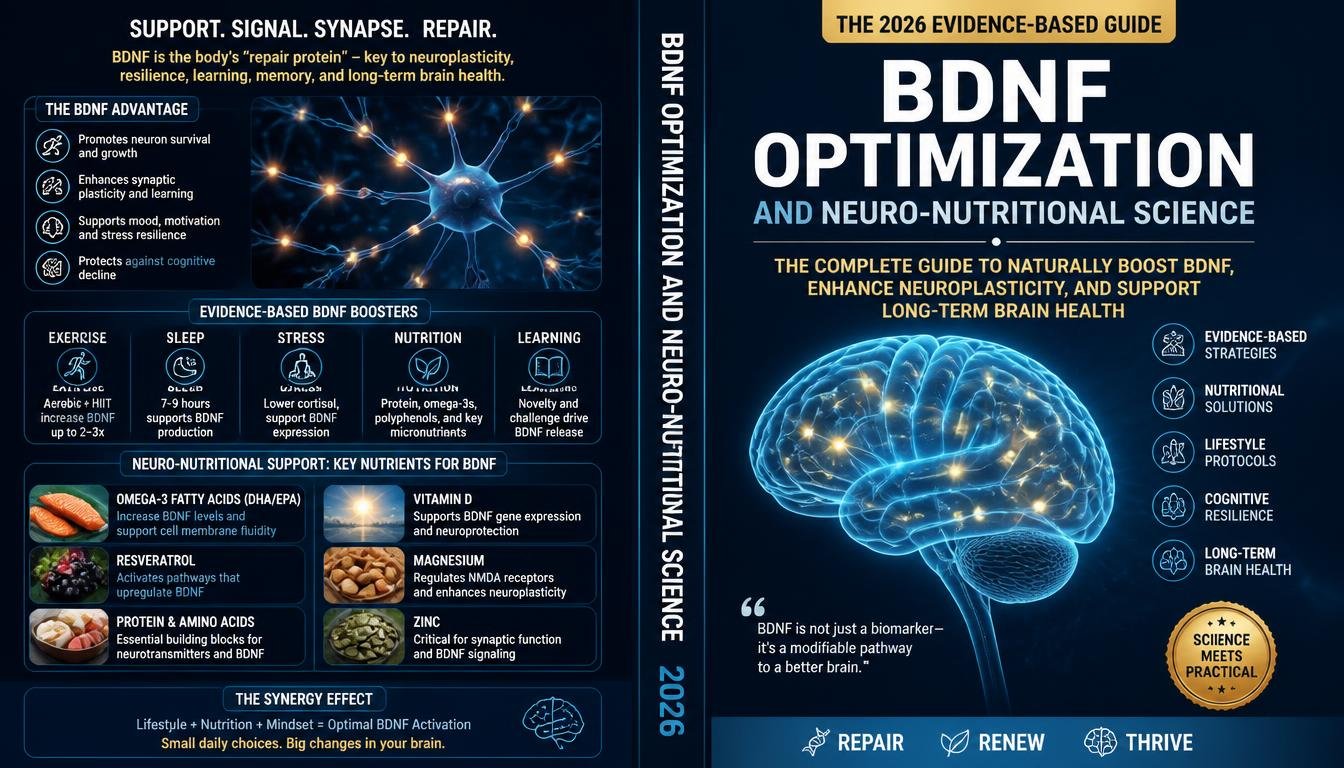
BDNF Optimization and Neuro-Nutritional Science matters because your brain does not change from vague effort, it changes from measurable biological signaling, and one systematic review screened 7,633 articles to isolate only the high-quality dietary trials that actually examine dietary impact on BDNF levels.
| Core idea | BDNF is a “repair protein” for neurons, not a vibe metric. |
| Training signal | You need the edge-of-ability dose, and movement is a consistent BDNF trigger. |
| Nutrition signal | Neuro-nutritional targets include omega-3 status, B-vitamins, and evidence-informed gut strategies. |
| Supplement reality check | If you’re asking “bdnf supplements do they work,” the answer is usually “modestly, and only with the right context.” |
| Passive tools don’t cut it | Static difficulty and passive scrolling are not the same as neuro-rehabilitation. |
| 2026 best practice | Build protocols around training, movement, sleep, and measurable follow-through, not random stacks. |
We treat Brain-Derived Neurotrophic Factor as your brain’s “repair protein,” supported by training, movement, and lifestyle. That is the foundation of BDNF Optimization and Neuro-Nutritional Science, because BDNF is involved in neurogenesis, synaptic plasticity, and neuroprotection.
But you need to be precise. A “best bdnf supplements” question is usually asked like BDNF is a switch you can flip with a bottle. In reality, BDNF responds to state, intensity, and the timing of signals that tell neurons, “change is allowed, change is needed.”
So our clinical filter is simple. Evidence over enthusiasm. You need measurable progress, not vibes. Static difficulty, predictable puzzles, and passive scrolling through trivia don’t meet that threshold.
In our 2026 approach, optimization means:
Nutrition is not just “fuel,” it is biochemical input that supports neuronal function and can influence BDNF signaling indirectly. That is why BDNF Optimization and Neuro-Nutritional Science takes diets and specific nutrients seriously, instead of chasing quick fixes.
One rigorous pattern from the clinical literature is that dietary and biological interventions show measurable effects on serum BDNF in certain contexts, but they are not universally large, not guaranteed, and not a substitute for the training signal.
When people search “supplements to increase bdnf,” they often jump to amino acids or herbs. But a growing evidence base has also examined gut-directed interventions. In clinical trials assessing probiotics and serum BDNF, there were 2,372 participants across 20 randomized controlled trials.
That doesn’t mean “any probiotic is best.” It means you should treat gut-targeted strategies as part of a protocol, not as an impulse purchase.
Across neuro-nutritional guidance, omega-3 fatty acids and B-vitamins are repeatedly highlighted for supporting brain function. We also see this as a “baseline or bottleneck” issue. If omega-3 status is low or micronutrient intake is inconsistent, you may feel like your training is not landing.
In 2026, the most reliable way to handle this is boring but effective: prioritize consistent dietary targets, use supplements only when there is a clear reason, and then observe whether your training outcomes improve.
If you want the mindset behind the bigger picture, not just nutrient lists, our habit framework is laid out here: Brain Health Longevity Habits.
Here is the part most supplement conversations skip. BDNF Optimization and Neuro-Nutritional Science is not “food or training.” It is food plus training, timed to biological states that support structural plasticity.
Modern neuro-rehabilitation is no longer guesswork; it is a measurable process built on rigorous evidence, clear dosing principles, and real follow-through.
We use neuroplasticity training that is specific, progressive, and measurable. It is not about endless volume. It is about consistent, challenging cognitive and functional work that stays in the zone where change is likely.
This is where “manifestation manifestation techniques BDNF BrainWave boost brain power naturally” gets misread by people online. We do not treat BDNF like a wish. We treat it like a neurobiological response. Your training provides the demand, nutrition provides the material and environment.
In 2026 protocols, that often means:
Digital detox is not a marketing slogan in our framework. Digital neuro-detox routines are treated as cognitive hygiene, because constant novelty and fragmented attention can work against the stable focus required for neuroplasticity.
Start with the basics in our longevity habit program: Digital Neuro-Detox 2026.
If you are asking “bdnf supplements do they work,” we will answer carefully. They can have modest, context-dependent effects on BDNF-related outcomes, especially when they correct a deficiency or support a biological pathway relevant to your training.
But if you show up with low sleep, no training dose, and inconsistent nutrition, then “supplements to increase bdnf” are often coping, not optimization.
We look for three things, and we treat the rest as marketing:
You should also be honest with yourself about bdnf supplement side effects. Even “natural” compounds can cause issues in sensitive people, or create problems when combined with other medications or supplements. That is why we prefer layered, evidence-informed protocols, not aggressive stacks.
Not every BDNF optimization lever is a supplement. Some tools aim to shift brain state through targeted stimulation, then you apply structured training and neuro-nutrition on top of it.
If you are curious about our 40Hz gamma audio approach, this is the core product: Genius Switch Audio Series ($39, one-time). We treat it as a state tool, not a replacement for training.


We often see people treat BDNF Optimization and Neuro-Nutritional Science as a “performance upgrade” topic. That is only one use case. The same biological signaling logic applies in recovery, where structured practice and supportive nutrition are essential.
Whether you are recovering from a neurological event, working on stroke-related motor tasks, or adapting after traumatic brain injury, the dosing principles and measurement mindset matter.
When you want real change, you do not rely on generalized supplements alone. You use task-specific neuro-rehabilitation protocols, then you support recovery with neuro-nutrition.
To see how we frame motor skill restoration, start with: Stroke Rehab Motor Skill Restoration.
And for BDNF-focused recovery training ideas, this is directly relevant: Neuroplasticity Exercises for Stroke Recovery.
Some people are not looking for another supplement. They are looking for supervision, outcome tracking, and a protocol that reduces decision fatigue. In 2026, clinician-guided neuro-training retreats are an example of that approach.
Our Blue Zone-inspired retreat framework combines longevity habits with clinical neuro-training protocols, and it includes nutrition, rest, and measured dose and intensity.


Pricing example: Neuro-training retreat priced at $3579, positioned for supervised, outcome-tracked recovery.
We grew out of a frustration shared by clinicians, researchers, and clients alike. There is a real gap between published peer-reviewed literature and the unregulated public market. That gap is where people get stuck buying “best bdnf supplements” without an actual dosing plan, then wondering why they do not see changes.
So here is a practical 2026 template. Not a universal profile, but a clinically grounded starting point you can adapt.
We hear versions of this all the time. Here is our clinical boundary. You can use motivation and intention, but BDNF Optimization and Neuro-Nutritional Science is biological. There is no evidence-based mechanism for “manifestation manifestation techniques BDNF BrainWave boost brain power naturally” to replace training, movement, nutrition, and sleep.
Where the concept can be useful is behavior. Intention can help you show up to your dosing, and consistency is where the biological targets get hit.
Optimization is not only about actions, it is about knowing whether the actions are changing the right system. That is why we emphasize measurable frameworks for brain longevity.
For example, our Brain Volume and Hippocampal Atrophy Reference Chart is built around monitoring brain volume and the medial temporal atrophy scale, with age-based trajectories. It also frames aerobic exercise effects, partly through BDNF.
If you want that monitoring approach, explore: Brain Volume & Hippocampal Atrophy Reference Chart.
That type of measurement helps separate “I tried supplements” from “my brain responded.”

Short daily sessions are enough to trigger meaningful brain-derived neurotrophic factor release.
Some people want a supplement style answer, others want an audio-state tool. Our position is consistent either way. Tools can help, but protocols still require training and neuro-nutrition dosing principles.
For audio-based BDNF activation, Genius Switch is positioned as a downloadable audio series using precision 40Hz gamma audio stimulation. We also describe it as a “digital tool for Whole Brain Activation,” using headphones to deliver slightly different tonal frequencies to each ear.
Pricing example: Genius Switch listed at $39.
If you prefer supplements, we provide a structured guide to cognitive performance supplements, including vitamins, minerals, omega-3, and B-vitamins. See: Unlocking Cognitive Potential: A Guide to Cognitive Performance Supplements.
And if you are asking “best bdnf supplements” because you want a tidy list, we still recommend starting with the debate itself: are supplements doing the real work, or is training and state management the true driver?
That comparison is laid out here: Neuroplasticity Training vs Supplements.
BDNF Optimization and Neuro-Nutritional Science is not a single product, and it is not a single habit. It is a protocol mindset, where training provides the change signal, neuro-nutrition supports the biological environment, and measurable follow-through tells you what is working. In 2026, the most defensible approach is rigorous, measurable, and individualized, not “best bdnf supplements” shopping without dosing principles.
We treat Brain-Derived Neurotrophic Factor as your brain’s “repair protein,” supported by training, movement, and lifestyle. You will never hear us promise to “reverse ageing” or “unlock 100% of your brain.” Evidence over enthusiasm, and the work is to build a system that your brain can actually respond to.
In 2026, BDNF Optimization and Neuro-Nutritional Science means using training, movement, sleep, and neuro-nutritional targets in a protocol with clear dosing principles, so BDNF signaling has the conditions to support structural plasticity. It is evidence-based and measurable, not a random supplement plan.
BDNF supplements can work modestly in some people, but only when the rest of the protocol supports neural change, including training edge-of-ability and adequate neuro-nutrition. If you are wondering about “brain derived neurotrophic factor supplement” claims, the best results usually come from combining context, not just adding capsules.
The “best” option is the one that matches your deficiency risk, your training plan, and your safety profile, because bdnf supplement side effects can happen with stacking or sensitive reactions. We recommend a cautious, evidence-first approach and starting with neuro-nutrition basics before escalating.
Clinical trials have evaluated probiotic supplementation and serum BDNF outcomes, with measurable effects reported in some settings. That said, probiotics are not a standalone solution, BDNF Optimization and Neuro-Nutritional Science still requires training and lifestyle dosing.
That phrase is not evidence-based as a biological mechanism for boosting BDNF by itself. In practice, the only part that can matter is behavior support, like consistency, showing up for training, movement, and neuro-nutrition that actually affect BDNF.
You should aim for measurable progress within a protocol timeframe defined by your training and recovery goals, and then adjust based on outcomes rather than expectations. If your plan is structured, you should be able to observe changes in performance, function, or recovery milestones.
Neuroplasticity training usually provides the most reliable driver of lasting change because it targets learning and structural plasticity directly. Supplements to increase BDNF can be layered in for narrow support, but training remains the core of an evidence-based protocol.