
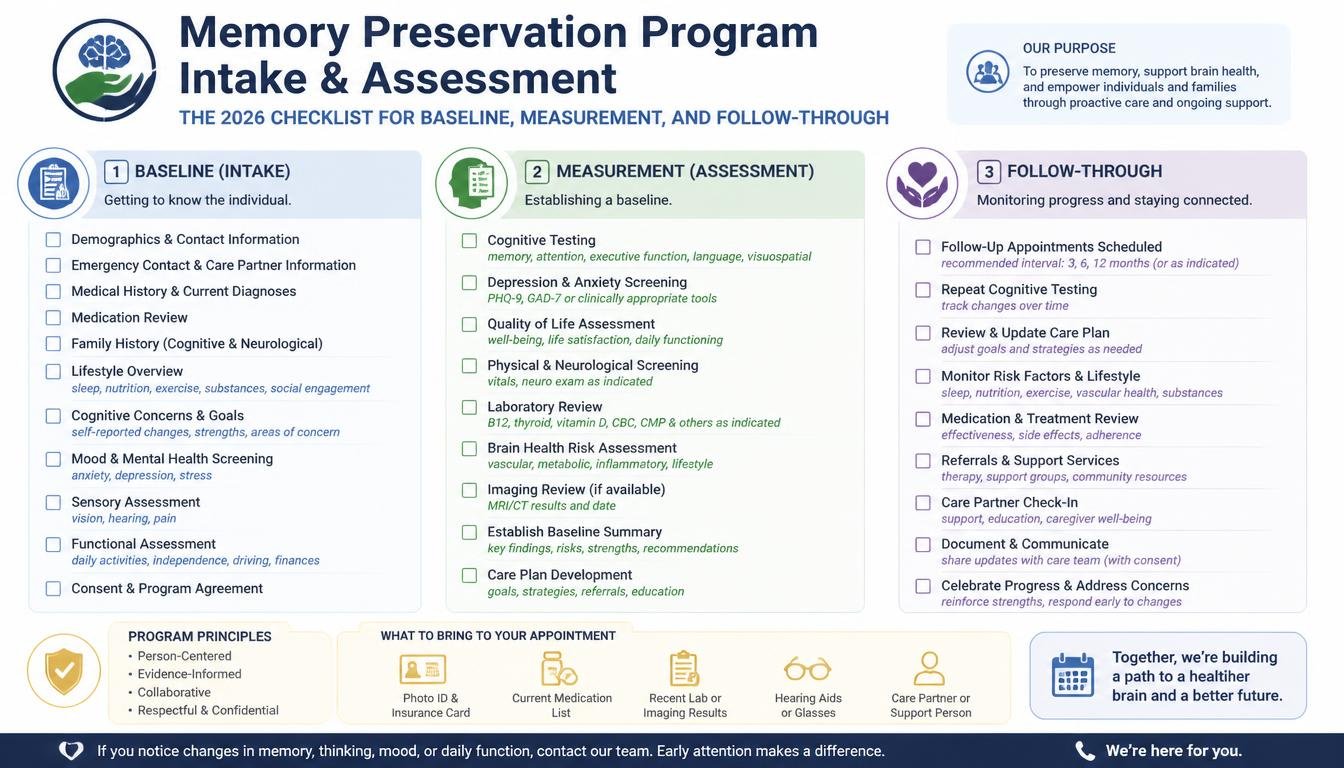
Memory Preservation Program Intake & Assessment matters because more than 7 million Americans are living with Alzheimer’s, and early evaluation changes what we can actually track and improve. In 2026, more people want brain-health guidance that is measurable, not vague, so we focus our intake process on consistent baselines, repeatable testing, and practical next steps.
| What we assess first | Baseline memory and attention using clinically recognizable tools (often MoCA/MMSE crosswalks) so progress is trackable. |
| What intake includes | Eligibility and history screening, structured cognitive training planning, and a dosing approach to reduce “random effort.” |
| What “good” looks like | Repeat measures over time, adaptive challenge, and adherence as part of the protocol. |
| What we exclude | Generic brain apps or unstructured content feeds that do not link training to outcomes. |
| Why biology matters | BDNF priming is treated as a preparation layer before structured work, not as a stand-alone fix. |
| Where people get stuck | They want “top programs” but skip the assessment step. If you start without baselines, you cannot confirm benefit. |
Quick Q&A:
Q: What is memory preservation assessment in 2026?
A: It is intake plus baseline measurement and repeated reassessment so we can confirm whether training changes memory and attention over time.Q: Why do we need repeated measures?
A: Because cognitive change can be subtle, and without longitudinal tracking we cannot tell improvement from day-to-day variability.

Nearly all Americans value brain health, but few know how to maintain it or have discussed it with a doctor.
When we talk about Memory Preservation Program Intake & Assessment, we mean the structured process we use to (1) understand your starting point, (2) determine what type of training your brain can respond to, and (3) track whether change is happening.
In 2026, we see people confuse intake with marketing or sign-up forms. Intake is not a content feed, it is a clinical process with measurable targets, dosing principles, and repeated reassessment.
For a practical breakdown of what belongs and what does not, we align intake with our clinical evidence-based plan to protect recall and focus.
Baseline is the whole point of Memory Preservation Program Intake & Assessment. If we do not establish a starting trajectory, we cannot responsibly say whether the program worked.
Many families ask whether we should use one test or another. In our intake workflow, we focus on repeatable measurement and interpretation, including a MoCA to MMSE crosswalk approach so changes can be followed even when the exact instrument differs.
For the practical mechanics, we use resources like our best cognitive assessment crosswalk (2026) MoCA to MMSE to keep the conversation consistent across measurement styles.
Intake is not only about tests. It is also about the intake interview and how we interpret what people report. In a community-style screening model, subjective memory concerns were tied to a higher failure rate, which means we handle self-reported concerns carefully and consistently.
When we manage Memory Preservation Program Intake & Assessment, we do two things: we respect subjective experience, and we confirm with measurable screening. That balance reduces panic while still treating early signals seriously.
We see many people skip intake conversation and go straight to tools. That can lead to mismatches between a program and the outcomes we need to measure. In practice, intake questions help us choose which baseline and tracking path fits best.
If you want a broader view of how assessment and early signals fit into planning, we also reference our assessment tools for early cognitive thinning.
After intake and baseline, we move from measurement to training. That is where Memory Preservation Program Intake & Assessment becomes more than an evaluation, it becomes a protocol that connects what we measure to what we do next.
Our approach includes structured cognitive training, BDNF priming, adaptive challenge, and real follow-through. We treat BDNF as biology that supports plasticity, not as a magic label.

If you are deciding on the entry point, our Genius Switch page explains the BDNF-centered purpose and why the audio is a primer layer before structured cognitive training.
Assessment does not end after the first evaluation. The goal of Memory Preservation Program Intake & Assessment is to confirm whether training is producing measurable improvement in recall and attention.
In our intake model, we plan reassessment so the story is chronological. That lets us detect when improvement is real, when adaptation is needed, or when the plan should be modified for safety and effectiveness.
This is also why we emphasize measurable outcomes when discussing top options. Our roundup of top memory preservation programs for seniors in 2026 focuses on structural plasticity and measurable results rather than generic brain games.
We often share this context when families ask, “Are we doing the right thing?” In that same 2026 ranking framework, the entry point frequently involves the Genius Switch priming layer, followed by structured work.
When people search for Memory Preservation Program Intake & Assessment, they are often comparing options: assessment tools, training structure, and “what starts first.” In 2026, that comparison usually includes pricing for program layers, and a clear explanation of how intake feeds the plan.
For example, Genius Switch is listed at $39 and is positioned as a priming layer before structured training. Families commonly compare this against memory apps that lack dosing and assessment continuity.
| Intake step | What we do | What you should expect next |
|---|---|---|
| Baseline assessment | Memory and attention measures, interpreted with a crosswalk approach (MoCA/MMSE style tracking) | A measurable starting point and a plan for reassessment |
| Training design | Structured cognitive training with adaptive challenge | Difficulty that adjusts based on your performance |
| BDNF priming | 40Hz gamma audio priming, Genius Switch audio series (price: $39) | Biology-support layer before cognitive training sessions |
| Adherence and follow-through | We build a real follow-through expectation into the protocol | Progress that can be verified, not guessed |
Intake and assessment set the clinical baseline, but memory preservation outcomes are supported by daily input. That is why our intake discussions in 2026 often connect to habits and environmental longevity design, not only brain training sessions.
We do not replace Memory Preservation Program Intake & Assessment with lifestyle advice. Instead, we add lifestyle supports that fit the same outcome goal, improved memory and sustained attention.
To make Memory Preservation Program Intake & Assessment easy to follow, we use a checklist format. You can bring this into your first consultation or use it to evaluate whether a program is built for measurement.
If you want to see how we describe the program-building blocks, we recommend reading our 2026 clinical evidence-based plan, which breaks down components, exclusions, and baseline assessment.
Memory Preservation Program Intake & Assessment is not a single test and it is not a one-time sign-up. In 2026, we treat intake as the measurement foundation that links baseline cognitive assessment to structured cognitive training, BDNF priming, adaptive challenge, and real follow-through.
When we do it this way, families get clarity, clinicians get trackable data, and programs can be adjusted based on outcomes rather than assumptions. If you are building a plan for memory preservation assessment, start with baselines and repeated reassessment, then select training that is designed to produce measurable change.
Memory Preservation Program Intake & Assessment is the structured process where we collect context, establish a baseline for memory and attention, and plan repeat reassessment so we can confirm change over time. General brain training often lacks baseline tracking, dosing logic, and outcome measurement, so it is harder to verify results in 2026.
The MoCA and MMSE crosswalk helps interpret scores across different but related testing styles so repeated tracking stays meaningful. This supports Memory Preservation Program Intake & Assessment by keeping the measurement story consistent while we reassess across time.
In 2026, memory apps are usually not enough because many do not include a clinical baseline, a dosing plan, or repeated reassessment. Memory Preservation Program Intake & Assessment focuses on measurable targets and structured training that can be adapted based on outcomes.
No. In our Memory Preservation Program Intake & Assessment framework, Genius Switch (40Hz gamma audio) is treated as a primer layer that prepares for subsequent structured cognitive training. It is a support tool, not a stand-alone cure, and progress is confirmed through baseline measurement and reassessment.
If concerns align with screening signals, we still confirm with the baseline assessment set and plan longitudinal reassessment. That is how Memory Preservation Program Intake & Assessment reduces uncertainty, because repeated measures show whether change is trending and whether training needs adjustment.
We include follow-through as part of the protocol, not as an afterthought. In Memory Preservation Program Intake & Assessment, adherence is tracked alongside outcomes so we can interpret results correctly and adapt the plan if the training cadence is not being followed.