In 2026, supplement labels are getting better at marketing and worse at truth, and that matters because natural brain boosting is only “natural” if it is actually consistent. One content analysis found that 67% of brain health supplements had at least one ingredient listed on the label that was not actually detected.
| What to focus on | Why it helps | What to do in 2026 |
|---|---|---|
| Clinical dosing | Predictable exposure supports predictable brain signaling. | Pick programs that use baselines, follow-ups, and dosing logic. |
| BDNF priming | Your brain responds better when training is paired with priming. | Look for BDNF-support routines (for example, BrainWave protocols). |
| Task-specific practice | Neuroplasticity needs repetition with an aim. | Use structured exercises, not “random” brain games. |
| Assessment first | Measurement helps you dose changes intelligently. | Use cognitive crosswalks like MoCA to MMSE for planning. |
| “Natural brain boosting” with guardrails | Less guessing, fewer wasted capsules. | Avoid stacking without a plan, especially in 2026. |
| Clinical tools as part of the protocol | Some non-drug tools are “dosed” too (like EEG neurofeedback). | Explore neurofeedback protocols for focus and executive function. |
Want more context? Start with our natural brain boosting solutions overview, then see how we structure training and priming in best supplements for deep work and concentration (2026).
Q: What counts as “natural brain boosting” in 2026?
A: In our framework, it includes lifestyle habits, foods, supplements, and non-invasive training tools designed to support memory and focus, but with real protocol logic instead of random stacking.
Q: Why clinical dosing instead of random supplementation?
A: Because consistent ingredient exposure and session structure support consistent brain signaling and measurable outcomes.
Natural brain boosting has gotten trendy in 2026, and that trend is pulling more people into supplement “stacks” that look good on a label but do not behave reliably in real use. The big issue is that formulation reality often diverges from the story the product tells.
In a content analysis, 67% of brain health supplements had at least one ingredient listed that was not actually detected. That doesn’t just waste money, it breaks the basic assumption behind supplementation, you are paying for a specific exposure pattern.
Here is the part we see most often: people take a few capsules “for memory,” another one “for focus,” and then they wonder why results are inconsistent. They are essentially changing multiple variables at once and using no baseline.
Meanwhile, natural brain boosting solutions, at their best, are designed to support cognitive longevity without pharmaceuticals, but that does not mean they are casual or unstructured. In 2026, the better approach is to treat brain support like training: define the target, define the dosing logic, and track what changes.
When we say “clinical dosing,” we are not saying you need prescription drugs. We mean the same principle clinical care uses: dosing should be defined, time should be structured, and changes should be measurable.
That is why the “natural brain boosting: why clinical dosing beats random supplementation” approach focuses on priming plus attention work. It is not random stacking, it is pairing a BDNF-support context with training so your brain has a more favorable setup to adapt.
On our deep work and concentration approach, we emphasize priming (BDNF support and BrainWave routines), attention work, and integration, not random stacking of whatever is currently trending. In 2026, that matters more than ever because many people are already taking supplements daily, and “more” is not the same as “better.”
If you want a simple example of dosing logic, consider how caffeine and L-theanine are used in many focus protocols, they can help smooth jitters while supporting focus. The point is not the ingredients alone, it is the dose, timing, and pairing with what you are actually trying to improve.
If you want the bigger picture, check our ingredient shortlist that makes sense for deep work and concentration, and look for language that mirrors training design, not “take these and hope.”
One reason “random supplementation” disappoints is timing. Supplements are often treated as background noise, but neuroplasticity is state-dependent. Your brain’s readiness to change is influenced by the context around training.
That is where manifestation manifestation techniques BDNF BrainWave boost brain power naturally ideas can be useful, if they are grounded in real protocol design. We use the “priming” concept, you set up the brain for learning, then you do the learning, then you integrate.
For example, our Genius Switch 40Hz gamma audio is positioned as a gamma-entrainment tool designed to prime BDNF when used with training. In practice, it supports a structure: prime first, train second, measure and adjust after.

Pricing example: Genius Switch 40Hz gamma audio costs $39 in our 2026 deep work and concentration lineup, and it is framed as a priming component rather than a standalone “brain enhancer.”
When you compare that to random supplementation, the difference is simple. Random stacks often change many variables at once, and they do not specify how you should train around the dose. Priming-based protocols tell you how to use the tool with attention work, so the brain gets a clearer “here is when to adapt” cue.
We get it, not everyone wants lab life. The goal in 2026 is to choose natural brain boosting that behaves like a protocol you can follow without guessing.
Here is the checklist we use when evaluating “natural brain boosting” approaches, including supplements and non-invasive training tools.
For cognitive tracking, we often point readers to a standardized framework like MoCA to MMSE conversion and brain power. The practical benefit is planning, you can compare progress in a way that is more consistent over time.
And for neurostimulation-style training, we recommend looking at how sessions are structured, electrode placement or targeting logic, and how sessions are timed. For example, in our best tDCS devices for enhancing learning and focus in 2026, we stress that tDCS is not a standalone fix, sessions typically run 20 to 30 minutes with proper placement and dosing.
People sometimes assume that “clinical dosing” is only for meds. In 2026, we see it just as clearly in brain training design, especially for seniors and stroke recovery, where repetition and structure are non-negotiable.
Our Top Memory Preservation Programs for Seniors in 2026 frames the Genius Switch as a foundation via BDNF activation before training. That is dosing in a training sense: you prep the brain, then you run structured practice.
We also call out that we distinguish research-backed training from casual brain games. That distinction is basically “protocol vs randomness.” If your plan does not specify intensity, repetition, and sequencing, you are not really dosing neuroplasticity.
After stroke, our guidance emphasizes multi-modal exercise, diet, cognitive training, and sleep, and it highlights BDNF priming and attention-support tools as part of a comprehensive longevity protocol.
If you are working on stroke recovery programs, our “how to choose” framing also focuses on baselines, dosing, and multi-modal approaches in How to choose the right stroke rehab program in 2026. That is exactly the clinical dosing mindset applied to neuro rehab.
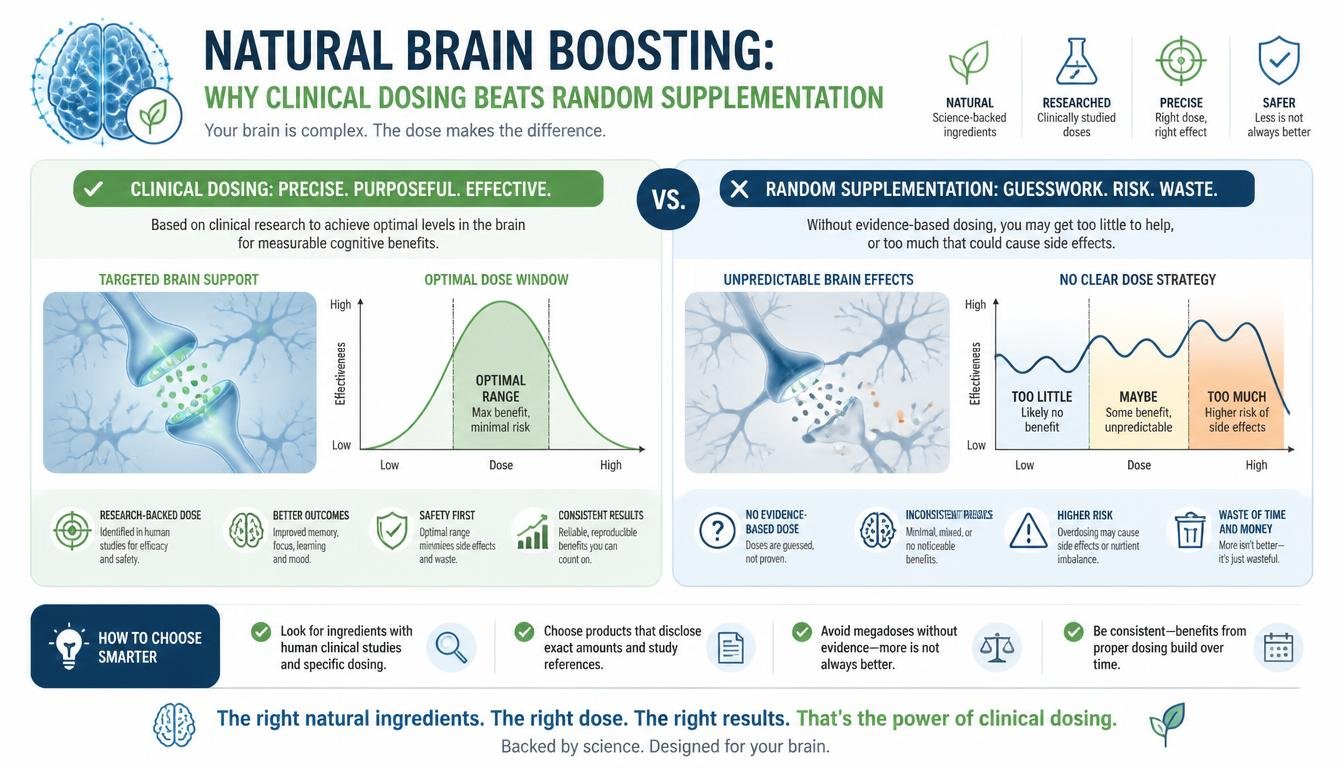
Random supplementation says, “Take it and see.”
Clinical dosing says, “Use a defined dose within a defined plan, then measure and adjust.”
In 2026, we see two extremes. Some people spend hundreds chasing stacks and feel no pattern of improvement. Others under-invest and try to replace structured support with willpower.
Let’s ground this with real pricing examples from our 2026 brain-boosting lineup.
| Protocol component | Price (from 2026 pages) | How it is framed |
|---|---|---|
| Genius Switch 40Hz gamma audio | $39 | BDNF priming with BrainWave timing before training |
| Deep work and concentration ingredient shortlist | Varies by supplement choice | Focus on priming and attention pairing instead of random stacking |
The real “savings” comes from avoiding wasted combinations. If your plan is doseable and measurable, you can stop, adjust, and keep only what works.
Natural brain boosting is not only capsules. In 2026, we increasingly recommend “dosed” non-drug training tools, because brain change often comes from the combination of targeted stimulation and practice.
Take neurofeedback for executive function. Our Neurofeedback Protocols for Focus and Executive Function: The 2026 Cognitive Performance Training Guide explains EEG-based training with real-time feedback to train the brain networks behind focus, planning, and impulse control.
It also emphasizes personalized baselines and ongoing reviews, that is clinical dosing thinking applied to neuro training. If you are trying to boost brain power naturally, structured feedback loops can be more doseable than random supplementation because you can map what changes during sessions.
And if your goals are broader than focus, our training framing extends into executive function support and attention work, not just “brain fog fixes.”

Use measurement, then choose the right tool, and only then decide if supplementation belongs in the plan.
Natural brain boosting: why clinical dosing beats random supplementation comes down to one practical idea, your brain responds best to consistent inputs paired with consistent training. In 2026, the evidence behind brain supplements often fails the “label equals reality” test, and that makes random stacking a risky way to try to boost memory and focus.
We prefer a protocol-based approach, build habits that compound, use priming (including BrainWave routines and BDNF-focused tools), practice with purpose, and track change. If you want manifestation manifestation techniques BDNF BrainWave boost brain power naturally in a way that actually holds up, choose doseable plans, baselines, and follow-ups, not capsule roulette.
Yes, natural brain boosting: why clinical dosing beats random supplementation is especially relevant if you want a non-drug approach. In our framework, it means using lifestyle habits and non-invasive training with dosing logic, baselines, and follow-ups so your efforts are consistent, not random.
Because the plan often has no dosing structure and no measurement, and in 2026 labels do not always match what is detected. That is why natural brain boosting: why clinical dosing beats random supplementation matters, you need consistent exposure and a training context your brain can actually adapt to.
BDNF priming is most useful when it is paired with attention work and structured practice. The “clinical dosing” part is timing and sequencing, which is the core of natural brain boosting: why clinical dosing beats random supplementation, including manifestation manifestation techniques BDNF BrainWave boost brain power naturally style routines.
We recommend treating BrainWave protocols as the priming layer and keeping supplementation minimal and purposeful. That lines up with natural brain boosting: why clinical dosing beats random supplementation, you dose the overall protocol, not just individual capsules.
They can be a practical way to plan progress if you use a consistent crosswalk. Using natural brain boosting: why clinical dosing beats random supplementation principles, baseline and reassessment help you adjust the plan instead of guessing.
Neurofeedback (EEG-based) and other non-invasive training can fit well when they are structured and dosed with baselines and review. That directly supports natural brain boosting: why clinical dosing beats random supplementation, because feedback and session structure are measurable inputs, not random additions.