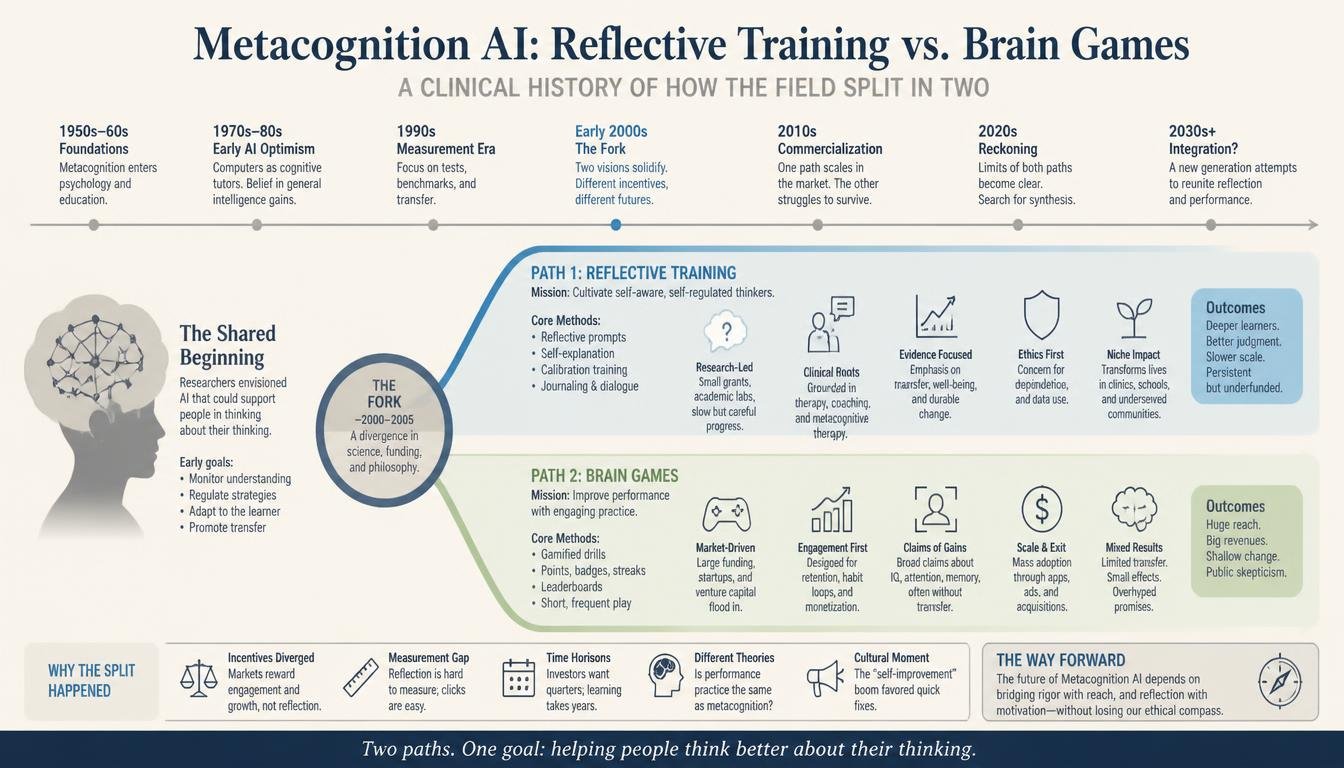
Metacognition AI: Reflective Training vs. Brain Games is not a new debate, but it is one the research finally caught up to in 2026. The wearable EEG headsets now used in serious reflective training protocols hold a charge for up to two weeks in standby mode, a detail that sounds trivial until you realize it means clinicians can track a client’s cognitive baseline continuously instead of guessing from a single office visit.
That shift, from guessing to measuring, is the entire history of this field in one sentence.
The consumer brain-game industry was built on a simple pitch: play a puzzle daily, keep your mind “sharp.” It was never built on a clinical premise.
Static difficulty, predictable puzzles, and passive scrolling through trivia don’t meet the threshold your brain actually needs to change. That threshold is not effort. It is intensity delivered at the edge of current ability, repeated with enough dosing to matter.
Brain games gamified attention. They did not train it.
Metacognition AI did not appear overnight. It grew out of decades of neuro-rehabilitation research on stroke and traumatic brain injury, where clinicians already knew that self-monitoring, catching your own error, adjusting your own strategy mid-task, drives recovery faster than passive repetition alone.
What changed in 2026 is that this insight left the clinic. Consumer-grade systems started asking users not just to respond, but to reflect on their own response accuracy and confidence in real time.
That reflective loop is the entire distinction between Metacognition AI: Reflective Training vs. Brain Games. One asks you to react. The other asks you to think about your thinking while you react.

Wearable neuro-tech specs enabling reflective training to outperform standard brain games.
We treat Brain-Derived Neurotrophic Factor as your brain’s repair protein, supported by training, movement, and lifestyle. It is the single biological marker that separates rigorous cognitive work from entertainment.
Brain games rarely mention BDNF because they were not designed around it. Reflective training protocols, by contrast, are frequently built to prime BDNF release first, then layer cognitive demand on top.
Our technology-based botanical nootropics content covers how gamma-frequency entrainment and BDNF priming can complement, not replace, structured reflective practice.


Here is how the two models actually compare once you strip out the marketing copy.
| Feature | Consumer Brain Games | Metacognition AI / Reflective Training |
|---|---|---|
| Difficulty scaling | Static or loosely adaptive | Adjusted to the edge of current ability |
| Self-monitoring component | Rarely present | Central to every session |
| Biological target | Not defined | BDNF and structural plasticity |
| Dosing approach | Unlimited, unstructured play | Rigorous dosing principles (frequency, intensity, duration) |
| Clinical grounding | Marketing-driven claims | Published research, adapted per individual |
| Best suited for | Casual entertainment | Cognitive longevity, executive function, neuro-rehabilitation |
You need measurable progress, not vibes. That table is the whole argument in six rows.
Reflective training did not start with executives chasing an edge. It started in stroke recovery, where high-repetition, task-specific exercises proved that repetition alone is not enough without feedback and self-correction built in.
Modern neuro-rehabilitation is no longer guesswork; it is a measurable process built on rigorous evidence, clear dosing principles, and real follow-through. That principle now guides how clinicians help families evaluate options when choosing the right stroke rehab program, and it is the same principle now showing up in consumer Metacognition AI apps.
The lineage is direct. Clinical reflective practice migrated into consumer tech, and brain games got left behind because they never had a lineage to begin with.
Reflective training protocols increasingly rely on hardware that can actually measure what is happening in the brain, not just track how many puzzles you finished.
Our 2026 guide to professional-grade EEG headsets breaks down which units actually meet clinical measurement standards versus which ones are consumer-grade wellness gadgets with a neuroscience-sounding name.
The specialized web-based cognitive systems that show strong clinical results, whether paired with tDCS, EEG feedback, or vagus nerve stimulation, are built around a fundamentally different design philosophy: make it scientifically rigorous first, then make it accessible.
Leadership research is where the reflective training model finally proved its case outside of injury recovery. Our piece on managing cognitive continuity in high-stakes leadership lays out why executives need self-monitoring under pressure, not entertainment during downtime.
A brain game asks you to react quickly. A reflective protocol asks you to notice your own decision fatigue before it costs you a bad call in a board meeting.
That distinction is exactly why Metacognition AI: Reflective Training vs. Brain Games is not a semantic argument. It is a functional one, with real consequences for people making decisions under pressure.
Reflective training does not exist in isolation from the rest of a person’s biology. Sleep, exercise, and environment all shape whether BDNF production and structural plasticity actually take hold.
Our environmental longevity and preventive lifestyle design research covers how the physical spaces people live and train in either support or sabotage cognitive gains.
This is also where the myths need clearing up. Our breakdown of memory decline myths vs. reality addresses the persistent belief that decline is inevitable, a belief that brain-game marketing has quietly exploited for years.
Not every product marketed as “brain training” belongs in the same category. Our roundup of brain training technologies for memory, focus, and real neuroplastic change was written specifically to separate rigorous tools from passive apps riding the same shelf space.
We apply the same filter to home recovery equipment. Our list of home-based neuroplasticity tools for stroke survivors only includes devices with a measurable dosing rationale behind them.

Neuroplasticity Solutions grew out of a frustration shared by clinicians, researchers, and clients alike: the gap between what published research says works and what the unregulated consumer market actually sells. Metacognition AI closed part of that gap by borrowing reflective techniques straight out of neuro-rehabilitation and putting them into daily-use tools.
Preventive strategies, from supervised training environments to structured retreats like the ones covered in our Blue Zone-inspired retreat guide, are increasingly built around this same reflective model instead of the old brain-game format.
The direction of the field is clear even if the marketing hasn’t caught up yet. Our full preventative longevity resources reflect that shift toward rigor over novelty.
The history of Metacognition AI: Reflective Training vs. Brain Games is really a history of two different questions. Brain games asked, “How do we keep someone engaged?” Reflective training asked, “How do we produce measurable change in the brain?”
Those are not the same question, and they never produced the same results. Evidence over enthusiasm remains the deciding line between the two, and 2026 is the year that line finally became visible to the average consumer, not just to clinicians in a rehab setting.
Yes, when the metacognition AI system is built around dosing principles and BDNF-supporting protocols rather than static puzzles. Brain games optimize for engagement, while reflective training optimizes for measurable structural change.
Reflective training means the user actively monitors their own accuracy, confidence, and strategy during a task, rather than just reacting to prompts. This self-monitoring loop is what separates clinical-grade cognitive work from passive brain games.
Brain games can offer casual entertainment, but they are not a substitute for evidence-based reflective training if your goal is real cognitive longevity or recovery. Static difficulty and passive scrolling through trivia rarely reach the intensity threshold needed for structural plasticity.
BDNF acts as the brain’s repair protein, and reflective training protocols are frequently designed to prime BDNF release before layering cognitive demand on top. Most consumer brain games are not designed with BDNF as a target at all.
Reflective training techniques originated largely in neuro-rehabilitation settings for stroke and traumatic brain injury recovery, where self-correction during high-repetition exercises proved essential. Many consumer Metacognition AI apps borrow directly from these clinical protocols.
Home-based EEG headsets, tDCS devices, and vagus nerve stimulation wearables are increasingly used to support reflective training with real physiological feedback. Not all hardware on the market meets clinical measurement standards, so checking the underlying research behind a device matters more than its marketing claims.
Yes, executive function research shows that leaders under sustained high-stakes pressure benefit specifically from self-monitoring protocols rather than casual brain games. Metacognition AI: Reflective Training vs. Brain Games becomes a practical distinction for professionals, not just an academic one, when decision fatigue has real consequences.