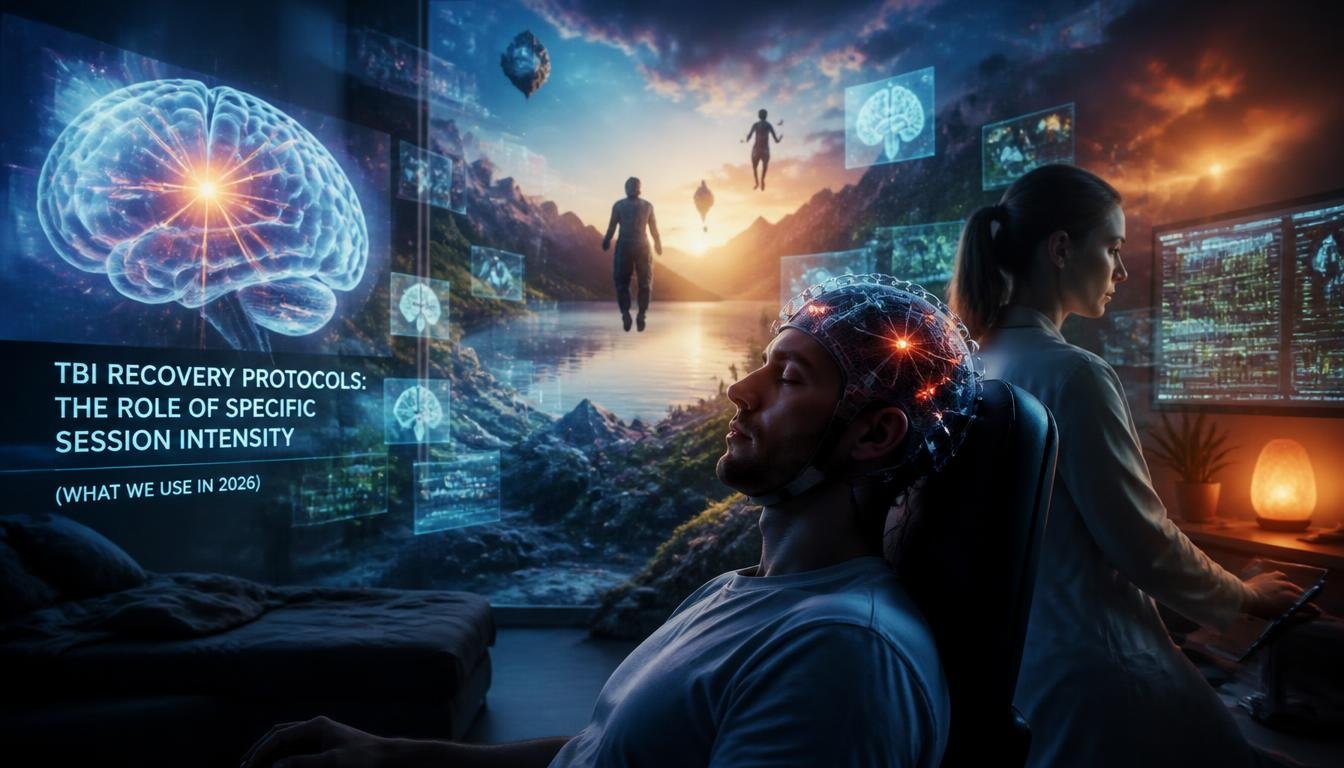
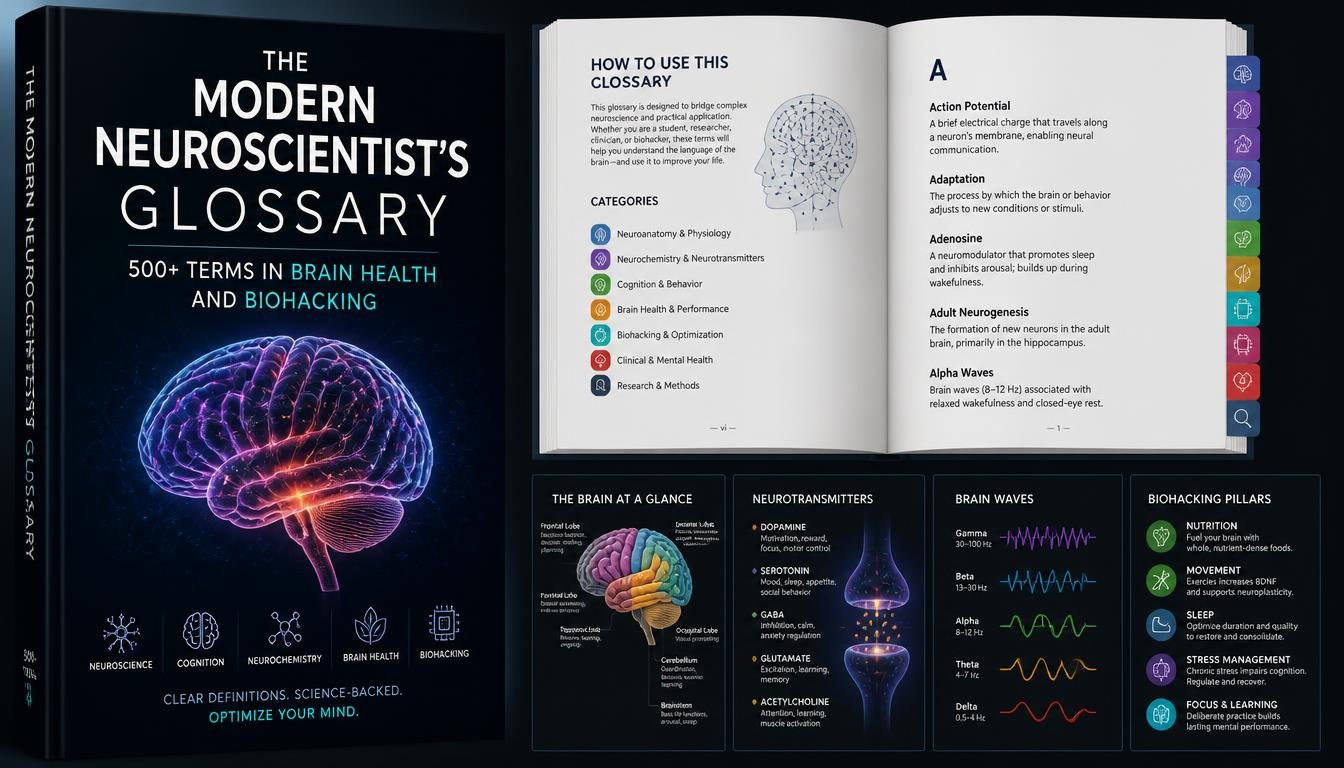
The Modern Neuroscientist’s Glossary
A definitive guide to 500+ terms in Brain Health, Biohacking, and Neuro-rehabilitation. From Long-Term Potentiation to the cutting-edge of 2026 Connectomics.

Evidence-Based Precision
At Neuroplasticity Solutions, we move beyond the “manifestation” hype. We believe the brain you have today is not the brain you are stuck with, but changing it requires more than vague coaching—it requires specific dosing principles and measurable training thresholds.
This glossary provides the clinical and technical foundation for understanding how structural plasticity is driven. Whether you are navigating neurological recovery or seeking cognitive longevity, these definitions clarify the mechanisms that translate biology into results.
A
The sixth cranial nerve responsible for the outward movement of the eye by controlling the lateral rectus muscle.
Context: Vital in evaluating brainstem function and sensory-motor integration after head injuries.
A primary neurotransmitter involved in memory, learning, and muscle activation.
Context: A key target for those using supplements for deep work.
An electrical impulse that travels down an axon, allowing neurons to communicate with one another.
Software-based protocols that automatically adjust difficulty in real-time to keep the user at the “edge of ability.”
Context: Essential for effective neuroplasticity results.
B
A protein that acts as “fertilizer” for the brain, supporting the survival of existing neurons and encouraging the growth of new ones.
Context: We treat BDNF as a primary clinical target in all recovery protocols.
The practice of using science, biology, and self-experimentation to take control of and upgrade your body, mind, and life.
A highly selective semipermeable border that prevents solutes in the circulating blood from non-selectively crossing into the extracellular fluid of the central nervous system.
C
The maintenance of cognitive health and function throughout the lifespan, focusing on neuroprotective strategies.
Context: This is the core goal of memory preservation programs for seniors.
The field of study concerned with mapping and analyzing the “connectome”—the comprehensive map of connections within the nervous system.
A rehabilitation technique where the unaffected limb is constrained, forcing the use of the affected limb to rewire motor pathways.
Context: Often compared against mirror therapy in stroke recovery.
D
The process by which neurons sprout new projections (dendrites) to create more synaptic connections.
Specific parameters (intensity, frequency, duration) required for a stimulus to trigger structural brain changes.
Context: Critical for avoiding the “randomness” of casual brain games.
E
Mathematical models that estimate “biological brain age” based on DNA methylation patterns.
Context: Learn more about brain age vs. birth age.
A set of cognitive processes including working memory, flexible thinking, and self-control.
Context: Targeted through neurofeedback protocols.
F
The part of the brain responsible for high-level cognitive functions, decision making, and personality.
The temporal correlation between spatially remote neurophysiological events, indicating how well different brain regions work together.
G
High-frequency brainwaves associated with high-level information processing and focus.
Context: Often used in light and sound therapy for cognitive stimulation.
Non-neuronal cells that maintain homeostasis, form myelin, and provide support and protection for neurons.
H
A complex brain structure embedded deep into temporal lobe, essential for learning and memory.
The state of steady internal physical and chemical conditions maintained by living systems.
L
A persistent strengthening of synapses based on recent patterns of activity; the cellular basis for learning and memory.
The muscle that moves the eye away from the nose, controlled by the abducens nerve.
M
The process by which a temporary, labile memory is transformed into a stable, long-term form.
Context: Directly affected in age-related memory decline.
An insulating layer, or sheath that forms around nerves, allowing electrical impulses to transmit quickly and efficiently.
N
A type of biofeedback that uses real-time displays of brain activity—most commonly EEG—to teach self-regulation of brain function.
The ability of the brain to form and reorganize synaptic connections, especially in response to learning or experience or following injury.
A population of neurons interconnected by synapses to carry out a specific function when activated.
O
A biological technique that involves the use of light to control neurons that have been genetically modified to express light-sensitive ion channels.
The visual processing center of the mammalian brain.
P
A complex disorder in which various symptoms—such as headaches and dizziness—last for weeks and sometimes months after the injury.
Context: Treated using targeted athletic recovery protocols.
The cerebral cortex which covers the front part of the frontal lobe, implicated in planning complex cognitive behavior and decision making.
R
The clinical philosophy of using targeted stimulus to trigger the production of neurotrophic factors (like BDNF) to repair neural tissue.
A measurable metric of the brain’s ability to withstand or recover from stress or pathology.
Context: Check your Brain Resilience Score.
S
A viral trend regarding earth’s resonance; often misapplied to neuroscience.
Context: We separate this from the actual science of coherence.
The process by which the nervous system integrates information from the senses to produce a motor response.
Context: Vital for head injury rehabilitation.
The natural process by which the brain eliminates extra synapses to increase the efficiency of neuronal transmissions.
T
A form of neuromodulation that uses constant, low direct current delivered via electrodes on the head.
Context: Frequently used as a “brake pedal” for emotional reactivity.
Disruption in the normal function of the brain that can be caused by a bump, blow, or jolt to the head.
Context: Recovery often involves targeted cognitive training.
V
The longest cranial nerve, which controls the parasympathetic nervous system and regulates heart rate and digestion.
Context: Essential for burnout recovery and autonomic hygiene.
A term describing the synchronized activity of neurons across different brain networks, often in response to specific rhythms.
Frequently Asked Questions
Why do these definitions matter for my recovery?
Understanding terms like “Long-Term Potentiation” and “Dosing Principles” helps you recognize why intensity matters. Without the right dose, training is just a game; with it, it is a clinical intervention.
Is biohacking the same as neuro-rehabilitation?
While they overlap, biohacking often focuses on optimizing a healthy brain, whereas neuro-rehabilitation focuses on restoring function after an injury or decline. Both rely on the same fundamental mechanism: neuroplasticity.
Can I measure my brain age using these terms?
Yes. By understanding “Epigenetic Brain Clocks” and using specific assessment tools, you can establish a baseline and track how your biological brain age responds to training protocols.
Ready for a Structured Protocol?
Don’t settle for “vibes.” Get a measurable, clinically-grounded plan for your cognitive future.