2026 Consumer Neuro-Tech Comparison: tDCS, Neurofeedback, and Photobiomodulation
Evidence-based evaluation of the most effective neuromodulation technologies for structural plasticity, cognitive longevity, and neurological recovery.
In 2026, the boundary between “mental wellness” and clinical-grade brain intervention has effectively dissolved. The rise of sophisticated consumer hardware has replaced the era of casual brain games with high-performance neuromodulation—tools designed not just to entertain, but to drive measurable structural changes in the brain. At Neuroplasticity Solutions, we move beyond the “vibes” of early-stage neuro-tech to focus on clear dosing principles and objective benchmarks.
Navigating this landscape requires understanding the three pillars of home-based neuro-optimization: Transcranial Direct Current Stimulation (tDCS), EEG-based Neurofeedback, and Photobiomodulation (PBM). This comparison evaluates each modality’s efficacy, clinical standing, and application for those seeking real neurological progress in 2026.

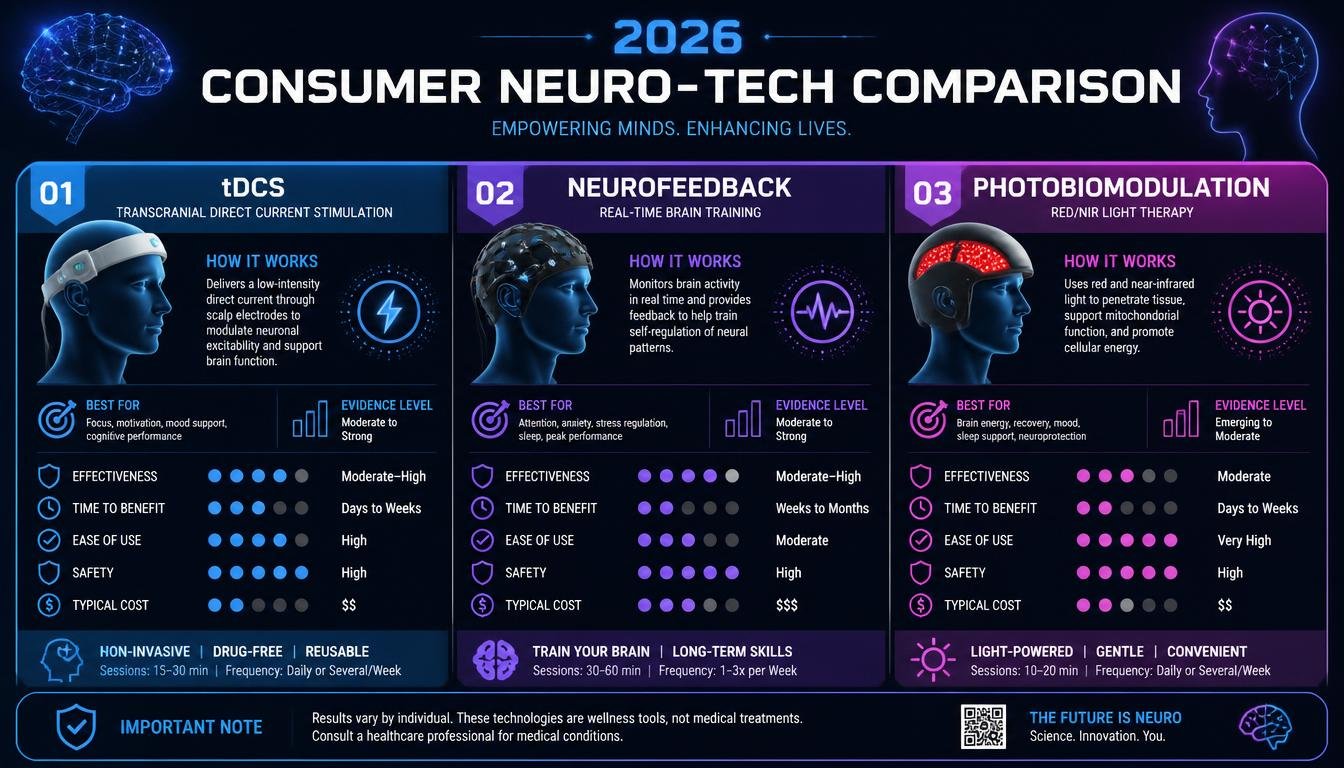
2026 Data Comparison Matrix
| Feature | Neurofeedback (EEG) | tDCS (Modulation) | Photobiomodulation (PBM) |
|---|---|---|---|
| Primary Mechanism | Real-time feedback for self-regulation of brainwaves. | Low-level electrical currents to shift neuronal excitability. | Near-infrared light to stimulate mitochondrial ATP production. |
| Clinical Evidence | High (Strongest for ADHD, Anxiety, and Peak Performance). | High (Strongest for Depression, Focus, and Pain). | Emerging (Strong for Inflammation and Cellular Repair). |
| FDA Status | Varies (Many devices “Cleared” for wellness or specific adjuncts). | Cleared for certain conditions; “Off-label” common for focus. | Generally Class II Medical Devices for pain/healing. |
| Complexity | High: Requires learning to interpret signals and maintain focus. | Medium: Requires specific electrode placement (montages). | Low: Often “wear and go” with set timers. |
| Target Outcome | Improved executive function and state control. | Enhanced learning speed and emotional reactivity control. | Neural recovery, priming, and metabolic support. |
| Cost-to-Benefit | High investment; durable long-term results. | Moderate investment; immediate but transient effects initially. | Moderate investment; best as a cumulative “primer.” |
1. Neurofeedback: The “Active” Training Model
Neurofeedback is the ultimate bio-hacking tool for self-regulation. By measuring your brain’s electrical activity (EEG) and feeding it back to you through audio or visual cues, your brain learns to reward itself for entering desired states. In 2026, we see a massive shift toward “Hybrid Wearables” that combine EEG with fNIRS to provide a more comprehensive view of executive function health.
Unlike passive technologies, neurofeedback requires the user’s active participation. This creates a “training dose” that challenges the brain to reorganize itself. It is particularly effective for those looking to address executive function deficits and long-term cognitive resilience.
- Executive decision making
- Sustained attention and ADHD management
- Long-term structural plasticity
- Significant time commitment per session
- Requires consistent motivation
2. tDCS: The “Modulatory” Accelerant
Transcranial Direct Current Stimulation (tDCS) does not force neurons to fire; instead, it changes the “resting membrane potential,” making it easier or harder for neurons to fire. This is often referred to as the “brake pedal effect” when used for emotional reactivity or a “turbo charge” for learning.
In the context of 2026, tDCS is favored by high-performers for its ability to lower the threshold for new skill acquisition. It is frequently applied in learning and focus protocols where rapid progress is required.
- Rapid skill acquisition
- Reducing emotional reactivity
- Adjunct to physical stroke rehab
- Incorrect placement can lead to unintended effects
- Mild skin tingling or irritation is common
3. Photobiomodulation (PBM): The “Cellular” Foundation
PBM uses near-infrared light to penetrate the skull and reach the cortical tissue. The mechanism is purely metabolic: it stimulates the cytochrome c oxidase in the mitochondria, increasing ATP (energy) production. This is the ultimate “primer.” Without cellular energy, the brain cannot sustain the metabolic demands of structural plasticity.
In 2026, PBM is increasingly used in neurological recovery protocols to reduce inflammation and support the “repair-protein approach” (BDNF) that Neuroplasticity Solutions champions. It is also a key component in protocols targeting 40Hz Gamma brainwaves for cognitive preservation.
- Reducing neural inflammation
- Priming for other training (tDCS/Neurofeedback)
- Post-concussion and recovery support
- Results are often subtle and cumulative
- Requires high-quality hardware to ensure skull penetration
Methodology: How We Evaluate Neuro-Tech
At Neuroplasticity Solutions, we reject “internet vibes” in favor of mechanism-based training. When comparing these technologies for neurological recovery or cognitive longevity, we use three primary clinical thresholds:
- Specificity: Does the technology target the specific functional system (e.g., motor cortex vs. prefrontal cortex) required for the goal?
- Intensity: Is the stimulus strong enough to drive Brain-Derived Neurotrophic Factor (BDNF) production and structural change?
- Repeatability: Can the protocol be replicated with high fidelity to ensure objective benchmarks are met?
For those recovering from specific injuries, such as stroke or TBI, these tools must be integrated into broader frameworks like evidence-based motor recovery or targeted cognitive training for TBI.
Frequently Asked Questions
In 2026, high-end consumer hardware often uses the same sensors and stimulators as clinical units. The difference lies in the protocol. Professional guidance is recommended to set the correct dosing principles for maximum efficacy.
Yes. In fact, many high-performance protocols suggest using tDCS to prime the brain into a “plastic” state before engaging in the active effort of neurofeedback.
Research (PMC7253802) indicates that while immediate state changes occur, sustained structural benefits typically require 8 to 12 weeks of consistent training. We track this through brain resilience scores and objective reporting.
PBM is non-invasive and has a very high safety profile. However, those with photosensitivity or specific neurological conditions should consult a professional. It is frequently used for mitigating memory decline mechanisms due to its support of cellular health.
Ready for a Protocol, Not a Mood?
Stop guessing with casual brain games. Our evidence-based neuroplasticity solutions provide the structured, clinical-grade training you need for recovery and longevity.
The brain you have today is not the brain you are stuck with.