Did you know that patients using the Vivistim Paired VNS System generate two to three times the amount of hand and arm function compared to standard rehabilitation alone? That is the kind of breakthrough that makes neuroplasticity after stroke one of the most exciting areas of clinical neuroscience today. We are living in a time where the brain’s ability to rewire itself is not just a theory but a measurable, trainable reality, and the tools available in 2026 are better than ever.
| Question | Answer |
|---|---|
| What is neuroplasticity after stroke? | It is the brain’s ability to reorganize and form new neural connections to compensate for damage caused by a stroke, driven by repetitive, intensive practice. |
| How long does it take to see results? | Recovery varies, but the critical window for maximum neuroplastic change starts within the first few weeks. However, gains can continue for years with consistent, dose-controlled training. |
| What tools work best at home? | BDNF-targeted audio training, guided neuro rehabilitation protocols, and attention-control tools form the backbone of a practical home rehab stack. Explore home-based neuroplasticity tools for stroke survivors for detailed picks. |
| Is BDNF really that important? | Yes. Brain-Derived Neurotrophic Factor (BDNF) is a central target in most effective neuro rehabilitation protocols because it supports the growth and survival of new neurons. |
| Can cognitive function recover too? | Absolutely. Post-stroke cognitive recovery is achievable with multimodal interventions targeting memory, attention, and processing speed. See our post-stroke cognitive longevity strategies for more. |
| What is the role of repetition? | High-intensity repetition is the dose that drives rewiring. Sessions often involve 300 to 400 repetitions of functional tasks to trigger meaningful neuroplastic change. |
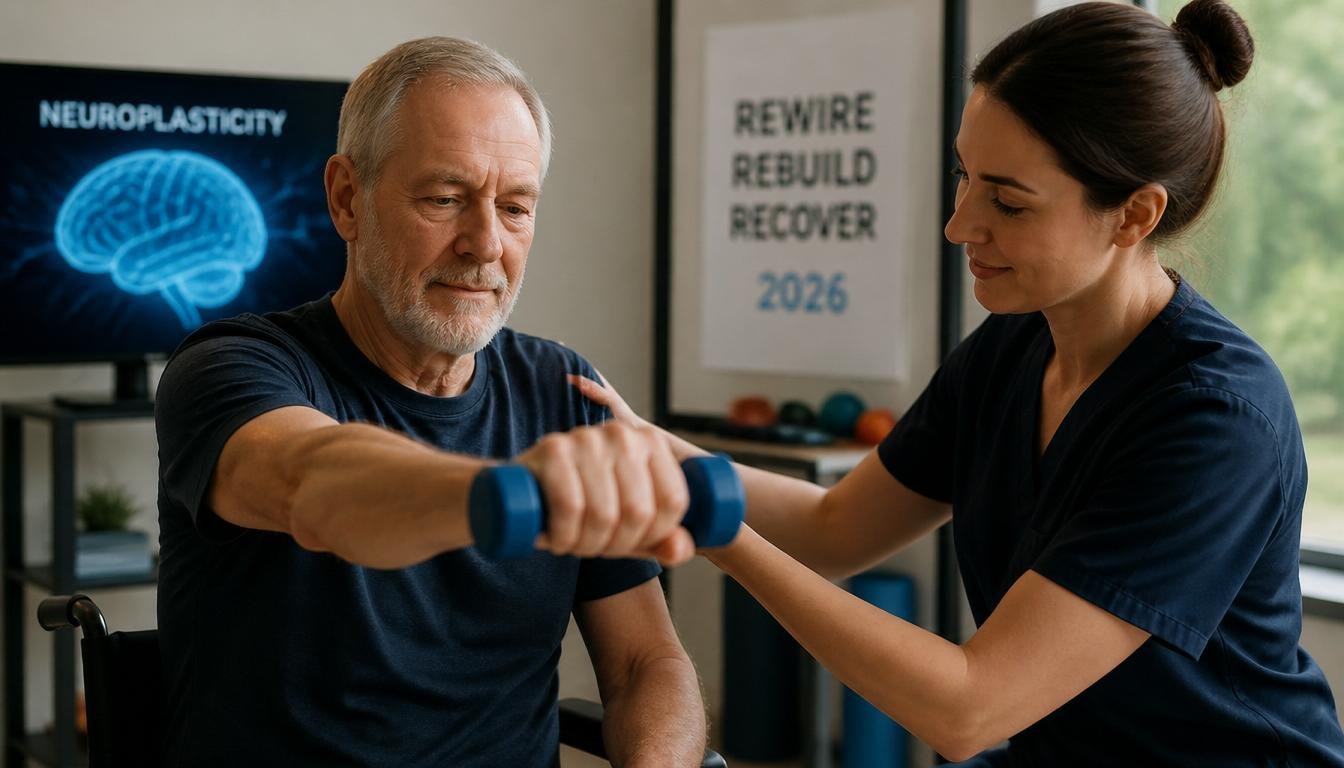
Neuroplasticity after stroke refers to the brain’s remarkable capacity to reorganize itself by forming new neural pathways. When a stroke damages part of the brain, surrounding areas can sometimes take over the functions that were lost.
This is not automatic. It requires deliberate, repetitive, and intensive practice to convince the brain that reorganization is necessary. The concept is simple: neurons that fire together, wire together.
In 2026, we understand that neuroplasticity after stroke is driven by three key factors: dose (how much practice), intensity (how challenging), and specificity (how relevant the task is to daily life). Without all three, the brain has no reason to rewire.
This is where many recovery programs fall short. They provide activity without enough dose or intensity to trigger actual neural change. The gap between discharge and real recovery is wider than most people realize, and bridging it requires a structured approach grounded in neuroscience.
Understanding BDNF (Brain-Derived Neurotrophic Factor) is also essential here. BDNF is a protein that supports the survival and growth of neurons. When you engage in manifestation techniques that involve focused, repetitive mental practice, you are essentially creating the conditions for BDNF release. This is not about wishful thinking but about directing sustained attention toward specific motor and cognitive goals.

Not everyone has access to a world-class rehab facility. That is why neuroplasticity after stroke at home has become a major focus in 2026. The right home-based tools can deliver dose-controlled, measurable progress without requiring daily clinic visits.
Here are the best categories of home tools we recommend:

The key with any home tool is tracking outcomes. You need baseline measurements and repeat testing to confirm that what you are doing is actually working. Without data, you are just hoping.
If neuroplasticity after stroke has a master switch, BDNF is it. Brain-Derived Neurotrophic Factor is a protein that acts like fertilizer for your neurons, promoting their growth, survival, and ability to form new connections.
When BDNF levels are high, the brain is primed for learning and adaptation. When they are low, recovery stalls. This is why so much of modern neuro rehabilitation in 2026 is designed around boosting BDNF.
There are several ways to boost brain power naturally and increase BDNF levels:

We often recommend pairing BDNF-targeted audio with active rehabilitation exercises. The audio primes the brain, and the exercises capitalize on that primed state. Think of it as warming up the soil before planting seeds.
For many stroke survivors, the best outcomes come from combining home tools with professional services. Finding the right neuroplasticity after stroke program locally can make a massive difference in motor recovery.
A structured, neuroplasticity-based rehabilitation plan is most effective when it begins within the critical early window. This plan should include clear dosing, intensity targets, and measurable progress markers.
Technologies such as neurofeedback, tDCS (transcranial direct current stimulation), and other neuromodulation tools are increasingly used to accelerate motor recovery in local rehab programs. These tools enhance the brain’s readiness to learn during therapy sessions.
When evaluating local services, look for programs that:
You can learn more about finding the right services in our guide to stroke rehabilitation services for restoring motor skills.
Recovery from stroke is not just physical. The mental side matters enormously, and techniques that combine focused intention with brainwave entrainment can support neuroplasticity after stroke in powerful ways.
Let us be clear: we are not talking about manifestation in the “think it and it appears” sense. We are talking about using sustained, focused mental practice to engage specific neural circuits. When you vividly imagine performing a motor task, your brain activates many of the same pathways as actually doing it.
This is where manifestation techniques meet neuroscience. The process looks like this:
This combination of mental and physical practice is one of the most effective ways to boost brain power naturally and drive real neuroplastic change. The BDNF release from gamma audio entrainment makes the brain more receptive to the rewiring that follows.

Not all rehabilitation approaches are created equal. When it comes to neuroplasticity after stroke, some modalities have far stronger evidence than others. Here is what the research actually supports in 2026.
CIMT restricts the unaffected limb to force use of the affected one. This creates intense, repetitive practice that drives neuroplastic change. It is one of the most evidence-supported approaches for upper extremity recovery.
Mirror therapy uses a mirror to create the illusion that the affected limb is moving normally. This visual feedback can activate motor circuits in the brain even when the affected limb has limited movement.
The Vivistim Paired VNS System pairs vagus nerve stimulation with rehabilitation exercises. As we mentioned earlier, this approach generates two to three times the hand and arm function improvement compared to standard rehab alone.
tDCS and rTMS are increasingly used alongside conventional therapy. These tools modulate cortical excitability, making the brain more responsive to rehabilitation.
This is where tools like the Genius Switch come in. By stimulating BrainWave activity at the gamma frequency, this approach promotes BDNF release and primes the brain for learning. It is an affordable, accessible addition to any rehab stack at just $39.

Driving neuroplasticity after stroke requires high-intensity repetition.
The best approach is rarely a single modality. It is a combination tailored to the individual’s specific deficits, timeline, and goals. You can explore our full breakdown of neuro rehabilitation approaches for more detail.
Motor recovery gets most of the attention, but cognitive recovery is equally important. Post-stroke cognitive decline affects memory, attention, processing speed, and executive function. Without intervention, these deficits can worsen over time.
The good news is that neuroplasticity after stroke applies to cognitive function just as much as motor function. The same principles of dose, intensity, and specificity apply. The difference is the type of tasks you practice.
Effective cognitive longevity strategies include:
We cover this topic in depth in our cognitive performance resources. The key takeaway is that cognitive longevity after stroke is achievable, but only with deliberate, sustained effort.
For those looking to boost brain power naturally over the long haul, combining cognitive training with BDNF-supporting practices is the most evidence-aligned approach available in 2026.
Neuroplasticity after stroke is not a passive process that happens on its own. It requires deliberate, intensive, repetitive practice paired with tools that prime the brain for change. Whether you are using BDNF-targeted audio like the Genius Switch, working with professional rehabilitation services, or building a home-based training stack, the principles are the same.
Dose matters. Intensity matters. Specificity matters. And BDNF is the biological engine that makes it all possible.
The tools and strategies available in 2026 give stroke survivors more options than ever before. From vagus nerve stimulation that triples motor recovery to gamma audio entrainment that costs less than $40, the barriers to effective neuroplasticity after stroke are lower than they have ever been.
But tools alone are not enough. You need a plan, you need consistency, and you need measurable outcomes to know it is working. That is how you turn neuroplasticity from a concept into real recovery.
Neuroplasticity after stroke does not have a hard expiration date. While the first few months offer the greatest window for change, the brain remains capable of rewiring for years with consistent, dose-controlled practice. The key is maintaining intensity and specificity over time.
The best home tool depends on your specific goals, but BDNF-targeted audio like the Genius Switch ($39) is one of the most accessible and effective options. It primes the brain for motor and cognitive learning by stimulating BDNF through 40Hz gamma entrainment, which you can pair with any rehab exercise.
Yes. You can boost brain power naturally through aerobic exercise, focused mental practice using manifestation techniques, quality sleep, and affordable tools like gamma audio entrainment. The combination of these approaches supports BDNF production and creates the conditions for neuroplasticity after stroke without requiring clinical-grade equipment.
BDNF is central to most effective neuro rehabilitation protocols in 2026. It supports the growth and survival of new neurons, making the brain more receptive to the rewiring that rehabilitation exercises aim to achieve. Without adequate BDNF, neuroplasticity after stroke is significantly slower.
Yes, though the extent of recovery varies. Research involving 500 stroke survivors showed that undamaged parts of the brain can rejuvenate to compensate for stroke damage. Even in severe cases, structured, intensive rehabilitation can drive meaningful neuroplastic change, though expectations should be calibrated with your clinical team.
Evidence suggests that 300 to 400 repetitions of functional tasks per 90-minute session is the dose that drives meaningful neuroplasticity after stroke. This level of intensity is what separates effective rehabilitation from activity that looks productive but does not produce neural change.
Constraint-induced movement therapy forces use of the affected limb by restricting the unaffected one, creating intense repetitive practice. Mirror therapy uses visual feedback to trick the brain into seeing the affected limb move normally. Both can drive neuroplasticity after stroke, but CIMT has stronger evidence for upper extremity motor recovery.