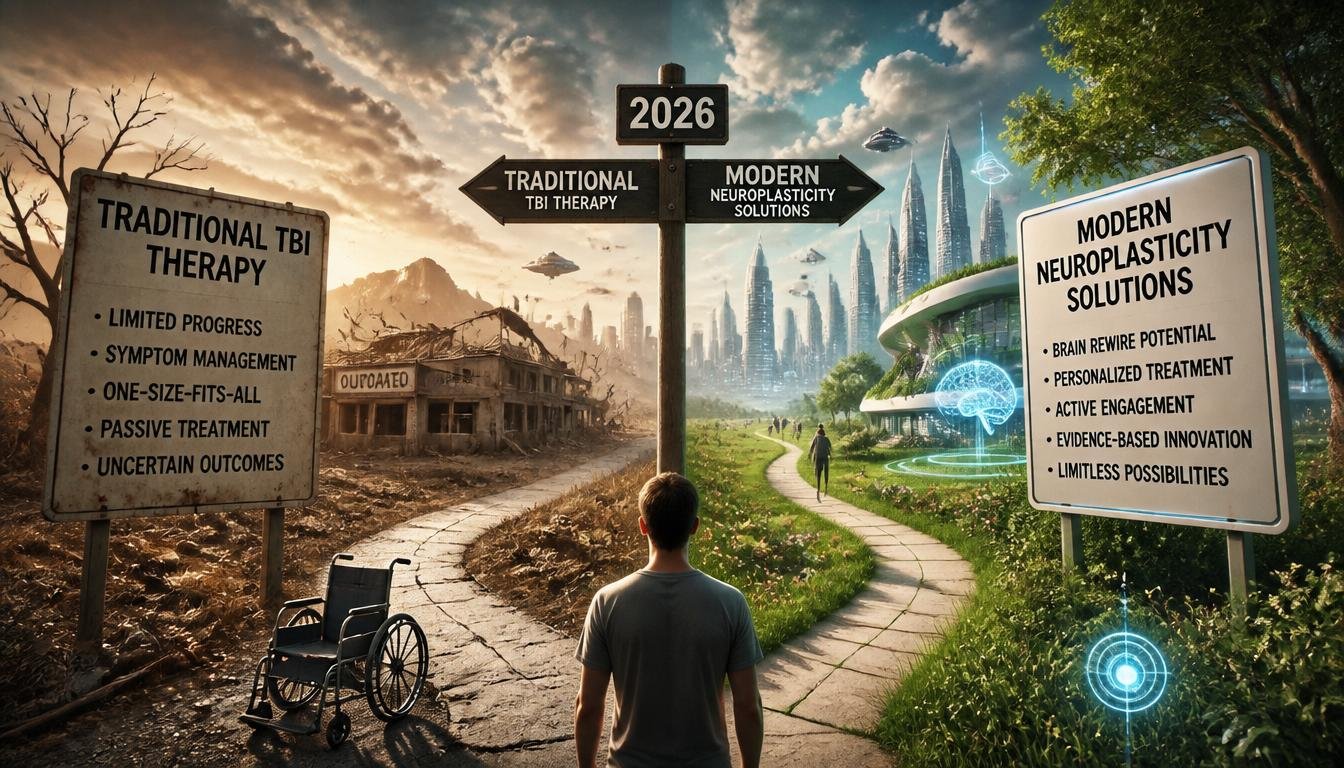
Globally, 16% of the population, roughly 1.3 billion people, live with significant disabilities, and many of them require the kind of rehabilitation services that force us to confront the limits of old methods. When you start comparing traditional TBI therapy vs modern neuroplasticity solutions, you are not looking at a cosmetic difference in approach; you are looking at a fundamental disagreement about what the brain actually is and how it rebuilds itself after injury.
The brain is a biological system, not a motivational one. For decades, traumatic brain injury treatment operated on assumptions that were closer to wishful thinking than clinical science, and the history of that shift is the history of how we learned to stop guessing and start dosing.
| Aspect | Traditional TBI Therapy | Modern Neuroplasticity Solutions |
|---|---|---|
| Core Philosophy | Symptom management, passive rest, compensation strategies | Active cortical reorganisation, synaptic reinforcement, structural repair |
| Assessment Model | Generic intake, subjective reporting | Baseline assessment mapping brainwave patterns, stress biomarkers, and sleep architecture |
| Dosing Logic | Fixed sessions, low repetition, generic protocols | Adaptive intensity, high-repetition task-specific training, real-time feedback |
| Tracking | Subjective, episodic | Objective, longitudinal, data-driven |
| BDNF Strategy | Not targeted | Central mechanism, stimulated via gamma entrainment and aerobic priming |
| Delivery Mode | In-clinic only | Home-based rehabilitation with objective reporting |
Explore our neurological recovery programs or learn more about our philosophy and approach to understand how we apply these principles in practice.
The history of traumatic brain injury therapy is not a story of steady progress. It is a story of long stagnation interrupted by sudden, data-driven corrections. For most of the 20th century, the standard approach to brain injury was rest, observation, and compensation. You learned to live with the deficit.
If your left arm stopped working, the protocol was to teach you to use your right arm better. That is not rehabilitation. That is surrender dressed up as accommodation.
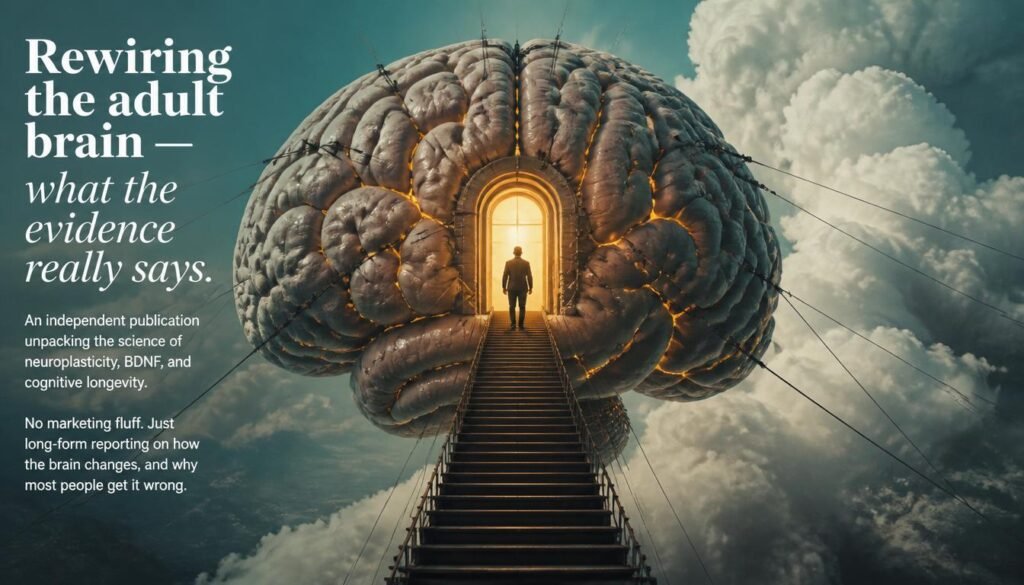
The shift began when neuroscience started producing evidence that the adult brain was not a static, fixed organ but a plastic, reorganising system capable of structural change. This was not a motivational discovery. It was a biological one. The concept of neuroplasticity, once controversial, is now the foundation of every legitimate rehabilitation protocol we build in 2026.
What changed was not just the technology. What changed was the understanding of biological timing. Recovery after TBI is not about waiting for the brain to heal on its own schedule. It is about intervening with the right intensity, at the right window, with the correct dosing to drive synaptic reinforcement before the brain settles into a maladaptive pattern.
Good intentions do not rebuild neural circuits; dosing, intensity, and sequence do. This is the line that separates traditional TBI therapy from modern neuroplasticity solutions, and it is the line that defines everything we do.
To be fair, traditional therapy was not entirely wrong. It identified that rest matters in the acute phase. It recognised that patients needed structured support. It built the infrastructure of clinical care that we still use today.
But the fundamental error was in the model of the brain itself. Traditional therapy treated the brain like a bone: you set it, you wait, it heals. The brain does not work that way. A bone heals by knitting back together along its original fracture lines. The brain heals by rerouting, reweighting, and reorganising its entire computational map. That process requires active stimulation, not passive waiting.

The second error was in measurement. Traditional therapy relied on subjective reporting and generic assessments. If a patient said they felt better, that was the outcome measure. We now know that subjective improvement often masks ongoing neurological dysfunction. Without objective tracking, you are flying blind.
The third error was in dosing. Traditional therapy sessions were short, infrequent, and low-repetition. A patient might see a therapist twice a week for 45 minutes. That is not enough stimulus to drive cortical reorganisation. Modern neuroplasticity research shows that thousands of repetitions are needed for structural change to occur. Anything less is maintenance, not recovery.

When we talk about comparing traditional TBI therapy vs modern neuroplasticity solutions, we are talking about two completely different frameworks for understanding recovery. Traditional therapy asked: “What is broken, and how do we compensate?” Modern neuroplasticity asks: “What circuits are available, and how do we rewire them?”
The difference is not semantic. It changes everything about how you structure a program, how you measure progress, and what you consider a successful outcome. Our neuro rehabilitation protocols are built on this shift.
Traditional therapy gave you a generic program. Everyone with a TBI got roughly the same exercises, the same timeline, and the same expectations. Modern neuroplasticity solutions start with a baseline assessment that maps your specific neurological profile. We look at brainwave patterns, stress biomarkers, and sleep architecture before we prescribe anything.
This is not a luxury. It is a clinical necessity. If you do not know where the baseline is, you cannot measure change. If you cannot measure change, you cannot adjust dosing. If you cannot adjust dosing, you are not doing therapy; you are doing guesswork.

Modern neuroplasticity solutions like VR/AR are driving the highest growth rates in the sector.
You cannot talk about modern neuroplasticity solutions without talking about BDNF. Brain-Derived Neurotrophic Factor is the protein that drives synaptic strengthening and neural restructuring. It is the biological mechanism behind every successful recovery story.
Traditional TBI therapy never targeted BDNF. It was not part of the protocol because the understanding of neurotrophic factors was still developing. In 2026, BDNF stimulation is a cornerstone of every evidence-based rehabilitation program. Learn more about how we approach neuroplasticity exercises for rapid motor recovery to see this in action.

BDNF is stimulated through several pathways: aerobic exercise, gamma-frequency auditory entrainment, and intensive motor training. Each of these drives neuroplastic yield in different ways. Aerobic exercise creates a systemic BDNF response. Gamma entrainment, like our Genius Switch protocol at $39, targets specific neural oscillations that support cognitive function.
The Brake Pedal Effect is relevant here. When you under-stimulate the brain, you get compensatory patterns that actively inhibit recovery. The brain learns to avoid the damaged pathway. Over time, that avoidance becomes the default. BDNF-driven stimulation is how you release the brake and force the brain back into adaptive reorganisation.
We are deliberately cautious about claims; if a modality lacks rigorous evidence, we say so. BDNF stimulation through gamma entrainment is not a miracle cure. It is a biological mechanism that, when combined with structured motor training and cognitive rehabilitation, produces measurable structural change.
The biggest difference between traditional TBI therapy and modern neuroplasticity solutions is the baseline. Traditional therapy started with a diagnosis and a generic plan. Modern neuroplasticity starts with data.
Before we recommend any protocol, we map brainwave patterns, stress biomarkers, and sleep architecture. This is what we mean by baseline rigor. We use tools like the MoCA to MMSE crosswalk to establish a measurable cognitive baseline. Without this, you are prescribing blind.
The Glymphatic Plumbing matters here too. Sleep architecture is not a wellness buzzword; it is the system that clears neurotoxic waste from the brain. If your sleep is disrupted, your recovery is compromised. Traditional therapy ignored sleep. Modern neuroplasticity treats it as a clinical input that must be measured and corrected.
If we cannot show you that something is working, we have no business recommending you continue it. This is the standard we hold ourselves to. It is also the standard that separates evidence over enthusiasm from marketing fluff.
Technology is where the comparison becomes most visible. Traditional TBI therapy used paper worksheets, physical balance boards, and subjective clinical observation. Modern neuroplasticity solutions use neurofeedback, VR-based motor training, and real-time EEG-guided optimization.

Adaptive intensity is the key concept. Most standard memory apps and traditional exercises lack the adaptive intensity required to drive structural brain change. They are too easy, too repetitive, and too unresponsive to your actual neurological state. The brain only reorganises when it is pushed past its current capacity. That requires a system that adapts in real time to your performance.
Neurofeedback solves this. By monitoring brainwave activity during practice, the system can adjust difficulty, detect when you are fatiguing, and ensure you are operating in the zone that maximizes neuroplastic yield. This is what we mean by clinical structure. It is not about doing exercises; it is about doing the right exercises at the right intensity at the right time.
The cognitive rehabilitation segment is projected to register the highest growth rate in the market, and that is not a coincidence. It reflects the fact that cognitive deficits are often the most persistent and disabling consequence of TBI, and they are also the most responsive to targeted neuroplasticity interventions.
One of the most significant differences when comparing traditional TBI therapy vs modern neuroplasticity solutions is where therapy happens. Traditional therapy happened in a clinic. You went to an appointment, did your exercises, went home, and waited for the next session.
That model is broken for a simple reason: neuroplasticity requires daily, intensive stimulation. Twice-weekly clinic visits cannot provide the dosing needed for structural change. Home-based rehabilitation, supported by digital tracking and remote adjustment, solves this problem.

Our home-based neuro rehabilitation frameworks come with objective reporting and remote adjustments. You are not left on your own with a generic program. The data flows back to us, and we adjust the protocol based on what your brain is actually doing, not what a generic template says should happen next.
This is not telehealth in the traditional sense. It is a structured, data-driven rehabilitation system that happens to be delivered outside the clinic. The clinic is where you start. Your life is where you recover.
Here is where we differ from most clinical publications. We treat faith, resilience, and mental rehearsal as neurologically active inputs, not motivational extras. Mental practice, when structured correctly, activates the same motor and cognitive circuits as physical practice.
This is not manifestation in the pop-psychology sense. Manifestation without clinical structure is empty. But when you combine structured mental rehearsal with physical training, neurofeedback, and BDNF stimulation, you get a compound effect that drives faster, more durable cortical reorganisation.

The brain responds to intention because intention activates neural circuits. When you mentally rehearse a motor task, you are literally firing the same pathways you would fire during physical execution. That firing drives synaptic reinforcement. This is why mental practice is part of every legitimate post-stroke and TBI protocol we build.
You will never hear us promise to “reverse ageing” or “unlock 100% of your brain.” That is marketing fluff. What we will tell you is that structured mental rehearsal, combined with correct dosing and biological timing, produces measurable changes in brain function that generic programs simply cannot match.
TBI recovery does not end when the acute rehabilitation phase is over. The brain that has been injured is a brain that needs ongoing protection and optimization. This is where preventative longevity intersects with neuroplasticity.
Our preventative longevity strategies are built on the same principles as our rehabilitation protocols. BDNF stimulation, cognitive training with adaptive intensity, and structured sleep optimization are not just for recovery; they are for long-term brain health.
Digital overload is a real threat to cognitive recovery. Constant smartphone use fragments attention and disrupts the deep focus needed for neuroplastic change. A structured digital detox is not a wellness trend; it is a clinical intervention that protects the cognitive environment your brain needs to reorganise.
The brain is the engine of your life; don’t wait for decline to start taking your cognitive health seriously. Whether you are recovering from a TBI or working to prevent one, the principles are the same: measure, stimulate, track, adjust.
Comparing traditional TBI therapy vs modern neuroplasticity solutions is not an academic exercise. It is a choice between two fundamentally different understandings of what the brain is and how it recovers. Traditional therapy treated the brain as a fragile organ that needed protection and compensation. Modern neuroplasticity treats it as a plastic, adaptive system that can be restructured with the right inputs.
The evidence is clear. The market is shifting. Home-based rehabilitation, VR/AR systems, and cognitive rehabilitation are driving the highest growth rates in the sector for a reason. They work because they are built on biological reality, not clinical habit.
If every claim sounds like marketing copy, it probably is. We are an independent publication that specifically rejects marketing fluff in favor of evidence over enthusiasm. Our programs are built on baseline rigor, adaptive intensity, and objective tracking. If we cannot show you that something is working, we have no business recommending you continue it.
It is a matter of biological timing, correct dosing, and an honest understanding of what the science actually shows. The next step is a conversation, not a payment. Contact us to begin that conversation.
Traditional TBI therapy focuses on symptom management and compensation strategies, while modern neuroplasticity solutions target active cortical reorganisation through structured dosing, adaptive intensity, and BDNF stimulation. The fundamental difference is that traditional therapy treats the brain as static, while neuroplasticity treats it as a reorganising system that can be measurably rewired.
Yes. Home-based rehabilitation is projected to hold the largest market share in 2026 because it allows for the daily, intensive stimulation that neuroplasticity requires. When paired with objective tracking and remote protocol adjustments, home-based programs can deliver higher total dosing than twice-weekly clinic visits, which is critical for comparing traditional TBI therapy vs modern neuroplasticity solutions.
BDNF (Brain-Derived Neurotrophic Factor) is the protein that drives synaptic reinforcement and neural restructuring. It is stimulated through aerobic exercise, gamma-frequency auditory entrainment, and intensive motor training. Modern neuroplasticity solutions target BDNF as a central mechanism, while traditional TBI therapy never addressed it directly.
Without a baseline assessment that maps brainwave patterns, stress biomarkers, and sleep architecture, you cannot measure change or adjust dosing. Modern neuroplasticity solutions require this data to build a protocol tailored to your specific neurological profile, which is a core distinction when comparing traditional TBI therapy vs modern neuroplasticity solutions.
VR/AR-based rehabilitation systems are projected to register the highest CAGR in the rehabilitation market because they provide adaptive intensity and real-time feedback that traditional exercises cannot match. They are not inherently better on their own, but when integrated into a structured neuroplasticity protocol, they deliver the repetition and engagement needed for structural brain change.
Yes, when structured correctly. Mental rehearsal activates the same motor and cognitive circuits as physical practice, driving synaptic reinforcement. We treat faith, resilience, and mental rehearsal as neurologically active inputs, not motivational extras. However, manifestation without clinical structure is empty; it must be paired with correct dosing and biological timing.
Structural neuroplasticity is not a fixed timeline; it depends on the intensity, frequency, and correctness of the intervention. Early, intensive interventions yield the strongest long-term outcomes, but the brain remains plastic throughout life. The key variable is not time but whether the dosing is sufficient to drive measurable cortical reorganisation, which is central to comparing traditional TBI therapy vs modern neuroplasticity solutions.