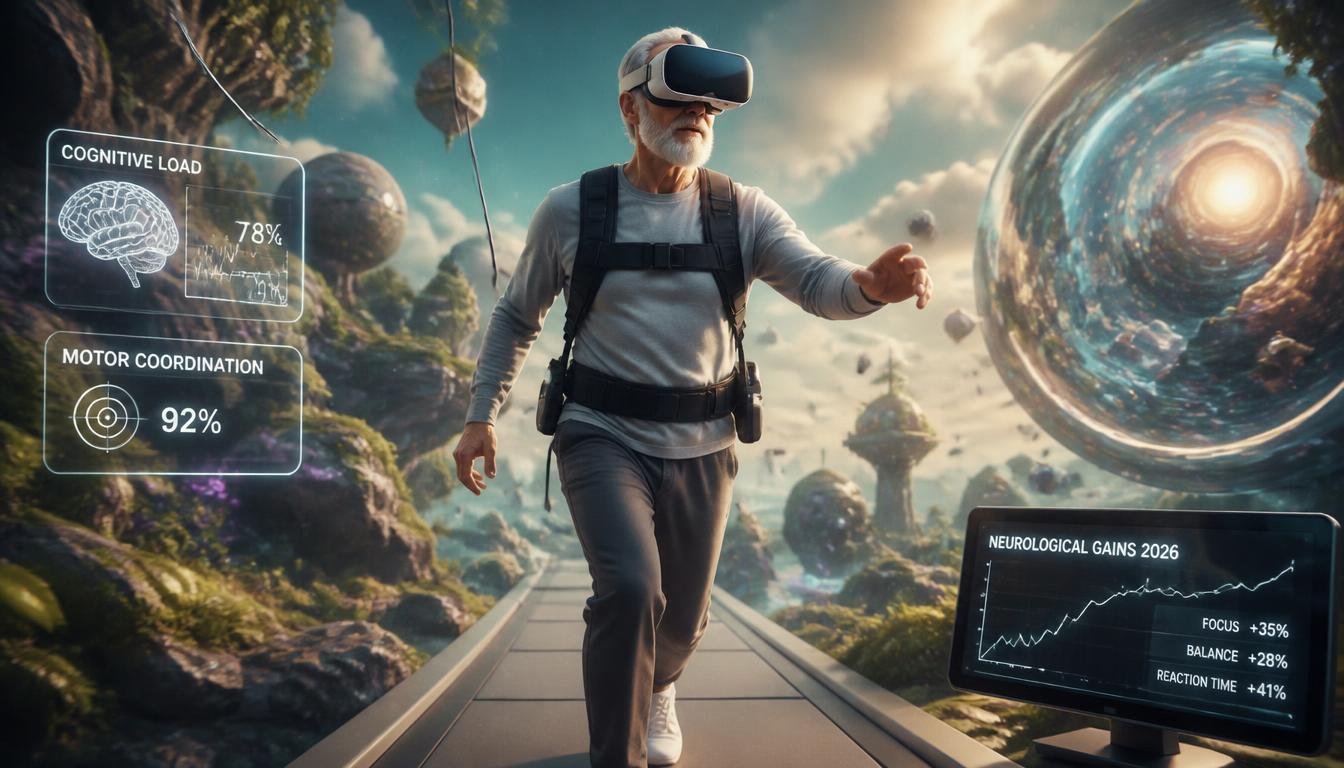
Dual-Tasking VR: Cognitive-Motor Training asks the brain to do two demanding things at once, moving the body while solving a cognitive problem, inside a virtual environment that can dial the difficulty up or down. The American Psychological Association has found that switching between tasks can cut productivity by as much as 40%, which sounds like an argument against doing two things at once. It is actually the argument for training that way, deliberately, under supervision, until the brain stops losing 40% and starts gaining ground.
We do not treat this as a novelty. We treat it as a rehabilitation and cognitive performance tool that has to earn its place through published data, not through a headset’s marketing copy.
Strip away the headset and the graphics, and dual-tasking VR is a very old rehabilitation idea wearing new hardware. Clinicians have known for decades that walking while doing arithmetic, or reaching for an object while naming words, reveals deficits that a seated cognitive test never catches.
Virtual reality just gives us a controllable, repeatable, data-logging way to do that. The system tracks a walking, reaching, or balancing task on one channel, and a memory, attention, or decision task on another, then measures how performance on each degrades when they’re combined.
That degradation, or the lack of it, is the actual clinical signal. A person who can walk fine and think fine separately but falls apart when doing both is showing exactly the kind of cognitive-motor interference that predicts falls, hospital readmission, and slower functional recovery.
We view Dual-Tasking VR: Cognitive-Motor Training as a diagnostic tool first, and a training tool second. You cannot dose an intervention correctly without first measuring where the interference actually happens.
Static difficulty, predictable puzzles, and passive scrolling through trivia don’t meet that threshold. Neither does a single-task VR game that only asks you to move, or only asks you to think.
The nervous system adapts to predictable load and then stops adapting. That is the entire problem with most consumer “brain training” apps: the difficulty curve flattens the moment it stops surprising you, and adaptation requires surprise, or more precisely, requires working at the edge of current ability.
Dual-task VR earns its clinical relevance because the two channels of demand can be adjusted independently and in real time. A therapist can hold the motor task steady and increase cognitive load, or vice versa, which is a level of dosing precision that a treadmill or a crossword puzzle simply cannot offer.
Modern neuro-rehabilitation is no longer guesswork; it is a measurable process built on rigorous evidence, clear dosing principles, and real follow-through. A 2026 systematic review published in the Journal of the American Medical Directors Association pooled 12 randomized controlled trials covering 529 participants to rank different VR modalities for cognitive outcomes in people with mild cognitive impairment.
Semi-immersive VR came out on top for improving global cognition. Fully immersive systems, the headset-and-controller setups most people picture when they hear “VR,” ranked lower across most trials in that review.
Around 1,000 scientific articles now exist on virtual and augmented reality in neurorehabilitation, which tells us this is no longer a fringe research area. Evidence over enthusiasm, and the evidence has been accumulating for years now.

Percentage-based outcome rates across studies of VR cognitive-motor interventions
You’d assume more immersion equals more benefit. The 2026 data disagrees.
Fully immersive VR, where a headset blocks out the real room, scored 43.6% in the same efficacy ranking that put semi-immersive systems at 87.8%. Semi-immersive setups typically use a large screen or projection rather than a headset, which keeps peripheral vision and real-world spatial cues intact while still delivering a controllable virtual task.
| VR Modality | Cognitive Efficacy Ranking | Best Suited For |
|---|---|---|
| Semi-immersive VR | 87.8% | Older adults, MCI, supervised clinical dual-task work |
| Nonimmersive VR | Moderate, above fully immersive | Home-based practice, lower-risk populations |
| Fully immersive VR | 43.6% | Younger, balance-stable users under close supervision |
Our read on this: sensory overload and disorientation from a fully sealed headset can undercut the exact cognitive resources you’re trying to train. A person spending processing power just staying oriented in a virtual world has less left over for the actual dual-task demand.
Up to 50% of people in less economically advantaged countries may experience a stroke at some point in their lifetime, which makes scalable, evidence-based rehab tools a genuine public health question, not just a clinical nicety. Dual-task VR training has produced some of the strongest effect sizes we’ve seen for post-stroke cognitive outcomes.
A 2026 analysis in BMC Neurology reported a standardized mean difference of 0.84 for cognitive flexibility and 0.80 for working memory in stroke patients who completed dual-task interventions. Those are large effect sizes by clinical research standards, well above what most single-modality cognitive drills produce on their own.

This is why we integrate dual-task principles into our stroke rehab protocols rather than treating motor recovery and cognitive recovery as two separate tracks. The brain doesn’t rebuild those systems in isolation, so we don’t train them in isolation either.
For a full breakdown of what’s actually working in post-stroke rehab right now, our guide to the best neuroplasticity exercises for stroke recovery in 2026 covers the task-specific, high-repetition work that dual-task VR builds on.
We treat Brain-Derived Neurotrophic Factor as your brain’s “repair protein,” supported by training, movement, and lifestyle. Dual-task VR training hits two of BDNF’s strongest known triggers at once: aerobic-adjacent physical movement and cognitively demanding, adaptive challenge.
That combination matters more than either trigger alone. Our review of the lifestyle habits that actually preserve synaptic plasticity found that dosed aerobic exercise is one of the most reliable levers for BDNF release, and pairing it with a structured cognitive load appears to amplify the effect rather than compete with it.
Some clients pair dual-task VR sessions with 40Hz gamma audio protocols as an adjunct, not a substitute. Our Genius Switch audio tool ($39) is one option we’ve reviewed for supporting that biological target between formal training sessions.

You need measurable progress, not vibes. That means an actual dosing framework, not “use it a few times a week and see how you feel.”
Research on interactive motor-cognitive dual tasks, including a Frontiers in Human Neuroscience study of 28 healthy participants performing tasks at varying difficulty levels, points to a few consistent principles:
A separate program out of Acta Psychologica Sinica screened 120 college students with below-average spatial ability for an 8-week VR motor-cognitive dual-task protocol, which gives a rough sense of the timeline researchers consider sufficient to detect real change in spatial and cognitive function, not just motor fluency.
Dual-task VR doesn’t operate in a vacuum. Several neurotechnology categories are commonly layered around it, and it’s worth understanding what each one actually does before adding it to a protocol.
| Tool Category | Role Alongside Dual-Task VR | Typical Price Range |
|---|---|---|
| EEG headsets | Objective tracking of cognitive load during sessions | Varies by clinical grade |
| HD-tDCS devices | Modulates cortical excitability before or during training | $99 entry-level to $800 clinically regulated |
| VNS systems | Clinical rehab adjunct in select stroke and motor recovery cases | Tens of thousands (clinical implantable systems) |
Our guide to the best tDCS devices for enhancing learning and focus in 2026 goes into how stimulation timing interacts with active training, which applies directly to dual-task VR sessions. For readers weighing whether EEG feedback is worth adding to a home setup, our 2026 guide to professional-grade EEG headsets breaks down what “professional-grade” actually requires.
On the VNS side, it’s worth being clear about the gap between clinical and consumer categories. Our overview of VNS devices distinguishes implantable clinical systems from non-invasive wellness wearables, and those are not interchangeable tools.
Not every dual-task VR setup belongs in a living room. Higher-risk populations, particularly stroke survivors with balance impairment, need supervision because the training is deliberately pushing them toward the edge of their current ability, and that edge is exactly where falls happen.
Supervised, clinician-led retreat formats have become more common in 2026, combining dosage-tracked VR sessions with the kind of environment design that supports recovery outside of training hours. Programs in this category run around $3,579 for a full supervised neuro-training retreat, which reflects the cost of clinician oversight and objective outcomes tracking, not just facility amenities.

For lower-risk individuals working on general cognitive-motor sharpness rather than post-injury recovery, a home-based approach can work if the difficulty progression is designed properly rather than left on a default setting. Our roundup of home-based neuroplasticity tools for stroke survivors covers which setups are appropriate for unsupervised use and which genuinely are not.
Environmental design matters here too. A cluttered, poorly lit training space undermines the exact balance and spatial demands dual-task VR is trying to challenge, a point we cover in more depth in our guide to environmental longevity and preventive lifestyle design.
Dual-task VR training isn’t only a stroke rehab tool. Its cognitive-motor demand structure has clear relevance to cognitive performance work in healthy adults and to preventative longevity protocols aimed at people who want to stay ahead of age-related decline rather than react to it.
The same interference effect that reveals stroke-related deficits also shows up, more subtly, in healthy aging. A 50-year-old who walks fine and thinks fine separately, but stumbles on both when combined, is showing an early signal worth training against now rather than waiting for it to become a fall risk later.
Memory decline research supports the same logic. Our breakdown of memory decline mechanisms describes memory health as a dynamic, trainable process, and dual-task cognitive-motor work is one of the more evidence-backed ways to intervene on it directly.
Dual-Tasking VR: Cognitive-Motor Training has moved from research curiosity to a documented, dosable clinical tool, backed by roughly 1,000 published studies and real effect sizes in stroke recovery, cognitive flexibility, and working memory. It works because it mirrors real life, where walking and thinking never happen separately, and because a well-run protocol can push both channels to the edge of current ability at the same time.
What it is not is a passive game you play unsupervised and hope for the best. Evidence over enthusiasm, dosing over guesswork, and Dual-Tasking VR: Cognitive-Motor Training belongs in that framework, not in a marketing brochure promising instant results.
If you’re weighing whether this fits your recovery plan or your long-term cognitive strategy, our neuro-rehabilitation services page walks through how we build individualized, dose-controlled protocols around exactly this kind of evidence.
It’s used to improve the brain’s ability to manage a motor task and a cognitive task at the same time, which matters for stroke recovery, fall prevention, and general cognitive-motor sharpness. Clinical protocols in 2026 apply it most heavily in post-stroke rehab and mild cognitive impairment programs, where the effect sizes are strongest.
Based on a 2026 review of 12 randomized controlled trials, semi-immersive VR outperformed fully immersive headsets, scoring 87.8% versus 43.6% on efficacy for improving global cognition. Fully immersive systems may cause sensory overload that competes with the cognitive resources you’re trying to train.
Yes. A 2026 BMC Neurology analysis found standardized mean differences of 0.84 for cognitive flexibility and 0.80 for working memory in stroke patients who completed dual-task VR interventions, which are strong effect sizes by clinical standards.
For stroke survivors, people with mild cognitive impairment, and anyone doing structured cognitive longevity work, the published evidence supports it as a legitimate clinical tool, not a novelty. The key is supervision and correct dosing, since an unsupervised, poorly calibrated session won’t produce the same results as a clinician-guided protocol.
Lower-risk individuals working on general cognitive sharpness can often use home-based setups if the difficulty progression is designed correctly rather than left on default. Higher-risk populations, particularly stroke survivors with balance impairment, should train under supervision because the method deliberately pushes toward the edge of current ability.
Dual-task VR combines physical movement with adaptive cognitive challenge, two of the strongest known triggers for BDNF release, the protein we describe as the brain’s “repair protein.” Pairing dosed aerobic movement with cognitive load appears to support BDNF activity more than either factor alone.
Most clinically studied protocols run 6 to 12 weeks with three sessions per week before reassessment, which gives enough time for measurable changes to show up on standardized cognitive and motor tests. Shorter programs exist, but the stronger effect sizes in published research come from sustained, dose-controlled training over multiple weeks.